

Suspension Trainer Exercises: 10 moves and a home workout

By Flexi Muscles — 22 October 2026 · 7 min read
The best suspension trainer exercises are the row, squat, chest press, push-up, lunge, knee tuck and single-leg squat. Together they train your whole body with nothing but straps and your body weight. Strength training suspension straps hang from a door, beam or tree, and you make each move harder by leaning further from the anchor. Below are ten moves and a 30-minute workout that uses them.
Shop the Suspension Trainer at Flexi Muscles
How to use a suspension trainer
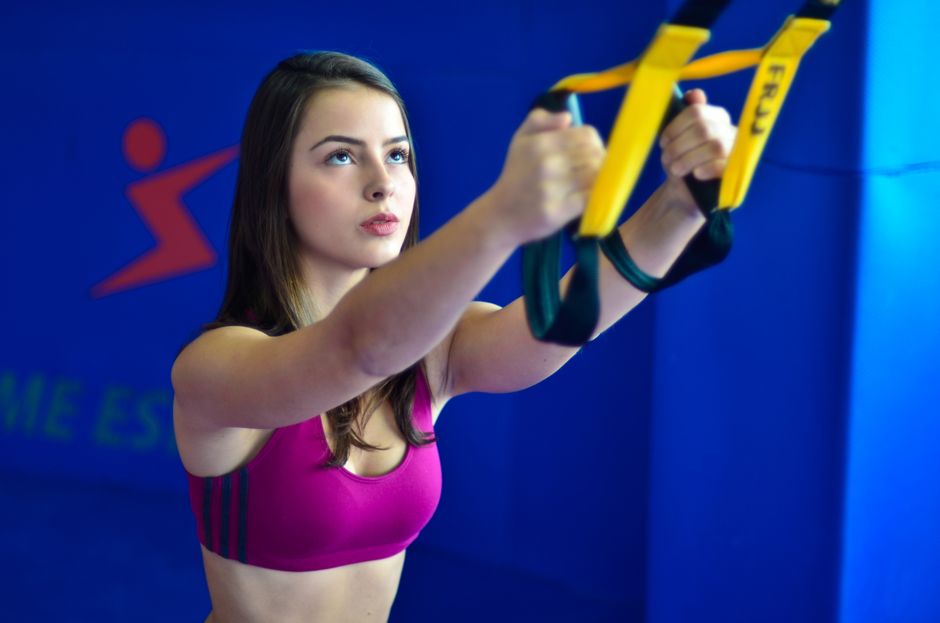
A suspension trainer is two straps with handles and foot cradles, hanging from a single anchor. You hold the handles or put your feet in the cradles, then use your body weight as the resistance.
You change the difficulty in three ways:
- Body angle. Lean further back or further forward and more of your weight goes into the straps. This is the main dial.
- Foot position. Step towards the anchor to make pulling moves harder, or away from it to make pushing moves harder.
- Base of support. Move your feet closer together, or onto one leg, and your core works harder to stay steady.
Because the straps move, your core works on every exercise. A push-up with your hands in the straps is a different job to a push-up on the floor.
Setting up training suspension straps safely

The anchor holds your whole body weight, so set it up properly before every session.
Using the door anchor
- Pick a solid door. Skip hollow-core doors, sliding doors and anything that rattles in its frame.
- Train on the side the door opens away from. When you pull, you pull the door into the frame, not out of it.
- Lock it. The most common accident is someone opening the door mid-set.
- Place the anchor near the top hinge side. That's the strongest part of the frame.
Other anchor points
Our suspension trainer wraps around a beam, tree branch, pole or a mounted pull-up bar with no drilling. A doorway pull-up bar that hooks over the frame is a different story. It isn't built for the sideways pull of a row, so use a wall-mounted bar or the door anchor instead.
Give each strap a hard tug before you lean into it. If anything shifts, fix it before you train.
Strap length: the setting most people get wrong
None of the top workout guides spend much time on this, but strap length changes how every exercise feels. Our straps have indexed extension markings, so you can set the same length every session.
| Strap length | Where the handles sit | Use it for |
|---|---|---|
| Short | Around chest height | Rows, squats, single-leg squats |
| Mid-length | Around waist height | Chest press, chest fly, ab fallout |
| Long | Mid-calf, a hand's width off the floor | Feet in cradles: knee tucks, pikes, plank, push-ups, lunges |
Keep both straps the same length. Uneven straps tilt your body and load one side more than the other.
10 suspension trainer exercises

- Inverted row. Face the anchor, hold the handles, walk your feet forward and lean back with a straight body. Pull your chest to your hands. Turn your palms to face up for a supinated row that hits the biceps more.
- Squat. Hold the handles with arms straight and sit back into a squat. The straps help you balance, so you can sit deeper. Add a jump once it's easy.
- Chest press. Face away from the anchor, lean forward with arms straight, then lower your chest between your hands and press back up.
- Push-up, feet in cradles. Put both feet in the cradles at long strap length and do a push-up. Your core works hard to stop your hips sagging.
- Chest fly. Same start as the chest press. Open your arms wide with a slight elbow bend, then squeeze them back together.
- Balance lunge. Face away, put one foot in a cradle behind you and lunge on the front leg. It works like a Bulgarian split squat.
- Glute bridge to hamstring curl. Lie on your back with your heels in the cradles. Lift your hips, then curl your heels towards your bum.
- Knee tuck. In a high plank with feet in the cradles, pull both knees to your chest. Progress to a pike by lifting your hips with straight legs.
- Ab fallout. Kneel or stand facing away, hands on the handles, and let your arms float overhead as you lean forward. Pull back with your abs, not your arms.
- Single-leg squat. Hold the handles, lift one foot and squat on the other leg. Use the straps for as much help as you need.
Our view: the inverted row is the single most useful move on a suspension trainer. Most home workouts are heavy on pushing and light on pulling, and the row fixes that with nothing else needed.
A 30-minute suspension trainer workout

Warm up for five minutes first: brisk walking, arm circles and a few bodyweight squats. Then do three supersets. Do A and B back to back, rest 30 seconds, and repeat for three or four rounds before moving on.
| Superset | A | B |
|---|---|---|
| 1. Legs | Squat, 45 seconds | Glute bridge to hamstring curl, 45 seconds |
| 2. Upper body | Chest press, 45 seconds | Inverted row, 45 seconds |
| 3. Core | Knee tucks, 30 seconds | Plank, feet in cradles, 30 seconds |
Beginners should stand more upright and stick to three rounds. If your form slips before the time is up, stop the set early. Grip often gives out first on rows, so shake your hands out between rounds.
Do this workout two or three times a week, with a rest day in between. Make it harder by changing your body angle, not by going faster.
When a suspension trainer isn't enough
- You want big leg strength. Body weight runs out fast for the legs. Add strength training equipment like a barbell or dumbbells.
- You have no solid anchor. No sturdy door, beam or mounted bar means no safe setup.
- You have shoulder or wrist pain. Unstable straps load these joints in new ways. Get a physio's go-ahead first.
- You're after cardio. Circuits raise your heart rate, but a rower or bike does that job better.
For more equipment-free ideas, see our guide to bodyweight training exercises.
Frequently Asked Questions
Is a suspension trainer good for beginners?
Yes. You set the difficulty with your body angle, so a beginner stands almost upright and a stronger lifter leans further back. Start with rows, squats and chest presses before moving to feet-in-strap exercises.
Can you build muscle with a suspension trainer?
You can build a good base of strength and some muscle, especially in the back, chest and core. Progress stalls once your full body weight at the hardest angle gets easy. At that point, add weights for the lower body.
Will a door anchor damage my door?
Our door anchor is foam covered to protect the frame. Use a solid door, close it so it opens away from you, and lock it. Avoid hollow-core doors and sliding doors.
How often should I do a suspension trainer workout?
Two or three times a week with a rest day between sessions works for most people. The exercises use your whole body, so your muscles need time to recover.
Is a suspension trainer the same as a TRX?
TRX is a brand name. A suspension trainer is the general product: two adjustable straps with handles and foot cradles that hang from one anchor point. The exercises are the same.