

Exercise using resistance bands: A 20-minute full-body workout
By Flexi Muscles — 22 September 2026 · 9 min read
Exercise using resistance bands works best as one continuous circuit rather than split into separate arm, leg, and ab days — a single band set can train all three in the same session, because tension is tension whether it is pulling on your shoulders, your hips, or your torso. The routine below runs eight exercises for three rounds, needs one stacked set of bands and about two square metres of floor, and fits into a lunch break. Straight up: it will not out-train a proper barbell programme forever, but for building real, usable fitness at home it holds up for longer than most people expect.
Shop Resistance Bands at Flexi Muscles
Warm Up First

Five minutes, no exceptions. Bodyweight squats, arm circles, and a slow walkout to a light stretch get blood into the joints this circuit is about to load. Skipping this because "it's just bands" is how a fine first rep on a Romanian deadlift turns into a strained lower back on the third.
Finish the warm-up with ten reps of whichever band exercise below feels least familiar, using the lightest band in your set. That rehearsal rep matters more for bands than for free weights, because the resistance builds through the stretch rather than sitting constant, and your body needs a preview of that changing load before it hits the working sets.
The Full-Body Circuit

Move through all eight exercises back to back with minimal rest between them, then rest 90 seconds and repeat the whole thing two more times. Three rounds, eight exercises, twelve reps per exercise unless noted — that is the entire workout.
1. Band squat to overhead press
Stand on the band with feet shoulder-width, handles at your shoulders. Squat down, then drive up and press the handles overhead as your legs straighten. One fluid movement, not two separate ones — the combination is what makes this a full-body exercise rather than just a leg exercise with an add-on.
2. Standing band row
Anchor the band at chest height, step back until there is tension at arm's length, pull the handles to your ribs and squeeze your shoulder blades together. Home routines under-train the upper back more than any other muscle group, and this is the fastest way to fix that.
3. Band chest press
Anchor behind you, press the handles forward at chest height until your arms straighten, then control the return. A workable substitute for a bench press on days a bench is not available.
4. Lateral band walk
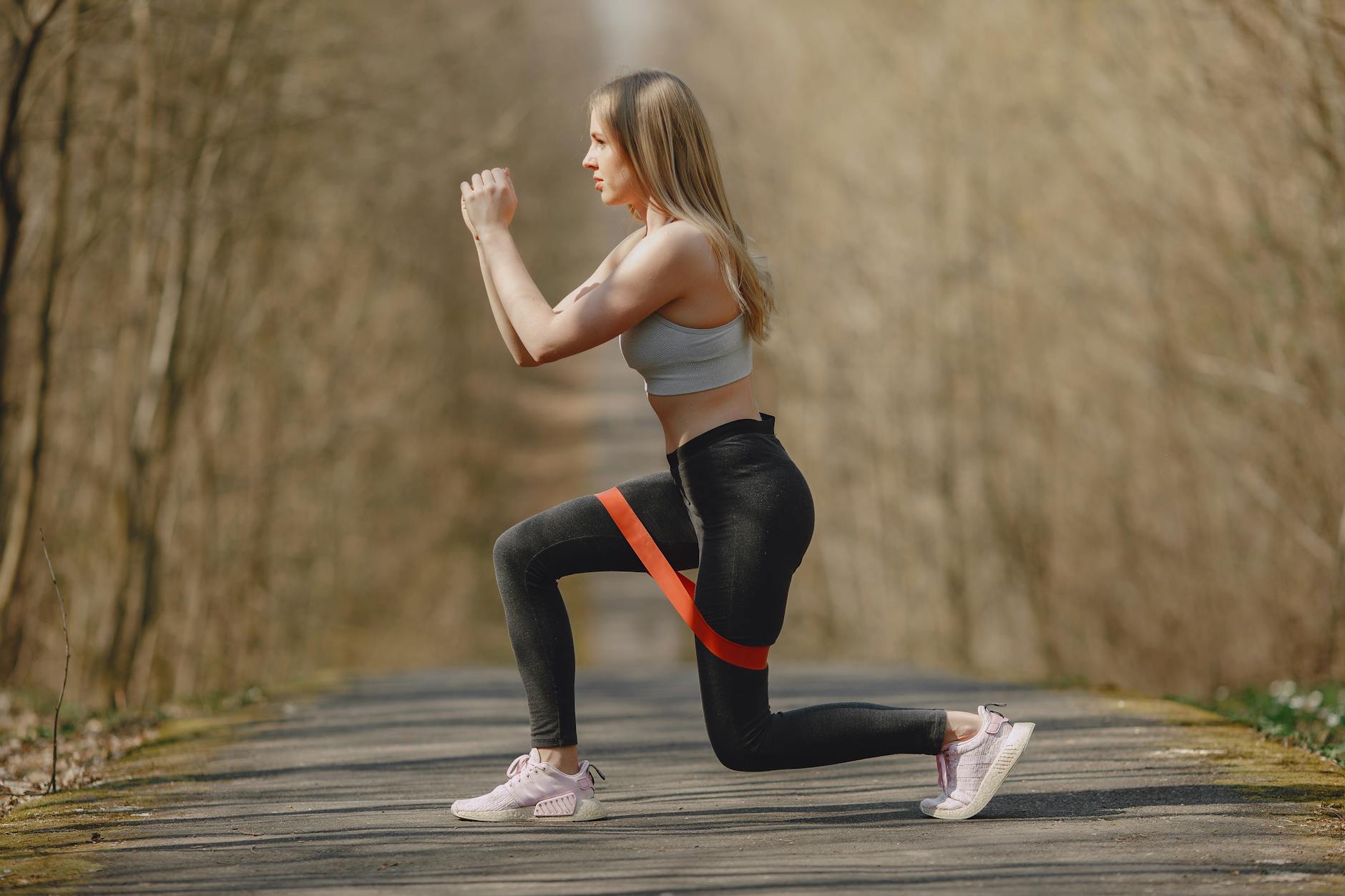
Loop a band above your knees, drop into a quarter-squat, and step sideways for ten steps in one direction, then ten back. Keeps constant tension on the glutes the whole time, which is exactly the muscle group most desk-bound days leave switched off.
5. Band Romanian deadlift
Stand on the band, hinge forward from the hips with a soft bend in the knees, let the handles travel down your shins, then drive your hips forward to stand tall. This is the hip-hinge pattern most home workouts skip entirely because it needs a barbell — bands make it possible without one.
6. Band pull-through
Anchor low behind you, face away, and hinge forward to grab the handle between your legs before driving your hips forward to standing. A second hip-hinge move, deliberately, because most people need twice the practice on this pattern that they get.
7. Banded plank row
Anchor low in front of you, hold a plank position with one hand on a handle, and row it to your ribs without letting your hips twist. Trains the core to resist rotation while the back does the pulling — two jobs in one exercise.
8. Band curl to press
Stand on the band, curl the handles to your shoulders, then press straight overhead. A finisher for the arms and shoulders after six exercises that mostly hit the legs, back, and core.
Which Band to Use for This Workout
Use your heaviest band for the squat-to-press, the Romanian deadlift, and the pull-through — the big lower-body movements can take more resistance from the first session. Drop to a medium band for the row, chest press, and plank row, and go lighter still for the curl-to-press, where smaller muscles fatigue faster.
If you only own one band right now, that is still enough to start, but you will hit the ceiling on the leg exercises well before the arm exercises stop being challenging. For the full breakdown of band types and how to build a proper stacked set, see our resistance bands guide. Our resistance bands range covers the levels this circuit needs.
Cool Down and Stretch
Five minutes again, this time slow and static: hamstring stretch, quad stretch, chest opener, and a seated spinal twist, thirty seconds each side. The hip-hinge exercises in this circuit load the hamstrings and lower back harder than most band workouts, so do not skip the hamstring stretch specifically, even if you skip the rest.
Turning This Into a Weekly Routine
Run this circuit three non-consecutive days a week — Monday, Wednesday, Friday works for most schedules. That gives roughly 48 hours of recovery between sessions, which is when the actual strength adaptation happens, not during the workout itself.
Weeks one and two: one or two rounds, lighter bands, focused on getting every exercise's form right before adding load. Weeks three and four: three full rounds at the resistance level suggested above. From week five onward, move up a band level once twelve reps on the last round stop feeling like genuine effort — that is the entire progression model, and it is the same one that works for free weights.
A single band circuit repeated for more than eight weeks without increasing resistance is why most home routines plateau. Progressive overload is not optional extra credit — it is the entire mechanism by which any form of resistance training makes you stronger, bands included.
When This Workout Stops Being Enough
This circuit is not the right tool if your goal is maximum strength or visible muscle size. A band has a ceiling on how much tension it produces even at its heaviest, and once your Romanian deadlift feels easy at the top resistance level in your set, you have reached it — usually within a couple of months of consistent training, not years.
It is also a poor fit if you need to track load precisely for a structured programme. A barbell tells you exactly what you lifted; a band's resistance shifts through the stretch and varies between brands, which is fine for general fitness and frustrating for anyone logging numbers week to week. At that point, our strength training range — barbells, plates, adjustable dumbbells — is the better next step, with bands staying useful for warm-ups and travel days rather than the main event.
Mistakes That Slow This Workout Down
Resting too long between exercises. The point of a circuit is keeping your heart rate elevated across all eight moves. Stopping for two minutes after every exercise turns a conditioning workout into eight separate strength sets with none of the cardio benefit.
Cutting the range of motion short. A band gives you the least resistance when it is slack, which makes it tempting to stop a rep early where it is easiest. That is exactly the part of the movement you are supposed to be training.
Doing only the exercises you are already good at. Skipping the hip-hinge moves because they feel awkward is common and defeats the purpose — this circuit exists specifically to cover the patterns most home workouts miss.
Using a door anchor not built for the job. A band looped over a door handle can slip or let the door swing open mid-rep on the anchored exercises here. A proper door anchor, available in our lifting accessories range, solves this for a few rand.
Frequently Asked Questions
Is a 20-minute resistance band workout actually enough exercise?
For general strength and conditioning, yes. Twenty minutes of continuous circuit work with brief rests keeps your heart rate up while still loading every major muscle group, which covers both the strength and cardio boxes most people are trying to tick. It is not enough if the goal is maximum strength or muscle size specifically.
How many days a week should I do this circuit?
Three non-consecutive days a week, such as Monday, Wednesday, and Friday. That spacing gives your muscles roughly 48 hours to recover between sessions, which is when most of the actual strength adaptation happens, not during the workout itself.
Can I do this resistance band workout every day?
Not at full effort. Daily training on the same muscle groups without recovery time slows progress rather than speeding it up. If you want to move daily, alternate this full-body circuit with light walking or stretching on the days in between.
Do I need a full set of bands for this workout, or will one do?
A stacked set of at least three resistance levels works better than one band. The squat-to-press and Romanian deadlift need more resistance than the plank row and curl-to-press, and one band forces you to either undertrain the big movements or overtrain the small ones.
How sore should I expect to be after the first session?
Noticeably, particularly in the legs and glutes, if this is your first structured workout in a while. That soreness usually peaks around 24 to 48 hours afterwards and fades within a few days. Sharp joint pain during the workout is a different signal and means stop, not push through.
Can complete beginners follow this circuit?
Yes, using a light band and one round instead of three for the first two weeks. Every exercise here has a bodyweight-only version — squat without the band, row against nothing but air — so you can learn the movement pattern before adding resistance.
Related at Flexi Muscles
- Resistance bands — the stacked sets this circuit is built around
- Resistance bands guide — types, benefits, and how to choose a resistance level
- Lifting accessories — door anchors for the anchored exercises above
- Strength training equipment — barbells and plates for once the bands hit their ceiling
Sources
- Cleveland Clinic — resistance band training and muscle-building evidence
- WebMD — resistance band exercises for beginners
- British Heart Foundation — resistance band exercises and cardiovascular activity