

Resistance Bands: Types, Benefits, and How to Use Them

By Flexi Muscles — 23 July 2026 · 12 min read
Resistance bands are lengths of elastic rubber that create tension instead of gravity-based load, which is why a band that weighs almost nothing can feel as hard to pull as a heavy dumbbell by the end of a stretch. They come in three main types — flat loops, tube bands with handles, and wide therapy bands — and cost a fraction of a comparable set of weights. Straight up: bands won't replace a barbell if maximum strength is the goal, but for mobility, home workouts, travel, and rehab, they do a job free weights can't.
Shop Resistance Bands at Flexi Muscles
What Are Resistance Bands?
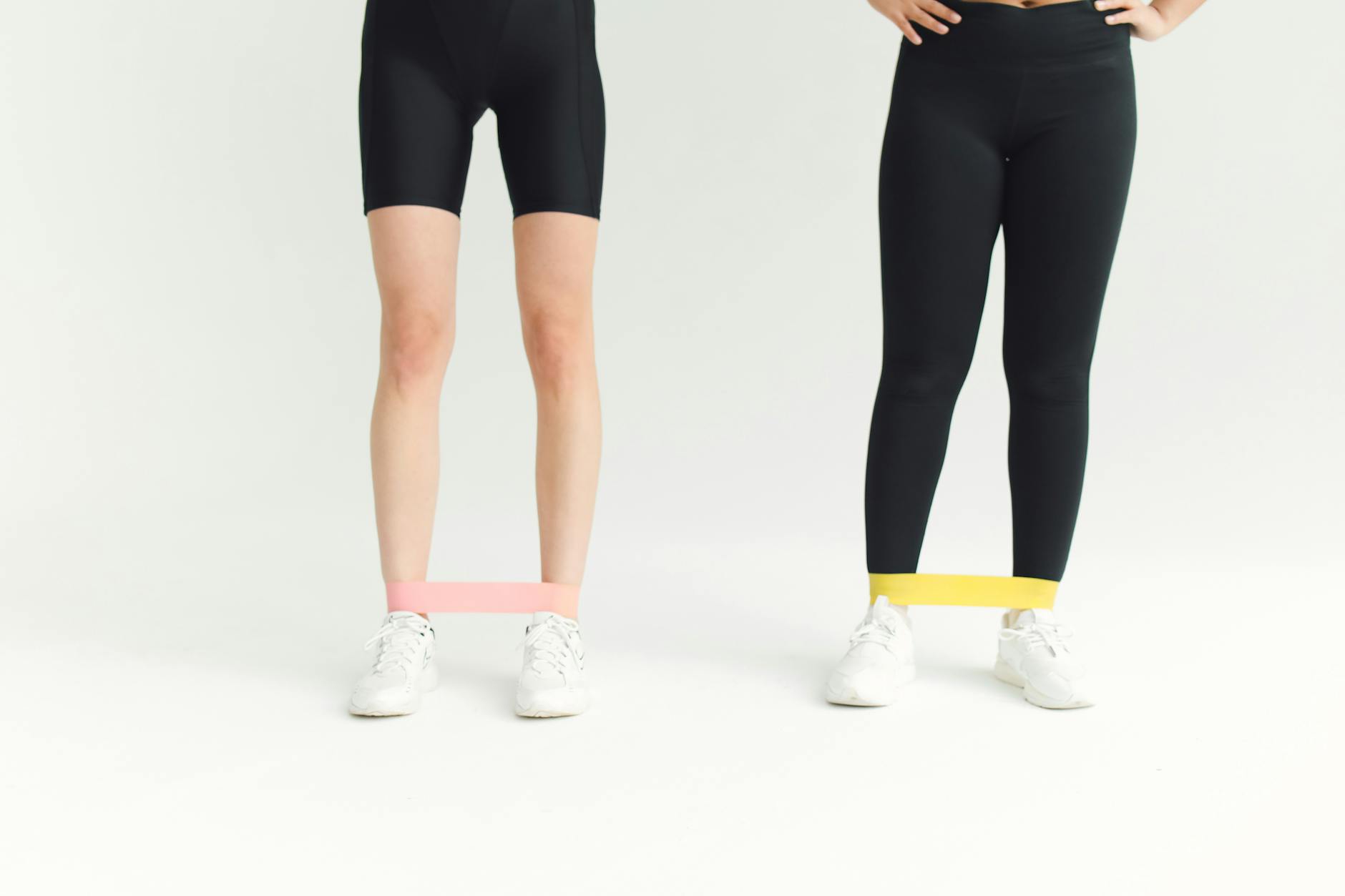
A resistance band works on elastic tension rather than gravity. Pull it further and the resistance climbs, which is the opposite curve to a dumbbell, where the load is identical at the top and bottom of the movement. That changing tension is why band exercises often feel easiest at the start of a rep and hardest at the end — the band is doing less work when it's slack and more the further it stretches.
This makes bands useful for two very different jobs: strength training resistance bands work when free weights aren't available, and mobility or rehab work where a smooth, adjustable resistance is safer than a fixed weight. A single set, usually five levels stacked from light to heavy, covers a wider range of exercises than most people expect — presses, rows, squats, curls, and stretches all work with the same length of rubber.
They also fold into a bag the size of a fist, which is the real reason exercise bands have become the default kit for home workouts, hotel rooms, and anyone training in a flat with no floor space to spare.
Types of Resistance Bands
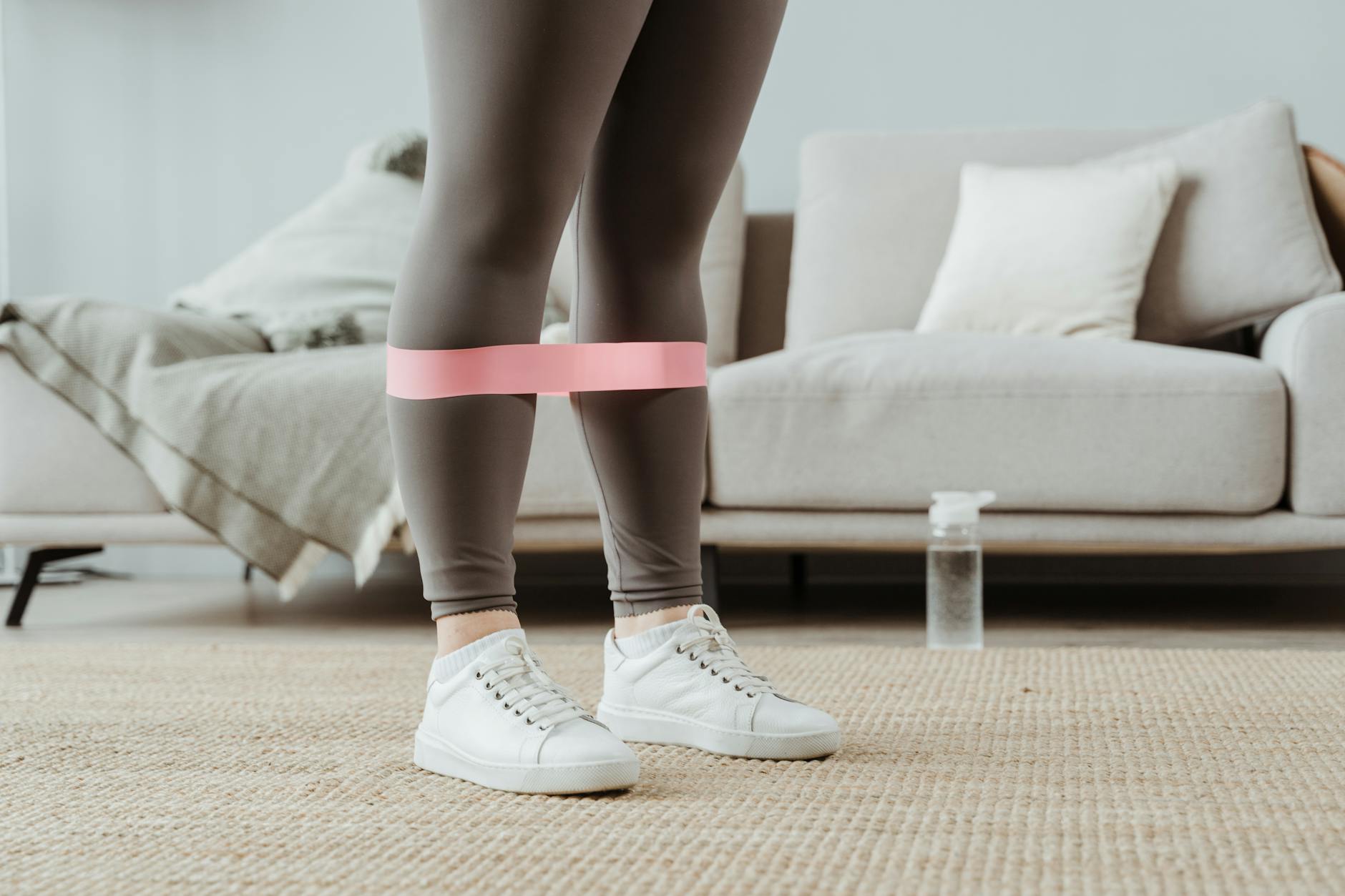
Loop bands (mini bands)
Loop bands are a continuous circle of flat rubber with no handles, usually worn around the ankles or thighs. They're the standard choice for a resistance bands leg workout — squats, lateral walks, glute bridges — because the closed loop keeps tension on the muscle through the full range of the movement without anything to grip.
Tube bands with handles
Tube bands come with moulded plastic or foam handles on each end, built for standing exercises where you push or pull — rows, presses, curls, and any exercise you'd otherwise do holding a dumbbell. They're the closest thing to a portable cable machine.
Therapy bands (flat bands)
Flat, wide, and usually sold in a long roll, therapy bands are what physiotherapists hand out for rehab work. No handles, no loop — just a strip of resistance you wrap around a limb or anchor point. They're lighter than tube or loop bands and better suited to controlled, low-load movement.
Figure-8 bands
A short band with a handle moulded into each end, shaped like the number eight. Less common than the other three, but useful for seated exercises and travel kits where a full-length band is more resistance than the space allows.
Benefits of Resistance Bands
The case for resistance bands over a first set of dumbbells comes down to four things.
Joint-friendly loading. Because tension increases gradually through the stretch rather than staying constant like a weight plate, the joint sees less peak stress right at the end range of a movement — the point where most strain injuries happen. Physiotherapists use bands for exactly this reason.
Portability. A set of bands weighs less than a single dumbbell and rolls up small enough for a laptop bag. No other piece of strength equipment covers as many exercises for as little space.
Cost. A stacked set of five bands, light to heavy, usually costs less than a single mid-weight dumbbell, and between them covers a similar range of exercises across the whole body.
Progression without more purchases. Most sets are sold across a range of resistance levels, so getting stronger means changing bands or doubling one up, not buying an entirely new rack of equipment.
How to Choose the Right Resistance Level
Buy a set, not a single band. A single medium band handles one or two exercises well and leaves you stuck everywhere else — a stacked set of three to five resistance levels covers presses, rows, and squats at their correct, separate intensities.
As a starting point: light bands suit shoulder and rehab work, medium bands suit arm and back exercises, and heavy bands suit squats and glute work, where the bigger muscles involved can handle more resistance from the first session. If in doubt, start lighter — bands that are too heavy break your form on presses and rows long before they build strength, which trains the wrong movement pattern.
Our resistance bands range covers loop bands and handled sets across these levels, so building a full stack doesn't mean buying from three different suppliers.
Resistance Band Exercises for Upper Body

Anchor a tube band around a door handle or pole at chest height for these.
- Band rows. Step back until there's tension at arm's length, pull the handles to your ribs, squeeze your shoulder blades together, release slowly. Targets the upper back — the muscle group most home workouts under-train.
- Band chest press. Anchor behind you, press the handles forward at chest height until your arms are extended, control the return. A close substitute for a bench press when no bench is available.
- Band bicep curl. Stand on the band, curl the handles to your shoulders, keep your elbows pinned to your sides. Works the same muscle as a dumbbell curl, with tension that increases through the top of the movement instead of staying flat.
- Band overhead press. Stand on the band, press the handles overhead until your arms are straight, lower under control. Useful shoulder strength and stability work that a lot of home routines skip entirely.
Resistance Band Exercises for Lower Body
Loop bands do most of the work here — worn just above the knees or around the ankles depending on the exercise.
- Banded squats. Loop above the knees, feet shoulder-width, squat as normal while pushing your knees out against the band. As one old gym line goes, life has its ups and downs — we call them squats, and the band just makes the down half work your glutes harder too.
- Lateral band walks. Loop above the knees, half-squat position, step sideways in a controlled line. A staple in return-to-training programmes for exactly this reason — it fires the glute muscles that keep knees stable.
- Glute bridges. Loop above the knees, lie on your back, drive your hips up while pushing your knees outward against the band.
- Standing kickbacks. Loop around the ankles, hinge slightly forward, kick one leg back and squeeze the glute at the top.
Resistance Band Exercises for Core
- Pallof press. Anchor a tube band at chest height to your side, hold the handle at your chest, press it straight out and hold — the band tries to rotate you, and resisting that rotation is the entire exercise.
- Band woodchoppers. Anchor low, pull the handle diagonally across your body to shoulder height, control the return. Works the obliques through a rotational pattern most core exercises miss.
- Banded dead bug. Loop a light band around your feet, lie on your back, extend opposite arm and leg while keeping your lower back flat against the floor.
A Simple Full-Body Resistance Band Routine
Three sessions a week, 20 to 30 minutes each, is enough to see real strength gains within six to eight weeks — the same general timeline as free-weight training, because muscle adapts to tension, not to the specific object creating it.
A straightforward session for workouts using resistance bands: band squats, band rows, band chest press, glute bridges, bicep curls, and a Pallof press on each side. Three sets of 12 to 15 repetitions per exercise, resting 45 to 60 seconds between sets. Move up to the next resistance level once 15 reps stop feeling like the last few are a genuine effort.
Safety: Avoiding Snapped Bands and Injuries

Heads up: a snapped band under tension is the most common resistance band injury, and it's almost always preventable.
Check for wear before every session — small cracks, discolouration, or a slightly sticky texture mean the rubber is breaking down and due for replacement. Bands don't fail gradually; they fail suddenly, usually at the weakest point in the material.
Anchor properly. A door anchor designed for the job holds far more securely than a band looped around a door handle, which can slip or let the door swing open mid-rep. Our lifting accessories range includes door anchors built for this.
Keep your face out of the return path. If a handle slips from your grip or the band snaps, it travels back toward wherever it was stretched from — which is often your face on curls and rows. Anchoring at chest height rather than head height reduces the risk if something does let go.
When Resistance Bands Are Not the Right Tool
Bands are not the right tool if your goal is maximum strength. There's a ceiling to how much tension even a heavy band produces, and serious strength athletes hit that ceiling within months, not years. If you're chasing a bigger squat or deadlift number specifically, a barbell and plates will get you there faster than any stack of bands.
They're also a poor substitute for free weights if you want to track progress precisely. A dumbbell says 10kg on the side. A band's resistance changes throughout the stretch and varies between brands, which makes exact load tracking difficult — fine for general fitness, frustrating if you're logging numbers for a structured programme.
And if your bands are more than a year or two old and stored somewhere hot — a car boot, a sunny garage — replace them before your next session rather than trusting them. UV exposure and heat degrade rubber faster than regular use does, regardless of how careful you've been with the exercises themselves.
For any of these situations, our strength training range is the better starting point.
Common Mistakes to Avoid
Buying one band instead of a set. Covered above, worth repeating — one resistance level covers a fraction of the exercises a full set does.
Rushing the return. The eccentric, releasing half of a band exercise is doing as much work as the pull. Letting the band snap back under its own tension skips half the exercise and increases the chance of losing control of the handle.
Anchoring too high or too low for the exercise. A row anchored too high turns into a shoulder exercise; a press anchored too low turns into something closer to a pull. Match anchor height to the joint doing the main work.
Skipping the warm-up because "it's just a band." Bands still load joints and connective tissue. A few light-resistance reps before the working sets matter as much here as with any weighted exercise.
Frequently Asked Questions
What's the difference between loop resistance bands and bands with handles?
Loop bands are a closed circle of flat rubber, worn around the legs for squats, walks, and glute work. Bands with handles are tube-shaped with grips on each end, built for standing presses, rows, and curls where you need something to hold. Most home setups use both rather than picking one.
What resistance level should a beginner buy?
A stacked set of three to five levels, from light to heavy, rather than a single band. Start light-to-medium for upper-body pressing and pulling, and medium-to-heavy for squats and glute work, adjusting once 15 controlled reps stop feeling like effort on the last few.
Can resistance bands really build muscle, or only free weights can?
Muscle responds to tension under load, not to the specific object producing it, so bands do build muscle and strength. The limit is how much tension a band produces at its heaviest, which is lower than a loaded barbell — fine for general strength, a ceiling for competitive lifting.
How long do resistance bands last before they need replacing?
Most last one to two years of regular use before the rubber shows cracks or a sticky texture. Heat and UV exposure shorten that considerably, so bands stored in a hot car or a sunny garage need checking more often than bands kept indoors.
Are resistance bands enough for a full workout on their own?
Yes, for general strength, mobility, and home training. A full-body session covering squats, rows, presses, curls, and core work is realistic with one stacked set. They're not enough on their own if the specific goal is maximum strength or precise, trackable load progression.
What's the safest way to anchor a resistance band at home?
A door anchor built for the job, rather than the band looped over a door handle or wedged in a door frame. A proper anchor won't slip, and it keeps the door from swinging open mid-rep, which is one of the more common ways bands come loose under tension.
When should you skip resistance bands and use free weights instead?
When the goal is maximum strength, precise load tracking, or you've outgrown what a heavy band can provide — which usually happens within months of consistent training, not years. At that point, a barbell and plates progress further than any stack of bands can.
Related at Flexi Muscles
- Resistance bands — loop bands and handled sets across light to heavy resistance levels
- Lifting accessories — door anchors and straps to pair with a resistance band set
- Strength training equipment — barbells and plates for when a band hits its ceiling
Sources
- Healthline — resistance band exercises, benefits, and buying guide
- American Council on Exercise (ACE Fitness) — equipment and training guidance
- Mayo Clinic — general exercise health guidance