

Workout Weights: The Complete Buying Guide

By Flexi Muscles — 16 August 2026 · 9 min read
Workout weights are the free weights and loaded equipment you use to add resistance to an exercise — dumbbells, barbells and plates, kettlebells, and weight machines. Which type you need depends on where you train and what you are training for. For a home setup, a pair of adjustable dumbbells and a barbell with plates cover most goals between them. The right starting weight is not a fixed number: it is whatever leaves your last two reps genuinely hard to finish with correct form.
Shop Workout Weights at Flexi Muscles
Types of workout weights

Every piece of weight training equipment falls into one of four categories. Most home gyms end up mixing two or three of them rather than committing to just one.
Dumbbells
Dumbbells are the most flexible weight exercise tool for a small space. A single pair works presses, rows, curls, squats, and lunges without changing equipment between exercises. Fixed pairs are quicker to swap mid-set; adjustable sets replace an entire rack in the footprint of two dumbbells.
Barbells and plates
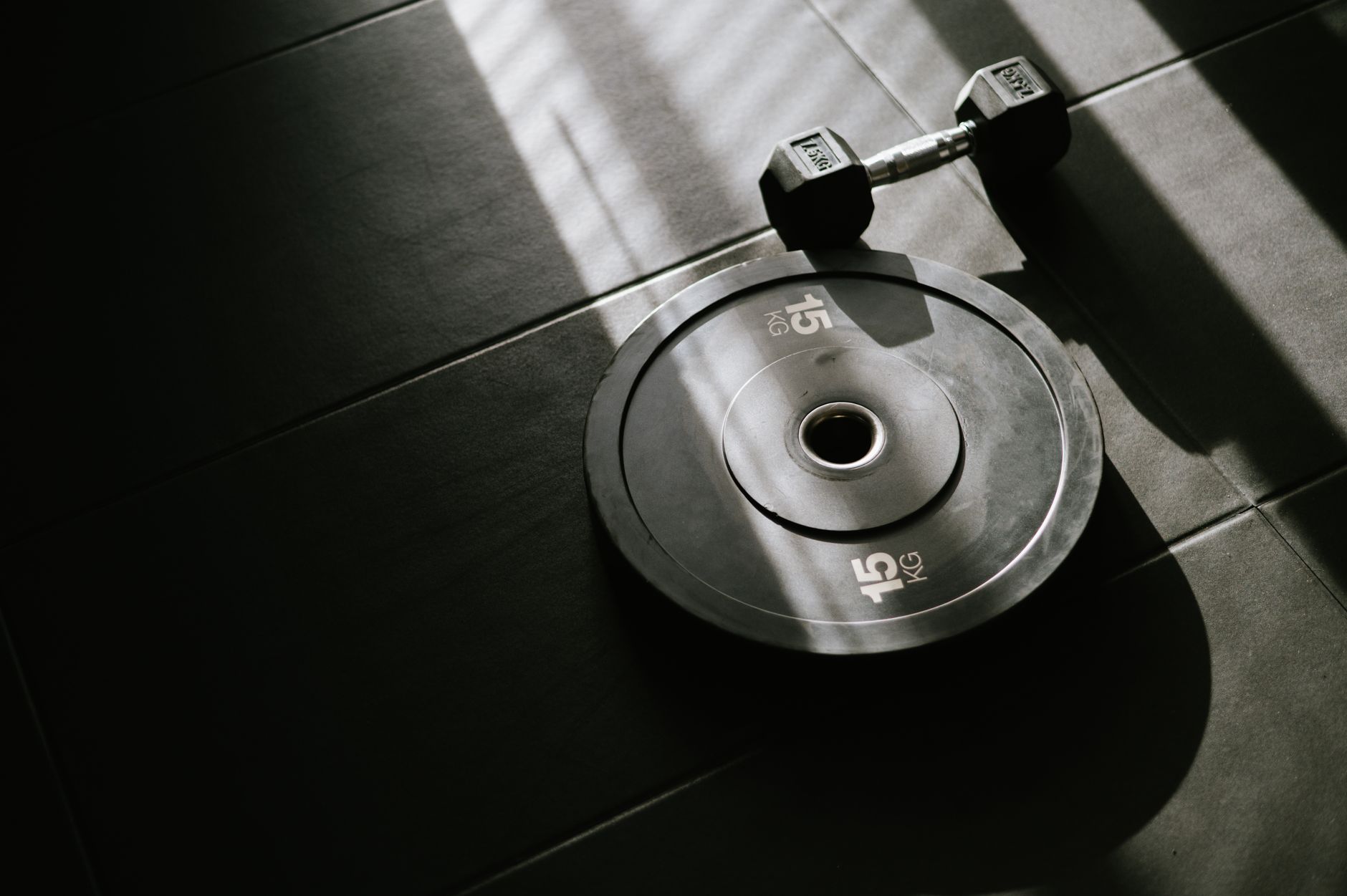
A barbell lets you load far more total weight than two dumbbells combined, which matters for compound lifts like squats, deadlifts, and bench press. A standard Olympic bar with a starter plate set — typically 2.5, 5, 10, and 20 kg plates per side — covers most strength programmes for well over a year of progression.
Kettlebells
A kettlebell's offset handle and centre of mass suit swinging, ballistic, and carrying movements that dumbbells handle awkwardly. One kettlebell in the 12 to 16 kg range covers swings, goblet squats, presses, and farmer's carries, making it one of the most versatile single pieces of workout exercise equipment you can own.
Machine weights and resistance bands
Weight machines guide the bar or handle along a fixed path, removing the balance and stabilisation demand that free weights require. Resistance bands do something similar in a portable, low-cost format, providing variable resistance that increases as the band stretches. Both suit beginners learning a movement, or lifters working around an injury.
Browse the full range of dumbbells at Flexi Muscles to compare fixed and adjustable options before deciding which type fits your space.
How to choose the right weight for your goal

Once you know which type of equipment you are buying, your training goal sets the actual number on the weight.
Building muscle
Hypertrophy training works best in the 8 to 12 rep range, at a load that brings the last one or two reps close to failure with good form. Too light and you never recruit enough muscle fibre; too heavy and form breaks down before you reach the rep range that drives growth.
Strength
Pure strength work uses lower reps — typically 3 to 6 — at 75 to 90 percent of what you could lift for one rep. This is where a barbell earns its place over dumbbells, since it lets you fine-tune load in small plate increments well past what two dumbbells can reasonably hold.
Weight loss and general fitness
For fat loss and general conditioning, a moderate load lifted for 12 to 20 reps across full-body circuits with short rest periods burns more total calories per session than either very light weights or maximal loads. The number on the equipment matters less than training with resistance consistently.
Free weights vs machine weights

| Factor | Free weights | Machine weights |
|---|---|---|
| Space needed | Small — one rack or corner | Large — one machine per exercise |
| Stabiliser training | High — balance is part of the lift | Low — path is fixed for you |
| Learning curve | Steeper — technique matters | Gentler — path removes guesswork |
| Cost per exercise covered | Low — one set covers many lifts | High — one machine per movement |
One view worth stating plainly: free weights are the better first purchase for a home gym. A single adjustable dumbbell pair and a barbell replace the function of six or more single-exercise machines, in a fraction of the floor space and at a fraction of the cost. Machines earn their place in a commercial gym with room for a full circuit, or for isolating a muscle when balance would otherwise be the limiting factor.
What workout weights cost
| Option | Price range (ZAR) | What you get |
|---|---|---|
| Single fixed dumbbell pair | R250–R900 | One weight, no flexibility. A reasonable way to test whether you will train consistently before spending more. |
| Adjustable dumbbell set (up to ~24 kg per hand) | R3,000–R6,500 | Replaces five or six fixed pairs in the footprint of two. The sensible default for most home gyms. |
| Single kettlebell (12–16 kg) | R450–R900 | Covers swings, presses, squats, and carries in one piece of equipment. |
| Barbell and plate set (bar plus ~100 kg) | R4,500–R9,500 | Covers most strength programmes for well over a year of progression. |
| Full home setup (barbell, plates, adjustable dumbbells, kettlebell) | R10,000–R18,000 | Covers strength, hypertrophy, and conditioning goals without needing a gym membership. |
For most people starting out, a single fixed pair or one kettlebell is enough to confirm you will actually train consistently. Once that is established, an adjustable dumbbell set plus a basic barbell covers years of progression for most goals other than dedicated powerlifting.
Common mistakes when buying workout weights
Buying too heavy, too soon
Buying a heavy set because a light pair felt easy in the shop is one of the most common mistakes. A weight that feels manageable for five reps in a showroom often falls apart by rep ten under real fatigue. Judge your working weight after two or three actual sessions, not a single test lift.
Buying only one weight
A single fixed weight covers one exercise well and every other exercise badly. Upper body isolation moves and lower body compound moves rarely suit the same load, which is the main reason adjustable sets outperform a single fixed pair for anyone training a full programme.
Buying a full setup before you know you will use it
Do not buy the full barbell-plus-plates-plus-kettlebell combination on day one if you have never trained with weights consistently before. Equipment sitting unused in a corner does nothing for your fitness regardless of how much it cost or how heavy it is. Start with one versatile piece, confirm the habit, then expand.
Frequently Asked Questions
What are the main types of workout weights?
The four main types are dumbbells, barbells with plates, kettlebells, and weight machines. Dumbbells and kettlebells work well for single-joint and full-body movements in a small footprint. Barbells let you load the most total weight, which matters for compound strength lifts. Machines guide the movement path, which suits beginners and rehab work.
How much weight should I lift as a beginner?
Start with a load that lets you complete 12 to 15 reps with correct form and two or three reps still left at the end of the set. For most first-time lifters, that means 2 to 5 kg for upper body isolation moves and 5 to 10 kg for lower body and compound movements. Add weight once the current load stops feeling challenging for two sessions in a row.
Are free weights better than machine weights?
For most home training, yes. A single adjustable dumbbell pair and a barbell replace the function of six or more single-exercise machines in a fraction of the floor space, and they train stabiliser muscles that fixed machine paths skip. Machines still have a place for beginners learning a movement pattern or for isolating a muscle without balance being the limiting factor.
What is the most versatile workout weight to buy first?
An adjustable dumbbell set is the most versatile single purchase, since one pair covers the range that would otherwise need five or six fixed pairs. A single kettlebell in the 12 to 16 kg range is the next most versatile option, since it covers swings, presses, squats, and carries with one piece of equipment.
How do I know when to increase my weight?
Increase weight once you can complete all prescribed sets and reps with two clean reps still in reserve on the final set, for two workouts in a row. A jump of 1 to 2.5 kg per hand is usually enough. Jumping straight to a much heavier load because one set felt easy is a common way to injure a shoulder or elbow.
Do I need heavy weights to lose weight?
No. For weight loss, a moderate load lifted for 12 to 20 reps across full-body circuits with short rest periods burns more total calories per session than either very light weights or maximal loads. The weight on the equipment matters less than training with resistance consistently and keeping rest periods short.
Related at Flexi Muscles
- Strength Training Equipment — dumbbells, barbells, plates, and racks for your home gym
- Dumbbells for Sale — fixed and adjustable dumbbell sets
- Resistance Bands — a portable, low-cost alternative to machine weights
- Lifting Accessories — gloves and straps to support heavier lifts