

Workout Plans for the Gym: Which Split Actually Fits Your Week

By Flexi Muscles — 5 September 2026 · 14 min read
The best workout plans for the gym match the split to the number of days you can actually train, not the other way round. Two to three days a week suits a full body split. Four days suits an upper/lower split. Five to six days is where a push/pull/legs split starts to pay off. Picking a split that assumes more days than you realistically have is the most common reason beginner plans fail within the first month.
Shop Strength Training Equipment at Flexi Muscles
Which split matches your schedule

A workout split is simply how you divide your muscle groups across your training week. Train everything in one session and repeat it, and you are running a full body split. Divide the body into two halves trained on alternating days, and you have an upper/lower split. Divide it into three movement categories, and you have push/pull/legs. None of these is objectively superior — each one trades session length against weekly frequency differently, which is exactly why matching the split to your actual schedule matters more than picking the split with the most impressive name.
How often to work out at the gym realistically, not aspirationally, is the single input that should decide your split. Answer that question honestly before picking a plan.
| Days per week | Recommended split | Why |
|---|---|---|
| 2–3 | Full body | Each muscle group still gets trained multiple times weekly despite the lower frequency |
| 4 | Upper/lower | Balances training frequency and recovery, each region trained twice a week |
| 5–6 | Push/pull/legs | Enough sessions to run the split twice through with meaningful volume per muscle group |
A weekly gym schedule built around fewer days than a split requires is the fastest way to undertrain half your programme. If you only have three realistic days most weeks, run a full body split — do not attempt a five-day push/pull/legs split and simply skip two days every week instead.
If your available days sit between two categories — three or four, say — default to the split requiring fewer days. A full body split run consistently on three of your four available days beats an upper/lower split that only gets completed three times out of its intended four most weeks.
Warm up before every session, regardless of split
Five to ten minutes of light cardio and dynamic movement — leg swings, arm circles, bodyweight squats — before loading a barbell or dumbbells reduces injury risk and improves performance on your first working sets. This applies identically whichever split you choose, since cold muscles and joints do not care which programme you are running.
Full body split

A full body split trains every major muscle group in each session, spread across three non-consecutive days a week. It is the standard gym workout routine for beginners because it repeats every movement pattern often enough to build competence quickly.
Sample full body session
- Squat — 3 sets of 8 reps. Keep the knees tracking over the toes and the chest upright through the descent.
- Flat dumbbell press — 3 sets of 10 reps. Lower under control until the elbows sit just below shoulder height.
- Bent-over row — 3 sets of 10 reps. Hinge from the hips and keep the spine neutral rather than rounding as fatigue sets in.
- Overhead press — 3 sets of 10 reps. Brace the core to avoid arching the lower back as the weight passes your face.
- Romanian deadlift — 3 sets of 10 reps. Keep the weight close to the legs and stop the descent once you feel a hamstring stretch.
- Plank — 3 sets to 30–45 seconds. Keep hips level with shoulders rather than letting them sag or pike upward.
Run this session on Monday, Wednesday, and Friday, with rest days between.
Benefits
- Every major movement pattern gets practised three times a week, which speeds up learning proper form.
- Fits easily around a busy schedule, since missing one session in a week still leaves two.
- Less to plan and track week to week compared to a multi-day rotating split.
Drawbacks
- Sessions run longer than a split routine, since every major pattern needs covering in one sitting.
- Less room for exercise variety per muscle group compared to a split with dedicated days.
- Progress on individual lifts can feel slower since total weekly volume per movement is lower than a higher-frequency split.
Upper/lower split
An upper/lower split alternates between upper body sessions and lower body sessions across four days a week, training each region twice. It is a natural next step once four gym days a week become realistic.
Sample upper day
- Bench press — 3 sets of 8 reps
- Single-arm row — 3 sets of 10 reps per side, one hand and knee braced on a bench
- Overhead press — 3 sets of 10 reps
- Bicep curl — 2 sets of 12 reps, keeping the elbows pinned to the sides
- Tricep extension — 2 sets of 12 reps
Sample lower day
- Squat — 3 sets of 8 reps
- Romanian deadlift — 3 sets of 10 reps
- Walking lunge — 3 sets of 10 reps per leg, stepping far enough forward that the front knee stays behind the toes
- Calf raise — 3 sets of 15 reps, pausing briefly at the top of each rep
Run upper Monday and Thursday, lower Tuesday and Friday, with Wednesday and the weekend free. This is the split most people land on once they have a few months of consistent training behind them — enough frequency to progress meaningfully without needing five or six weekly sessions.
Benefits
- Each muscle group trains twice a week, which research generally links to faster strength and size gains than once-weekly training.
- Session length sits in the middle ground — shorter than full body, more focused than a three-way split.
- Four fixed training days are easier to build into a weekly routine than a rotating schedule that shifts which day trains what.
Drawbacks
- Requires four reliable days a week, which is a bigger commitment than a three-day full body plan.
- Missing an upper or lower day unbalances the week more than missing a full body session does.
- Still less exercise variety per session than a dedicated push, pull, or leg day allows.
Push/pull/legs split

Push/pull/legs groups all pressing movements into one session, all pulling movements into another, and legs into a third, usually repeated twice across five to six days. It is the split most associated with dedicated hypertrophy training, since each muscle group gets a high volume of focused work per session.
Push day
- Bench press — 3 sets of 8 reps
- Overhead press — 3 sets of 10 reps
- Lateral raise — 3 sets of 15 reps, lifting only to shoulder height
- Tricep extension — 2 sets of 12 reps
Pull day
- Barbell or dumbbell row — 3 sets of 10 reps
- Pull-up or lat-focused pulling movement — 3 sets to near-failure or 8–10 reps assisted
- Bicep curl — 3 sets of 12 reps
- Rear delt fly — 2 sets of 15 reps, light weight and strict form
Legs day
- Squat — 3 sets of 8 reps
- Romanian deadlift — 3 sets of 10 reps
- Walking lunge — 3 sets of 10 reps per leg
- Calf raise — 3 sets of 15 reps
This split needs five to six training days to deliver its main advantage — running it twice through in three days undoes the higher-frequency benefit it is built around. If your week cannot reliably fit that many sessions, upper/lower or full body will produce more consistent results.
Benefits
- Highest total training volume per muscle group of the three splits, which suits a specific hypertrophy or bodybuilding-style goal.
- Each session is shorter and more focused, since it only covers one movement category.
- Running it twice through the week means each muscle group still gets trained roughly twice, similar to upper/lower, but with more exercises per session.
Drawbacks
- Needs five to six consistent training days to work as designed, which is a significant weekly commitment.
- Recovery management becomes more important, since consecutive days often train overlapping muscle groups indirectly.
- Not an efficient use of a beginner's early training weeks, when a simpler split builds the same foundational strength.
What equipment each split needs
All three splits above run on the same core equipment — the difference is exercise variety, not exotic machinery. This matters most for anyone training at home rather than a commercial gym, since the equipment list below determines the ceiling on which splits are realistic before any additional purchase.
Full body and upper/lower
A set of adjustable dumbbells and a flat or adjustable bench covers every exercise in both sample routines above. Squats, presses, rows, and Romanian deadlifts all work with dumbbells alone, which makes this the minimum viable home gym for either split and the setup most beginners should start with. Add a set of resistance bands for warm-ups and light accessory work, and the setup handles a full year of progressive training before anything more is strictly necessary.
Push/pull/legs
The same dumbbells and bench cover the core lifts, but the extra exercise variety in a six-day rotation benefits from a barbell and plates for squats and rows, plus a pull-up bar for vertical pulling work. A barbell in particular becomes worth adding once your squat or deadlift numbers exceed what a pair of dumbbells can practically provide. None of this is mandatory to start, but it becomes more valuable as the split's higher exercise count draws on more movement patterns.
How to progress week to week
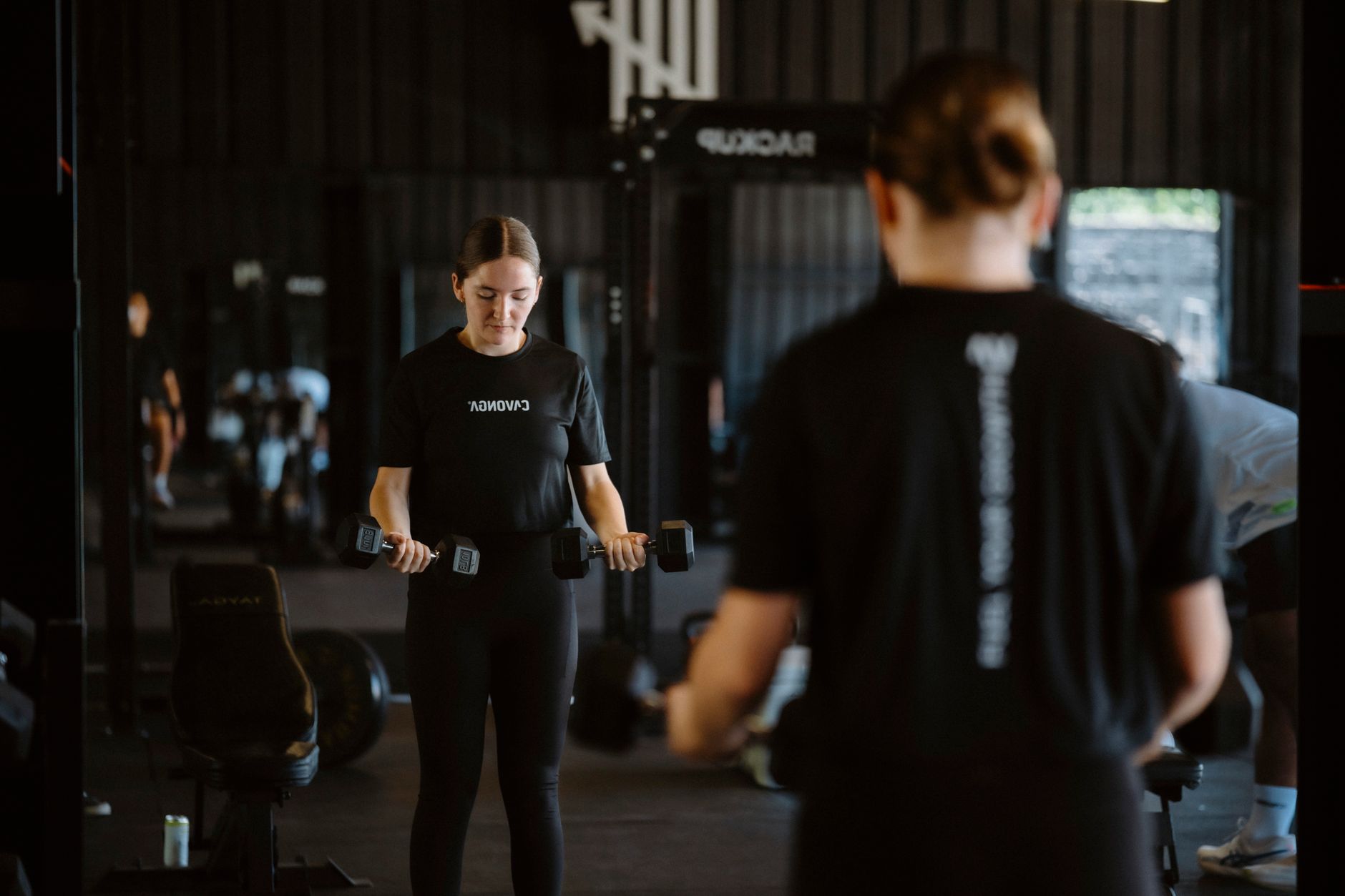
Increase reps before you increase weight. Once every set of an exercise hits the top of its rep range with good form, add weight and drop back to the bottom of the range. Track your numbers somewhere — a notes app is enough — since memory alone rarely tells you accurately whether last week's session was actually heavier than this week's.
A realistic pace for a beginner is a small increase in weight or reps every one to two weeks on the main lifts, not every single session. Expecting every workout to beat the last is a fast route to stalling early and then assuming the programme has stopped working, when the issue is usually the pace of expected progress rather than the plan itself.
Moving between splits follows the same logic as choosing one in the first place: let your available days change before your split does. Someone who starts on a three-day full body plan and later frees up a fourth training day has a natural, low-risk upgrade path to upper/lower. Jumping straight to a six-day push/pull/legs split from a standing start, rather than progressing through the middle step, is a common reason ambitious beginner plans do not survive their first month.
One opinion worth stating: of the three splits in this guide, full body is the one most beginners actually stick to past the first month, since three sessions a week is easier to protect on a busy schedule than five or six. A programme run consistently for twelve weeks beats a more "optimal" split abandoned after three.
Common mistakes
Straight up: most workout plans fail for reasons that have nothing to do with exercise selection.
- Choosing a split that assumes more days than you have — a six-day plan run three times a week trains nothing properly, since each session covers only a third of the intended weekly volume.
- Changing programmes every two or three weeks — no plan gets enough time to show whether it is working, and constant switching means you never learn which variables actually drove your progress.
- Skipping progression tracking — without recorded numbers, it is nearly impossible to tell if you are actually getting stronger, and memory alone tends to overestimate week-to-week consistency.
- Training the same muscle groups on consecutive days — recovery happens between sessions, not during them, and stacking similar sessions back to back leaves you fatigued rather than stronger.
- Copying an advanced lifter's plan — a six-day hypertrophy split designed for someone with years of training history is the wrong starting point for a beginner, whose recovery capacity and technical proficiency are both still developing.
- Ignoring warm-up because sessions feel too short already — the five minutes saved skipping a warm-up is a poor trade against a strained muscle that costs two weeks of training.
- Judging the plan after one or two sessions — soreness or awkwardness in the first week reflects unfamiliarity with the movements, not a flaw in the split itself.
When you don't need a rigid plan yet
A detailed split is not always the right next step. Skip the optimisation if any of these apply.
You have not built the attendance habit yet
If getting to the gym consistently is still the hard part, a rigid split is solving a problem you do not have. Run a simple full body routine and focus purely on showing up for the first month. Optimising exercise selection and split structure before attendance is solid is solving the wrong problem in the wrong order.
Your goal is general health, not muscle-specific training
If the target is general fitness rather than maximising muscle growth or strength in specific lifts, a structured push/pull/legs split adds complexity without a proportional benefit. A simple full body or upper/lower routine covers general health goals fine, and the time saved on planning and tracking is better spent on the consistency that actually drives long-term health outcomes — things like sleep, daily movement, and simply not quitting.
You are returning from a long break
Coming back after months away, your previous plan's weights and volume are the wrong starting point. Restart with a lighter full body routine for two to three weeks before reintroducing a more demanding split. Muscle memory means strength returns faster than it was originally built, but the tendons and connective tissue supporting that strength take longer to catch up, which is the more common source of injury when someone jumps straight back into their old numbers.
Frequently Asked Questions
How many days a week should I go to the gym as a beginner?
Three days a week is a sustainable starting point for most beginners, with a rest or light activity day between sessions. It is enough frequency to build strength and the training habit without the recovery demands of a five or six day schedule.
What is the best workout split for beginners?
A full body split trained three times a week is the best starting point for most beginners. Each major muscle group gets trained multiple times weekly, the routine is straightforward to follow, and three sessions a week fits most schedules without requiring a big lifestyle change. Move to an upper/lower or push/pull/legs split later, once more training days become realistic and the basic lifts feel comfortable.
Do I need different splits for muscle gain vs general fitness?
Not necessarily at the start. A full body or upper/lower split covers both goals reasonably well for the first several months of training. Splits like push/pull/legs, which need higher training frequency to pay off, become more relevant once your goal shifts specifically toward maximising muscle growth and you can reliably commit five or six days a week to training.
How long should I stay on the same workout plan before changing it?
Run a plan for at least eight to twelve weeks before making major changes. Switching programmes every two or three weeks does not give any single routine enough time to produce visible progress, which makes it impossible to tell whether the plan was working. Minor adjustments — swapping one exercise for a similar variation, adding a set — are fine within that window; wholesale changes to the split itself are what needs the longer runway.
Can I run a gym workout plan with just dumbbells at home?
Yes. A full body or upper/lower split runs well on adjustable dumbbells and a bench alone. Push/pull/legs splits are also achievable at home but typically benefit from a wider range of equipment, since the higher exercise count per session draws on more variety. Most people can train productively for a full year on dumbbells and a bench before a barbell setup becomes a genuine limiting factor rather than a nice-to-have.
When do I not need a structured workout plan yet?
If you have not yet built the habit of showing up consistently, a detailed split is solving a problem you do not have yet. Spend the first few weeks on a simple full body routine and focus purely on attendance and form. Add structure once consistency is no longer the hard part.
Related at Flexi Muscles
- Strength Training Equipment — dumbbells, benches, barbells, and plates for any split
- Dumbbells — the core equipment for full body and upper/lower splits
- Lifting Accessories — belts, straps, and gloves to support heavier training
- All Products — the full Flexi Muscles range