

Workout Exercises With Weights: A Full-Body Guide to Dumbbells, Barbells, and Kettlebells

By Flexi Muscles — 3 September 2026 · 9 min read
Workout exercises with weights fall into three equipment categories — dumbbells, barbells, and kettlebells — and each suits certain movements better than the others. Eleven exercises across push, pull, legs, and core cover a complete full-body session using whichever combination of the three you have access to. The equipment matters less than getting the exercise selection and progression right, which is where most home training guides fall short.
Shop Strength Training Equipment at Flexi Muscles
What counts as a workout with weights

Free weights — dumbbells, barbells, kettlebells, and weight plates — are any loaded implement that moves freely through space, as opposed to a machine that guides the path for you. Exercise for weight lifting with free weights forces your stabilising muscles to control the load themselves, which is the main reason free weight training builds coordination and balance alongside raw strength.
You do not need all three equipment types to get a complete workout. Most of the eleven exercises below have a dumbbell, barbell, or kettlebell version, so the guide works whether you own one implement or all three.
Weight plates deserve a mention too. On their own, plates work well for weighted carries, Russian twists, and loaded stretches, and a barbell with plates is simply a barbell exercise with adjustable load. Strength training exercises with weights do not require every category of equipment at once — a barbell and a set of plates alone can carry a full programme for years.
Which type of weight suits which exercise
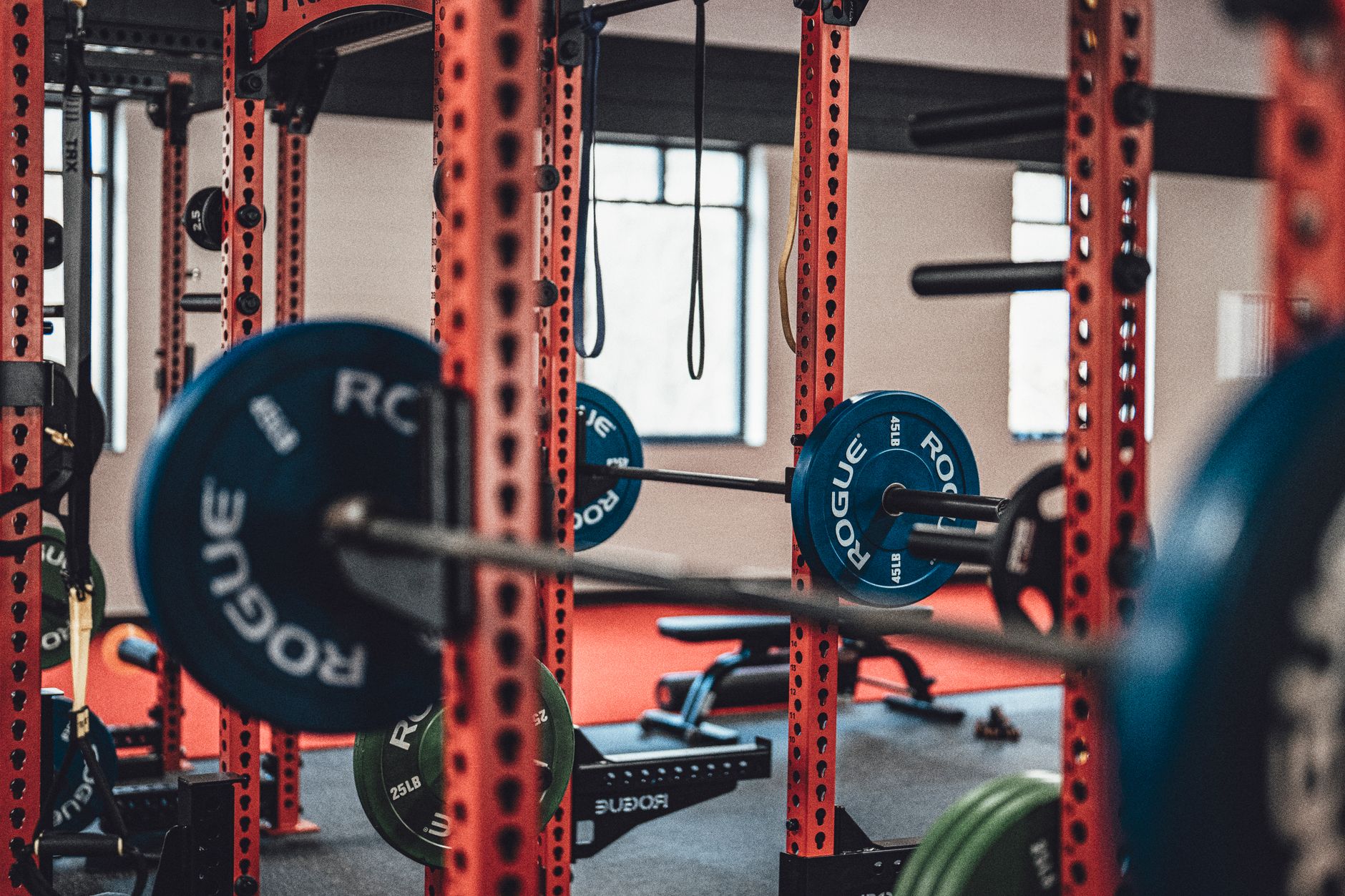
| Dumbbells | Barbell | Kettlebell | |
|---|---|---|---|
| Learning curve | Shortest | Moderate to steep for compound lifts | Moderate for swings and carries |
| Best for | Unilateral work, isolation, pressing | Maximum load, squats, deadlifts | Swings, carries, explosive hip drive |
| Total load potential | Moderate | Highest | Moderate |
| Space needed | Smallest | Largest, needs clearance | Small to moderate |
If you are choosing one implement to start with, dumbbells cover the widest range of exercises with the least setup. A barbell becomes worth adding once you are pressing or squatting more than a pair of dumbbells can practically provide. Kettlebells are a specialist addition for swings, carries, and explosive hip movements that dumbbells and barbells do not replicate as naturally.
Barbell and dumbbell exercises overlap considerably — a bench press, a row, and an overhead press all exist in both forms — so the choice mostly comes down to how much total weight you eventually want to lift and how much floor space you have for a bar and plates.
Eleven full-body exercises with weights

Push
- Dumbbell bench press — lying on a bench, press dumbbells from chest level to full extension. Trains chest, shoulders, and triceps. Keep the wrists stacked directly over the elbows at the bottom of the movement.
- Barbell overhead press — standing, press the bar from shoulder height to overhead. One of the most direct shoulder strength builders available. Brace the core hard to stop the lower back arching as the bar passes your face.
- Dumbbell shoulder press — seated or standing, press dumbbells overhead independently, which exposes any left-right strength imbalance a barbell hides. A seated version with back support removes the need to brace against lower back arch.
Pull
- Bent-over barbell row — hinge forward, row the bar to the lower ribs. Builds the mid-back and rear shoulders. Keep the spine neutral rather than rounding as the weight gets heavier.
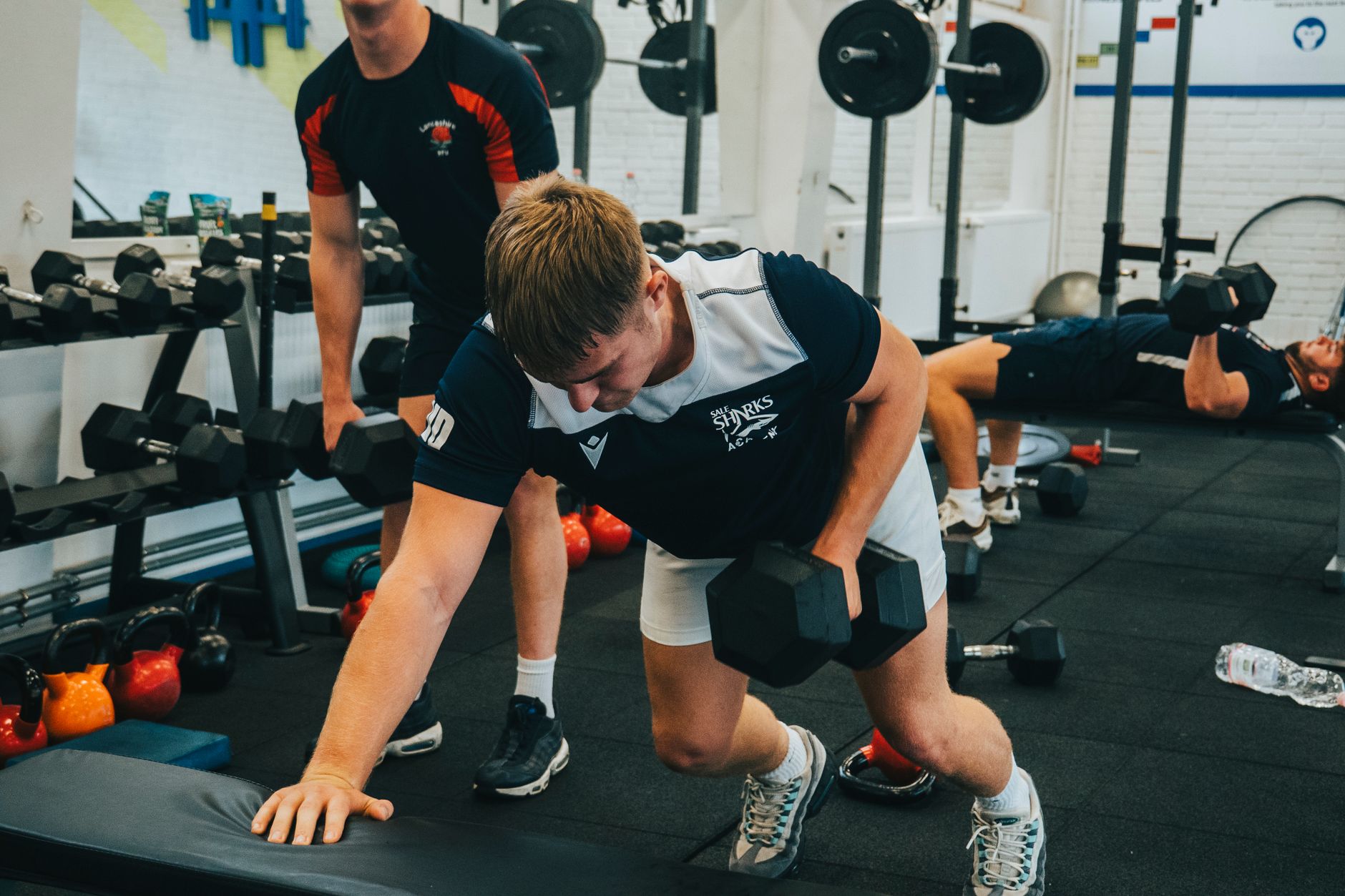
- Single-arm dumbbell row — one hand and knee on a bench, row the dumbbell to the hip. Trains each side of the back independently. Avoid rotating the torso to help the weight up.
- Farmer's walk — carry a heavy dumbbell or kettlebell in each hand for distance or time. Trains grip, traps, and core stability simultaneously. Walk with short, controlled steps rather than rushing.
Legs
- Barbell back squat — bar across the upper back, squat to depth and stand. The most complete lower body strength exercise in this list. Keep the knees tracking in line with the toes throughout.
- Goblet squat — hold a dumbbell or kettlebell at chest height, squat between your knees. A safer entry point to squatting mechanics than a loaded barbell, since the front-loaded weight naturally encourages an upright torso.
- Romanian deadlift — barbell or dumbbells, hinge at the hips keeping a soft knee bend, lower until you feel a hamstring stretch. Targets the hamstrings and glutes directly. Keep the bar or dumbbells close to the legs on the way down.
Core
- Weighted Russian twist — seated, feet off the floor, rotate a plate or dumbbell side to side. Trains rotational core strength. Move slower if you feel the motion mostly in your shoulders rather than your midsection.
- Renegade row — in a plank position with a dumbbell in each hand, row one side at a time while resisting hip rotation. Combines core stability with a pulling movement. Widen your foot stance if the hips twist excessively during the row.
These eleven free weight exercises rotate well across a week — pick two to three per category per session rather than attempting all eleven in one workout.
Sample full-body workout
A balanced session using dumbbells, a barbell, and a kettlebell together. Rest 60 to 90 seconds between sets.
- Barbell back squat — 3 sets of 8 reps
- Dumbbell bench press — 3 sets of 10 reps
- Single-arm dumbbell row — 3 sets of 10 reps per side
- Romanian deadlift — 3 sets of 10 reps
- Farmer's walk — 3 rounds for 30 to 40 metres
- Weighted Russian twist — 2 sets of 15 reps per side
If you only have dumbbells, substitute a goblet squat for the barbell back squat and dumbbells for the Romanian deadlift — the session still trains the same movement patterns and muscle groups. If a kettlebell is your only piece of equipment, the farmer's walk, goblet squat, and Russian twist all work equally well with it, leaving only the pressing and rowing movements needing a dumbbell substitute.
How to progress safely
Increase reps before you increase weight. Once every set of an exercise hits the top of its rep range with strict form, add weight and drop back to the bottom of the range for that exercise. This keeps technique ahead of load rather than the other way round.
One opinion worth stating: chasing heavier weight before reps are consistent is the most common mistake in home strength training. Of the eleven exercises in this guide, at least seven — the squat, deadlift, row, and press variations — break down in a predictable, visible way under too much load, and that breakdown teaches the wrong movement pattern far faster than slow, controlled progress teaches the right one.
When NOT to add more weight
Straight up: more weight is not always the right call. Hold off if any of these apply.
Your current load already breaks form before the set ends
If the last two reps of a set already look different from the first two — rounding back on a deadlift, elbows flaring on a press — the weight is already too heavy for clean technique. Fix form at the current load before adding more.
You feel a joint, not a muscle
Sharp, pinching, or joint-specific discomfort is a signal to stop and reassess, not to push through with heavier load. Muscular fatigue and burn are normal; joint pain is not.
You are still learning the movement pattern
A barbell back squat or a Romanian deadlift takes weeks to groove properly. Adding weight to a pattern you have not yet learned reinforces whatever compensations you are currently making, which are harder to unlearn later than they are to avoid now.
Frequently Asked Questions
Should a beginner start with dumbbells, a barbell, or kettlebells?
Dumbbells. They have the shortest learning curve, let each side of the body work independently so imbalances show up early, and need no additional equipment to get started. A barbell adds more total load potential once technique is solid, and kettlebells suit swinging and carrying movements specifically.
How many exercises should a workout with weights include?
Five to six exercises covering push, pull, legs, and core is enough for a complete full-body session. More than that in a single workout usually means sets get rushed or form suffers toward the end, particularly for anyone training after work or early in the morning.
How often should I do a full-body workout with weights?
Two to three sessions a week, with at least one rest day between each, lets muscles recover while building strength steadily. Training the same muscle groups on consecutive days with no rest slows progress rather than speeding it up.
Should I increase weight or reps first?
Increase reps first. Once you can complete every set at the top of your rep range with strict form, add weight and drop back to the bottom of the rep range. Adding weight before reps are consistent usually comes at the cost of technique.
What is the difference between free weights and machines?
Machines guide the movement path for you, which is more forgiving for beginners but trains fewer stabilising muscles. Free weights require you to control the bar or dumbbell through the entire range of motion, which builds coordination and balance alongside strength.
When should I not add more weight to an exercise?
Do not add weight if your current load already breaks form before the set ends, if a joint feels sharp or pinching rather than muscularly fatigued, or if you are still learning the movement pattern. Added load on a flawed movement pattern trains the flaw, not the muscle.
Related at Flexi Muscles
- Strength Training Equipment — dumbbells, barbells, plates, and kettlebells for your home gym
- Dumbbells — the most versatile starting point for weight training
- Lifting Accessories — belts, straps, and gloves to support heavier lifts
- All Products — the full Flexi Muscles range