

Weightlifting Wall Ball: The Complete Training and Buying Guide

By Flexi Muscles — 24 August 2026 · 11 min read
A weightlifting wall ball is a soft, weighted ball, usually 4-10 kg, thrown against a wall from a squat and caught on the way back down. It combines a front squat with a push-press into one continuous rep, which is why it shows up in conditioning workouts more often than strength programmes — it trains power output under fatigue rather than a single maximum lift. This guide covers the exercises, the weight to start with, how a wall ball differs from a slam ball, and who should leave it on the shelf.
Shop Strength Training Equipment at Flexi Muscles
What Is a Weightlifting Wall Ball
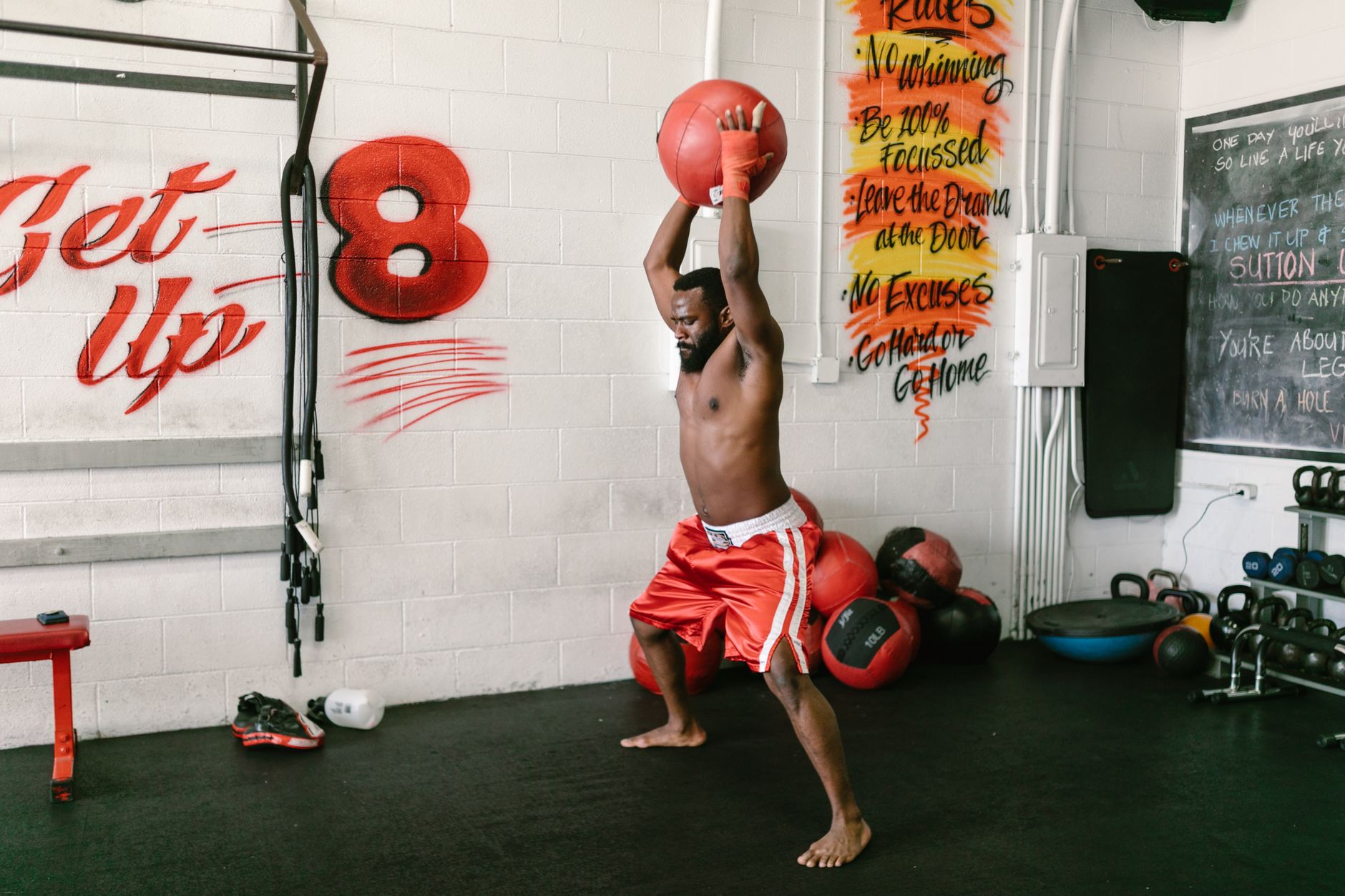
The exercise it's named for, the wall ball shot, is a front squat that ends in a push-press: hold the ball at chest height, squat below parallel, then stand up fast enough that the momentum carries the ball out of your hands and into a target on the wall above head height. Catch it as it drops and go straight into the next squat. Done for time or reps, that single movement trains legs, shoulders and core in one continuous chain rather than as separate exercises.
A wall ball earns its place in conditioning programmes for a reason most single-joint exercises can't match: it forces the transition from a slow, controlled squat into a fast, explosive throw, over and over, under real fatigue. That transition, not the squat and not the throw in isolation, is what most training programmes are short on.
It isn't a strength-building tool in the way a barbell squat is. The ball is light enough to move fast, which is the point, but that also means it can't progressively overload a lifter the way adding plates to a bar does. Wall balls build conditioning and coordination on top of strength you've already built elsewhere, not instead of it.
Wall Ball vs Slam Ball vs Medicine Ball
These three get used interchangeably, and that mix-up is the most common reason a new ball gets returned within a week.
- Wall ball: built to be thrown and caught. A softer, grippier shell with some bounce, so it doesn't slip out of sweaty hands mid-catch and doesn't hurt when it lands against your forearms on a bad rep.
- Slam ball: built to be driven straight into the floor, not caught. A dead bounce and a tougher, textured cover designed to survive repeated slams without splitting. Use one for wall ball shots and it either bounces back too hard to catch cleanly or, over time, the shell cracks from an impact angle it wasn't built for.
- Medicine ball: the broader category both of the above sit inside. Older medicine balls were leather and barely bounced at all, closer to a slam ball than a wall ball. Modern "medicine ball" branding covers rubber, vinyl and hybrid shells that can lean either way, so check whether a specific ball is rated for wall throws or floor slams before buying it for one purpose and using it for the other.
If you're only buying one ball and want to do both wall ball shots and slams, a mid-bounce rubber medicine ball is the compromise. It won't catch as cleanly as a dedicated wall ball or survive slams as long as a dedicated slam ball, but it won't fail outright at either.
Muscles a Wall Ball Workout Targets

The squat portion loads quads and glutes the same way any deep squat does. What a wall ball adds on top is the drive: because the rep ends in a throw rather than a controlled stand, the legs have to produce force fast, not just move a load through a range of motion.
The throw itself works the shoulders, upper back and triceps, since they're what finishes pushing the ball past head height once the legs have done the initial work. The core sits between the two halves of the movement, bracing through the squat and staying tight through the extension so force transfers from legs to arms instead of leaking out through a rounded back.
Few single exercises load that much of the body in one uninterrupted rep, which is exactly why wall balls turn up in conditioning benchmarks rather than in programmes built around isolating one muscle group at a time.
How to Choose the Right Wall Ball Weight
The competition standard, set by the CrossFit Games Rx workout requirements, is a 9 kg (20 lb) ball to a 10-foot target for men and a 6 kg (14 lb) ball to a 9-foot target for women. That number gets treated as a starting point far more often than it should be — it exists to make competition scores comparable to each other, not to define a correct training weight for a first session.
A more realistic progression for home training:
- First few sessions: 4-6 kg. The goal is learning the squat-to-throw timing, not loading it.
- Once form holds for 15+ reps: 6-8 kg. This is where most people training at home settle long-term.
- Matching competition standard: 9 kg (men) / 6 kg (women), once squat depth and catch position stay consistent past rep 20.
- Beyond 10 kg: only worth it for lifters specifically training toward a competition Rx standard heavier than their own bodyweight training calls for.
My opinion: skip anything below 6 kg if you can already squat to depth with your own bodyweight for 15 reps without your knees caving in. A ball lighter than that trains conditioning at a pace so easy it stops being conditioning, and it's the single most common reason a wall ball ends up unused after the first month — not that it's too heavy, but that it was bought too light to feel like it's doing anything.
5 Wall Ball Exercises Worth Learning
1. Wall ball shot
The exercise the equipment is named for. Hold the ball at chest height, squat below parallel, then drive up and extend through the throw so the ball leaves your hands at the top and hits the target. Catch it on the way down and drop straight back into the next squat without resetting your stance.
2. Squat-to-press
The version for anyone without a wall to throw at. Same squat, but instead of releasing the ball, press it overhead at the top of the stand and lower it back to chest height before the next rep. You lose the catch-and-absorb coordination work, but keep the leg-to-shoulder power transfer that makes the exercise worth doing.
3. Russian twist
Sit with knees bent and feet either on the floor or lifted for a harder version, lean back slightly, and rotate the ball from hip to hip. This isolates the core work the wall ball shot only trains indirectly, and it's a useful accessory move on days you're not doing full wall ball sets.
4. Overhead wall pass
Standing close to the wall, press the ball overhead and bounce-pass it against the wall just above head height, catching it on the rebound. It isolates the shoulder and tricep portion of the wall ball shot without the squat, useful as a warm-up primer or a finisher when the legs are already fatigued from other work.
5. Rotational slam
This one needs a slam ball, not a wall ball — using a bouncy wall ball here means it rebounds unpredictably off the floor. Lift the ball to one side at shoulder height, then drive it down and across to slam it at the opposite foot. It trains the rotational core strength that straight-ahead squatting and pressing don't touch.
A Wall Ball Workout for Beginners

Run this as a straightforward circuit before adding it into anything more complicated:
- Warm-up: 2 minutes of bodyweight squats plus 10 slow, unweighted squat-to-press reps to groove the pattern.
- Round structure: wall ball shot → rest 60 seconds → Russian twist → rest 60 seconds. Repeat for 4 rounds.
- Reps: 10-12 wall ball shots per round, 15-20 Russian twists per side.
- Weight: 4-6 kg for the first two weeks, moving to 6-8 kg once every rep in round four still looks like round one.
- Frequency: twice a week, with at least a day of rest between sessions since the squat volume adds up fast when it's paired with a throw.
Add a third round of a different accessory move, like the overhead wall pass, once the basic circuit stops leaving your legs and shoulders equally fatigued by round four — that imbalance is usually the sign one half of the movement needs more direct work than the combined exercise gives it.
Common Wall Ball Mistakes
- Squatting too shallow — a wall ball shot that doesn't break parallel turns into an arm exercise. The legs should be doing most of the work driving the ball up, not the shoulders.
- Catching with straight arms — absorb the ball with bent elbows flowing straight back into the squat. Catching stiff-armed transfers the impact into the wrists and shoulders instead of the legs.
- Standing too close or too far from the wall — too close and the ball has no arc, forcing an awkward catch angle; too far and you're throwing for distance instead of height, which wastes the leg drive on a flatter trajectory.
- Using a slam ball for wall ball shots — the dead bounce either doesn't come back far enough to catch cleanly or comes back at an unpredictable angle, both of which are how fingers get jammed.
- Buying too light and never progressing — a ball chosen to make the first session comfortable often stays too light for the next six months, since there's no obvious cue (unlike a barbell) telling you it's time to size up.
Who Shouldn't Buy a Wall Ball
A wall ball is not the right first purchase for everyone. Skip it, or put it well down the list, if any of these apply:
- You don't have squat depth yet — if a plain bodyweight squat below parallel isn't comfortable, a wall ball adds a throw on top of a movement you haven't built yet. Fix the squat first.
- You're training for maximum strength, not conditioning — a wall ball can't progressively overload the way a barbell does. It's a conditioning and coordination tool, not a replacement for a loaded squat programme.
- You don't have a wall to throw at, or downstairs neighbours — the squat-to-press variant works without a wall, but the real exercise needs a clear, solid surface above head height and enough ceiling clearance that a mis-thrown ball doesn't hit a light fitting.
- You have a current shoulder or lower back injury — the fast, fatigued nature of wall ball sets is exactly the kind of loading that makes an existing injury worse. Get cleared by a physiotherapist before adding it back in.
If none of those apply, a wall ball is one of the few pieces of equipment that trains legs, shoulders and core together in a single rep, and it takes up less floor space than almost anything else in a home gym.
Ready to add wall ball training to your setup? Shop strength training equipment at Flexi Muscles. If you're building out accessories around it, see our lifting accessories range too.
Frequently Asked Questions
What's the difference between a wall ball and a slam ball?
A wall ball is built to be caught, so it has more bounce and a softer, grippier shell. A slam ball is built to die on the floor, with a dead bounce and a tougher, textured cover that survives being driven straight down. Using a slam ball for wall ball shots wears out your hands and the ball faster; using a wall ball for slams means it bounces back at you.
What weight wall ball should a beginner use?
6-8 kg (13-18 lb) for most beginners, regardless of gender. Drop to 4 kg if squat depth or overhead lockout breaks down before the tenth rep. The regulation CrossFit Open standard of 9 kg for men and 6 kg for women is a competition target, not a starting point.
What muscles does a wall ball workout target?
Quads and glutes drive the squat, the shoulders and triceps drive the throw, and the core stabilises the transition between the two. Few other single exercises load that much of the body in one continuous movement, which is why wall balls show up in conditioning tests rather than isolation-focused programmes.
Can you do wall ball exercises without a wall?
Yes. Swap the throw for a squat-to-press, holding the ball at chest height and pressing it overhead at the top of the squat instead of releasing it. You lose the catch-and-absorb component that builds coordination, but you keep the leg-to-shoulder power transfer that makes the exercise worth doing.
How heavy is a regulation CrossFit wall ball?
9 kg (20 lb) for men to a 10-foot target, and 6 kg (14 lb) for women to a 9-foot target, per the CrossFit Games Rx standard. Most home training doesn't need to match this, since the standard exists to make competition scores comparable, not to define a correct training weight.