

Weightlifting Arm Exercises: The Complete Guide to Biceps, Triceps and Shoulders

By Flexi Muscles — 25 July 2026 · 13 min read
The best weightlifting arm exercises are not always the ones most people default to. ACE Fitness tested eight biceps exercises and eight triceps exercises using EMG electrodes, and the results go against gym-floor habit: the concentration curl beat the barbell curl for biceps, and triangle push-ups and kickbacks beat rope pushdowns for triceps. This guide covers what the data says works for biceps, triceps, shoulders and forearms, how to structure it into a session, and the equipment that actually gets you there at home.
Shop Dumbbells at Flexi Muscles
What you're actually training
"Weightlifting arm exercises" as a search term covers four separate muscle groups, not one.
- Biceps brachii — front of the upper arm, handles elbow flexion and forearm rotation.
- Triceps brachii — back of the upper arm, three heads (long, lateral, medial), handles elbow extension and makes up roughly two-thirds of upper arm mass.
- Deltoids — the shoulder cap. Most exercises people file under "arms" — presses, lateral raises — are technically shoulder exercises.
- Forearm flexors, extensors and brachioradialis — grip strength and wrist movement, trained directly through curls and carries.
Since triceps make up more of the arm's total size than biceps, a session weighted heavily toward curls and light on pressing or extension work is working against the goal, not toward it.
Best weightlifting arm exercises for biceps

ACE Fitness had researchers attach EMG electrodes to the biceps brachii, anterior deltoid and brachioradialis of test subjects, then measured muscle activation across eight common exercises at 70 percent of one-rep max. The concentration curl came out on top, producing significantly higher biceps activation than the barbell curl, cable curl, preacher curl, incline curl, chin-up, or EZ-bar curl. The reason given: bracing the elbow against the leg stops the upper arm swaying, which keeps the work isolated to the biceps instead of letting momentum and the shoulder take over.
Concentration curl
Sit on a bench, brace the back of your upper arm against the inside of your thigh, and curl a single dumbbell through a full range of motion without letting the elbow drift forward. Slow the lowering phase down — two to three seconds — since that is where most of the muscle damage that drives growth happens.
Barbell curl
Still a solid weight lifting arm exercise even though it ranked below the concentration curl. The barbell lets you load more total weight than a dumbbell version, which matters once isolation moves alone stop providing enough stimulus. Keep elbows pinned to your sides; swinging the bar with your back turns the exercise into a hip hinge, not a curl.
Hammer curl
A neutral, palms-facing-in grip shifts more of the work onto the brachialis and brachioradialis — the muscle underneath the biceps and the main forearm flexor. It was not part of the ACE ranking, but it fills a gap the top-ranked exercises leave, since none of them train the brachialis directly.
Best weightlifting arm exercises for triceps
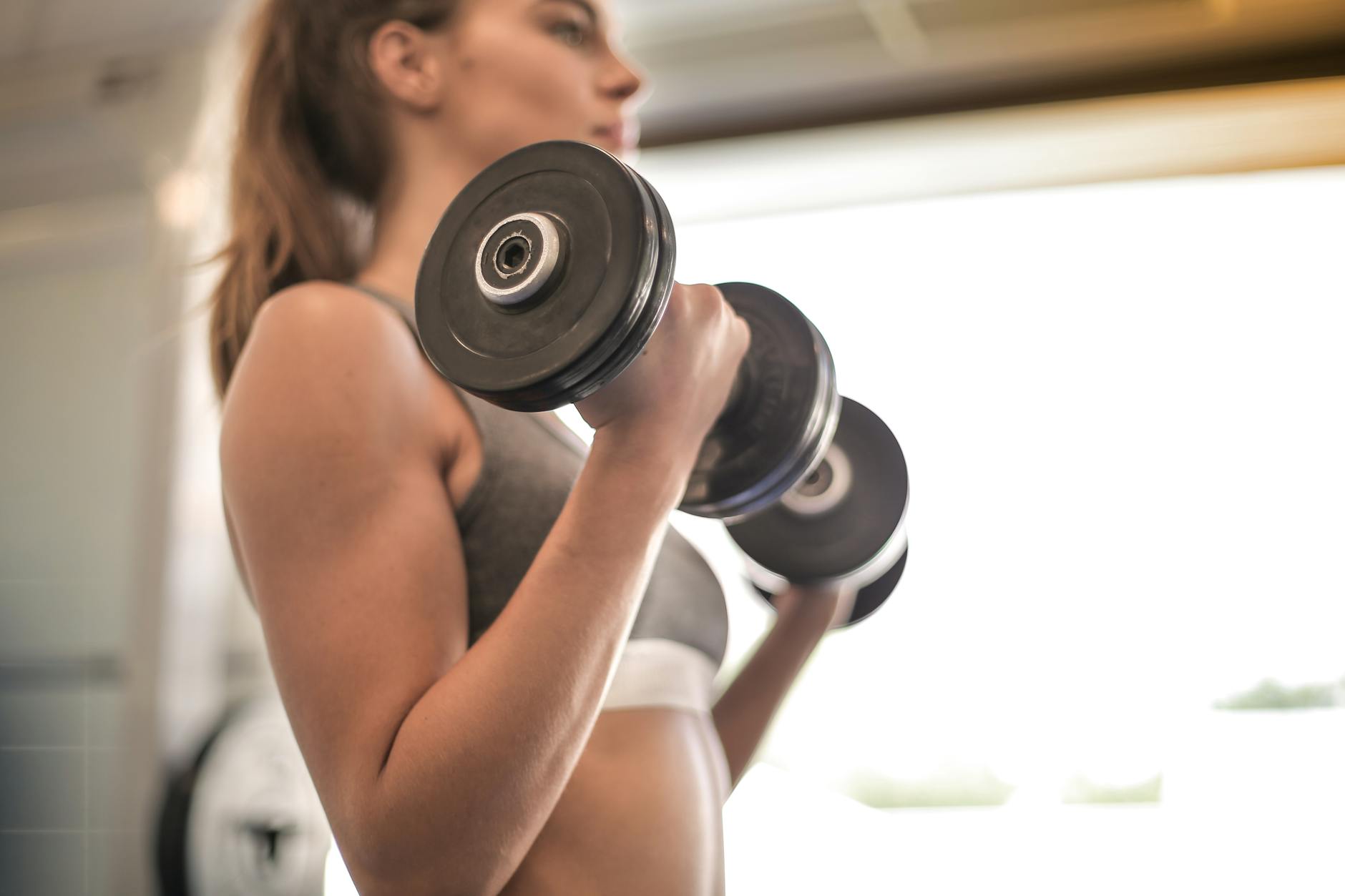
A separate ACE study ran the same EMG process across eight triceps exercises, scored against the highest reading as a baseline of 100. Triangle push-ups topped the list at 100, with kickbacks and dips tied close behind at 87. Overhead extensions scored 76, rope pushdowns 74, bar pushdowns 67, and lying barbell extensions and close-grip bench press both came in at 62 — roughly 40 points below the top exercise, despite bar pushdowns and close-grip bench being two of the most common triceps exercises on any gym floor.
Triceps kickback
Hinge forward with a flat back, elbow held high and tucked to your side, then extend the forearm back until the arm is straight. Keep the upper arm still throughout — if the elbow drops on each rep, the shoulder is doing work that belongs to the triceps.
Dips
Bodyweight or weighted, dips scored on par with kickbacks in the ACE data. Lean forward slightly to keep the emphasis on triceps rather than chest, and stop the descent once your upper arm is roughly parallel to the floor to protect the shoulder joint.
Rope pushdown
The classic tricep pull down rope exercise, done on a cable stack or a resistance band anchored above a door at home. Split the rope apart at the bottom of the movement rather than keeping your hands together — that extra range is where the rope attachment earns its higher EMG reading over the straight bar.
Overhead triceps extension
Whether done with a dumbbell, EZ-bar or rope attachment, the overhead position stretches the long head of the triceps under load, which the kickback and pushdown positions do not. It scored well above bar pushdowns in the ACE ranking, making it worth including even if a pushdown variation is already in your session.
Shoulder training with dumbbells

Most people searching for weightlifting arm exercises are really after bigger, more capable shoulders as much as bigger biceps and triceps. Dumbbells are better suited to shoulder training with dumbbells than a barbell in most home setups, since each arm moves independently and through a more natural path.
Dumbbell shoulder press
Press from shoulder height to just short of locking out overhead, keeping the dumbbells slightly in front of your ears rather than directly overhead, which reduces strain on the front of the shoulder joint. Three to four sets of 8 to 10 reps is a sensible starting point.
Lateral raise
Lift dumbbells out to the sides to roughly shoulder height with a slight bend in the elbow. This is a light-weight exercise by design — most people use too much load and end up using momentum from the hips instead of the shoulder muscle itself.
Front raise
Raise a dumbbell in front of your body to shoulder height, alternating arms or working both together. It targets the front deltoid specifically, which already gets significant work from pressing exercises, so this one earns a smaller share of total volume than the lateral raise.
Forearm and grip exercises
Forearms rarely get their own training block, which is why grip tends to fail before the target muscle does in exercises like rows and deadlifts.
Wrist curl
Rest your forearm on a bench with the wrist hanging off the edge, palm up, and curl the dumbbell using only wrist movement. Reverse the grip (palm down) on a second set to hit the extensors on the top of the forearm, which get far less indirect work than the flexors.
Farmer's carry
Pick up a heavy dumbbell or kettlebell in each hand and walk for 20 to 40 metres or 30 to 45 seconds, keeping shoulders back and grip tight. It builds forearm endurance and grip strength faster than isolated wrist work alone, and doubles as core and trap training.
How to structure a weightlifting arm workout
Individual exercise choice matters less than most people assume once the fundamentals of volume, load and frequency are in place.
| Muscle group | Sets × reps | Frequency |
|---|---|---|
| Biceps | 3–4 × 8–12 | 2× per week |
| Triceps | 3–4 × 8–12 | 2× per week |
| Shoulders | 3 × 8–15 | 2× per week |
| Forearms | 2–3 × 12–20 | 2× per week |
NASM's progression guideline is to keep weekly increases in load at roughly 10 percent or less. In practice: once you can complete every set at 15 to 20 reps with good form, add 5 to 10 percent more weight and drop back into the 8 to 12 rep range, rather than jumping straight to a much heavier dumbbell because the previous set felt easy.
Leave at least 48 hours between direct arm sessions. Biceps and triceps also get worked indirectly on push and pull days through presses, rows and pull-ups, so total weekly volume is usually higher than the direct sets above suggest on their own.
Equipment you actually need at home
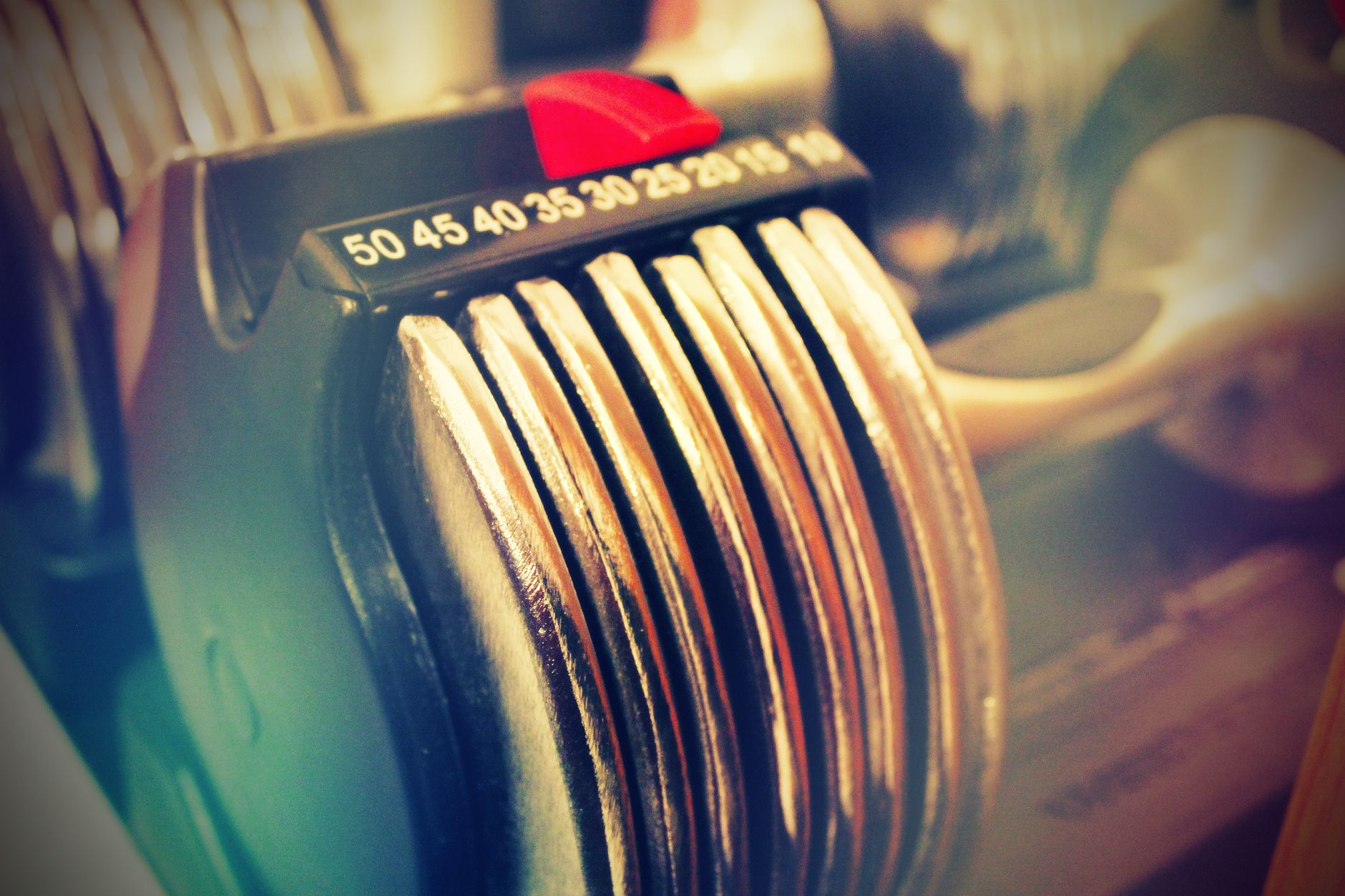
Every exercise in this guide except dips and the cable-specific rope pushdown can be done with a single pair of dumbbells. That makes dumbbells the one non-negotiable purchase for arm training at home.
| Equipment | Price range (ZAR) | Covers |
|---|---|---|
| Adjustable dumbbells (up to ~24 kg) | R3,000–R6,500 | Every exercise in this guide except dips |
| Resistance bands with door anchor | R250–R700 | Rope pushdown and cable curl substitutes |
| Kettlebell | R600–R1,800 | Farmer's carries, kettlebell curls, overhead presses |
| Dip station or dip bars | R900–R2,500 | The one exercise dumbbells can't replicate directly |
A kettlebell arm exercise like a bottoms-up press or rack carry is a reasonable addition for variety and grip demand, but a kettlebell is not a substitute for dumbbells on strict isolation moves like the concentration curl — the offset weight distribution makes it harder to keep the rest of the body still, which works against the isolation the exercise is built for.
Browse dumbbells for sale at Flexi Muscles, or check the wider resistance bands range for a rope-pushdown alternative that anchors to any door.
When not to add a dedicated arm day
Skip the dedicated arm day if you are new to training. Rows, pull-ups, presses and dips already put meaningful load on biceps and triceps, and stacking a full separate arm session on top often adds more total volume than a beginner can recover from before the next session. The result is usually sore elbows and stalled progress everywhere else, not faster arm growth.
Two short, direct arm blocks tacked onto existing push and pull days — four or five exercises, 20 minutes, twice a week — do more for most people than a dedicated day. Save the standalone arm day for once you have several months of consistent training behind you and can tell, from experience, that your current programme genuinely isn't giving arms enough attention.
It's also not worth buying a full rack of fixed-weight dumbbells purely for arm isolation work. A single adjustable pair covers the load range every exercise in this guide needs, at a fraction of the floor space.
Frequently Asked Questions
What is the single best weightlifting arm exercise?
There is no single best exercise for the whole arm, because biceps and triceps respond to different movements. ACE Fitness EMG testing found the concentration curl produced significantly higher biceps activation than any other exercise tested, while triangle push-ups and triceps kickbacks topped the triceps rankings. A well-built arm session needs at least one exercise from each list, not one exercise doing all the work.
How many sets and reps should I do for arm exercises?
Three to four sets of 8 to 12 reps per exercise is the standard range for building size in biceps, triceps and shoulders. Once you can complete every set with two or more reps left in reserve, NASM's progression guideline suggests adding roughly 5 to 10 percent more weight rather than jumping straight to a much heavier load.
How often should I train arms in a week?
Twice a week, with at least 48 hours between sessions, is enough for most people to see progress in biceps and triceps without overreaching. Arms also get worked indirectly during pressing and pulling exercises like rows and shoulder presses, so total weekly volume is usually higher than the direct arm sets alone suggest.
Do I need a cable machine for arm day, or can dumbbells replace it?
A cable machine is not required. Rope pushdowns and cable curls can be substituted with resistance bands anchored above a door, which apply similar constant tension through the movement. Dumbbells alone cover concentration curls, hammer curls, overhead extensions, kickbacks, shoulder presses and lateral raises, which is most of a full arm session.
Is a kettlebell arm exercise as effective as dumbbells for biceps and triceps?
Kettlebells work well for compound and grip-heavy arm work — kettlebell curls, overhead presses and rack carries all load the biceps, triceps and forearms effectively. They are less precise for strict isolation moves like concentration curls, because the offset weight distribution makes it harder to keep the rest of the body still. Most home setups do best with dumbbells as the primary tool and a kettlebell for variety.
Should beginners do a dedicated arm day?
Not usually. Beginners already train biceps and triceps indirectly through rows, presses and pull-ups, and adding a full dedicated arm day on top often means more total volume than a new lifter can recover from. Two short, direct arm sessions added to an existing upper body split work better than a separate day until you have several months of consistent training behind you.
Related at Flexi Muscles
- Dumbbells for Sale — adjustable and fixed sets for biceps, triceps and shoulder training
- Resistance Bands — a door-anchored rope pushdown and cable curl substitute
- Strength Training Equipment — kettlebells, barbells and dip stations for a full arm setup
- Lifting Accessories — gloves and wrist support for heavier pressing work
- All Products — the full Flexi Muscles range