

Weight Bench Buying Guide: How to Choose the Right Bench for Your Home Gym

article id="top">
By Flexi Muscles — 1 July 2026 · 20 min read
The right weight bench for a home gym comes down to three things: your available floor space, the maximum load you plan to press, and how much training variety you want. A flat bench handles the fundamentals reliably. An adjustable bench opens up incline pressing, seated shoulder work, and rows without any additional equipment. If you train primarily with dumbbells and have room for one bench, an adjustable model gives you the most return on the floor area it occupies.
Shop Strength Training Equipment at Flexi Muscles
Types of weight bench

There are four types of weight bench worth knowing about. Each has a clear use case. Buying the wrong type is one of the most common home gym mistakes.
Flat bench
A flat bench has a fixed horizontal pad. The frame is typically simpler and heavier than adjustable models, which makes flat benches more stable under very heavy loads. If your training revolves around barbell bench pressing and you already have incline or shoulder exercises covered through other equipment, a flat bench is a practical choice. It is also the most compact option — there is no adjustment mechanism to account for in storage.
The limitation is obvious: without any angle adjustment, your exercise selection is restricted to movements that work on a flat surface. That means standard bench press, flat dumbbell press, dumbbell rows, tricep dips, and step-ups. Anything requiring an incline or seated position is off the table.
Adjustable bench
An adjustable bench has a backrest that moves through multiple positions, usually from flat up to around 85 degrees. Most models offer between five and eight backrest positions. Some also have an adjustable seat, which matters for incline pressing — without it, you slide down the pad during incline movements.
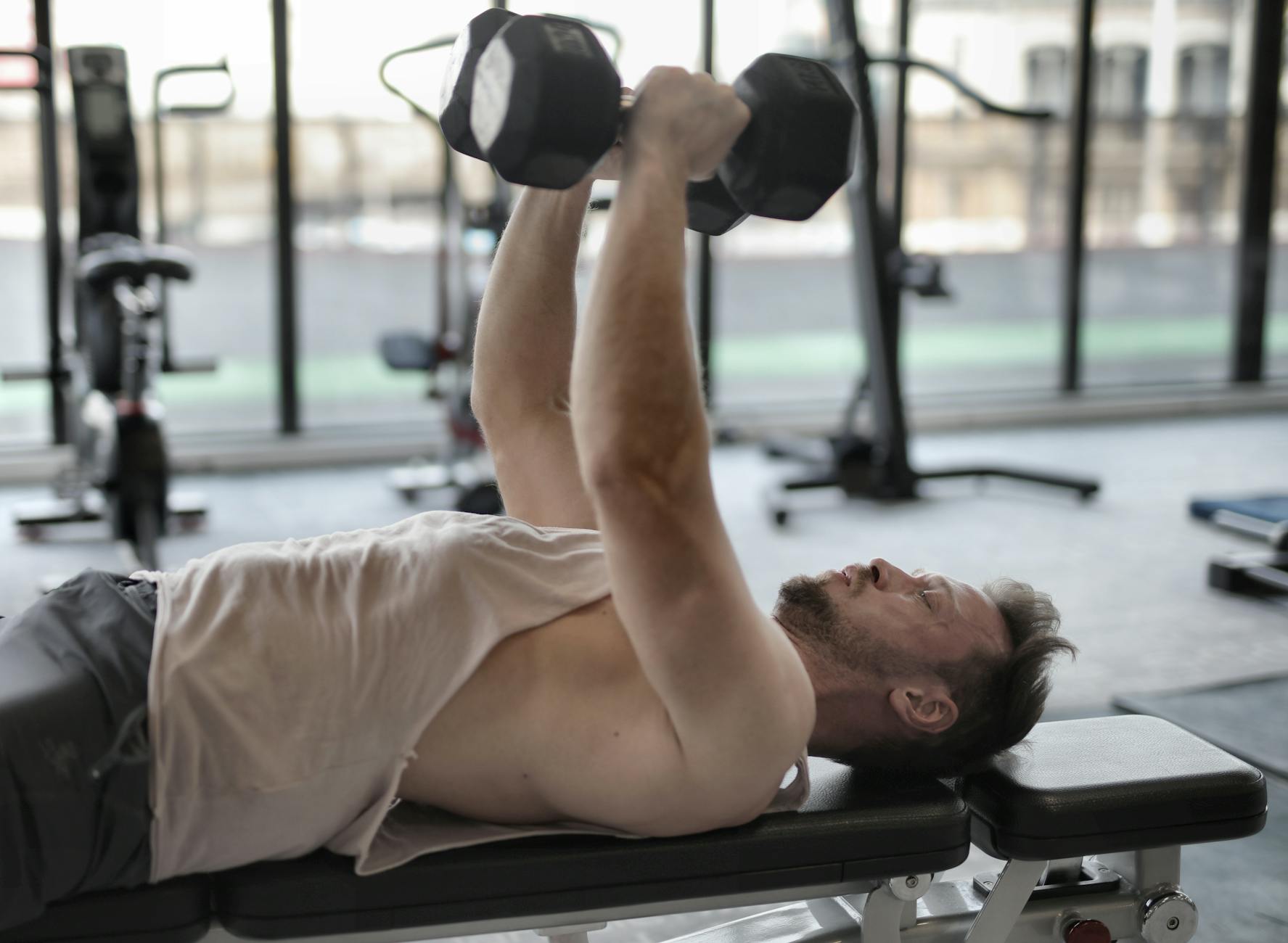
For a home gym bench paired with dumbbells, an adjustable bench is the sensible default. The incline position lets you vary chest training stimulus, seated positions work for shoulder presses and bicep curls, and a low incline angle gives you a chest-supported row setup. Most people get everything they need from an adjustable bench without ever needing a decline position.
FID bench (flat/incline/decline)
An FID bench adds a decline position — typically 10 to 30 degrees below horizontal — to the standard adjustable range. Decline pressing loads the lower chest fibres differently from flat or incline pressing, and some lifters find it a useful addition to chest training.
The trade-off: FID benches are bulkier, heavier, and more expensive than standard adjustable models. They also require a leg brace or ankle roller to stop you sliding during decline work. Buy an FID bench if decline pressing is a deliberate, consistent part of your programme. If you are buying your first bench or your training does not include decline work, the added cost and footprint are not justified.
Utility and speciality benches
Beyond the three main types, you will come across preacher curl benches, hyperextension benches, and seated calf raise benches. These are single-purpose tools. They make sense in a dedicated home gym where you already have the foundations covered. They are not a starting point.
Specs that actually matter

The spec sheet on most bench listings is longer than it needs to be. These are the numbers that actually predict whether a bench will hold up and feel right under load.
Weight capacity
This is the most important single number on any weight bench listing. It covers the combined weight of your body and whatever load you are pressing. For recreational lifters, a bench rated to at least 272 kg (600 lb) gives meaningful headroom. Intermediate and advanced lifters pressing heavy barbells should look at benches rated to 450 kg (1,000 lb) or above.
Do not assume high weight ratings automatically mean better quality everywhere else. Some benches inflate capacity numbers with testing methods that do not reflect real training conditions. Check whether the rating is a static load rating or a dynamic (impact) rating — dynamic ratings are the more meaningful figure for actual lifting.
Pad width
A pad width of around 28 to 32 cm (11 to 12.5 inches) suits most lifters for barbell pressing. Narrower pads allow more shoulder blade movement during pressing, which some lifters prefer. Wider pads feel more stable and comfortable for general training and dumbbell work. If you press heavy barbells with the cue to retract and depress your shoulder blades, lean toward narrower pads. If comfort and versatility matter more, a wider pad works fine.
Pad height
Most flat benches sit 42 to 47 cm (16.5 to 18.5 inches) off the floor. Taller lifters need more height to plant their feet flat without their hips rising. Shorter lifters need less. Approximately 43 to 45 cm (17 to 17.5 inches) is the range where most adults can press with their feet flat on the floor — the standard safe pressing position. Check this measurement before buying, particularly if you are under 165 cm or over 190 cm.
Frame gauge and stability
Thicker steel means a more rigid frame. Most reputable benches use 11-gauge or 12-gauge steel for the main frame. Anything described as 14-gauge or above is thinner and more prone to flex under load. Stability also depends on the base geometry — wider foot pads distribute weight more effectively and reduce rocking. If a bench wobbles noticeably under light loads in a shop or on a demonstration video, that wobble gets worse under heavy weights.
Adjustment mechanism and pad gap
On adjustable benches, the backrest folds down into the frame when the bench is set flat. How it folds, and how it gaps, affects both comfort and safety. A large gap between the backrest pad and the seat pad causes discomfort during flat pressing — your lower back spans an unsupported void. Benches with a zero-gap or near-zero-gap design at the flat position are more comfortable for most lifters. Check this specifically for any adjustable bench you are considering.
The adjustment mechanism should be firm and positive — clicking into each position clearly and not creeping when loaded. Ladder-style and pop-pin mechanisms are both common. Ladder mechanisms tend to be more durable; pop-pin mechanisms are faster to adjust but wear sooner with heavy use.
Footprint and storage
A standard adjustable weight bench is typically 120 to 130 cm long and 60 to 65 cm wide. That is the minimum floor space you need during use — add working clearance around it for the exercises you plan to do. Many adjustable benches store vertically: folding the backrest down and standing the bench upright. Vertical storage dramatically reduces the floor footprint, which matters in a smaller garage or spare room.
If your training space is tight, confirm whether the bench stores vertically before you buy. Not all do.
Exercises you can do with a weight bench

A bench and a pair of dumbbells cover most of the major muscle groups without any other equipment. Here is what is possible across both flat and adjustable configurations.
Chest
- Flat dumbbell press — the standard horizontal pressing movement. Trains the mid and lower chest, front deltoids, and triceps.
- Incline dumbbell press (adjustable bench only) — set the backrest to 30–45 degrees. Shifts emphasis toward the upper chest and front deltoids.
- Decline press (FID bench only) — loads the lower chest. Useful for lifters who specifically want to target that area.
- Dumbbell flyes — flat or incline. An isolation movement for the chest, using a wider arc than pressing movements.
Back
- Single-arm dumbbell row — one knee and hand on the bench, row with the other arm. One of the most effective back exercises with minimal equipment.
- Chest-supported row (adjustable bench only) — set the backrest to a low incline, lie chest-down, and row. Removes lower back involvement entirely.
- Prone rear delt fly — same position as chest-supported row but with a wider arc. Targets the rear deltoids and upper back.
Shoulders
- Seated dumbbell shoulder press (adjustable bench only) — set the backrest upright at around 80–85 degrees. Provides back support for overhead pressing.
- Incline front raise — lie chest-down on a low incline, raise dumbbells forward. Isolates the front deltoids.
- Seated lateral raise — sit upright on the bench, raise dumbbells to the sides. Targets the lateral deltoids.
Arms
- Incline dumbbell curl (adjustable bench only) — set to around 60 degrees, sit back and curl. The stretched starting position adds a different stimulus to standard standing curls.
- Tricep dips — hands on the bench edge, feet extended. An effective bodyweight tricep movement requiring no additional weight.
- Lying tricep extension — lie flat, extend dumbbells from behind the head. Works all three heads of the tricep.
Legs and core
- Bulgarian split squat — rear foot elevated on the bench. One of the most challenging single-leg exercises available without a barbell or squat rack.
- Step-ups — step up onto the flat bench with a dumbbell in each hand. Builds quad strength and single-leg stability.
- Decline sit-up (FID bench only) — anchor feet under the roller, lie back on the decline. A harder variation of the standard sit-up.
- Hamstring curl — anchor feet under a fixed dumbbell, lie face down on the bench, curl the legs. A basic hamstring isolation option when a cable machine is not available.
For the full range of strength training equipment to pair with your gym weight bench, visit Flexi Muscles strength equipment.
When NOT to buy a weight bench
Straight up: a weight bench is not the right first purchase for every home gym. Here are the situations where it makes more sense to wait or buy something else first.
You do not yet have weights to pair it with
A bench without weights is a seat. There is nothing wrong with that, but it is not going to improve your bench press. If you are building a home gym from scratch, buy your weights first — a pair of adjustable dumbbells or a barbell and plates — before adding the bench. The weights determine how much you can do. The bench determines in which positions you can do it.
Your space is genuinely too small
A full-size adjustable weight bench is around 120 cm long and 60 cm wide. During pressing, your arms extend beyond the pad. During rows, you need clearance on one side. Realistically, you need a clear working area of about 2 m by 2 m to use a bench without constantly reorganising around it. If your training space is smaller than that, resistance bands, a pull-up bar, or adjustable dumbbells alone are more practical starting points.
You mostly train for cardio or low-impact work
If your programme is built around rebounder cardio, walking, or light resistance band work, a weight bench adds nothing to it. It is a pressing and support platform for strength training. If strength training is not currently part of your goals, do not buy the equipment that goes with it.
You want to barbell bench press but do not have a power rack
Barbell bench pressing without a power rack and safety bars set correctly is risky when training alone. A flat bench and a barbell, without safety equipment, means that if you fail a rep with no spotter, the bar comes down on your chest. Do not buy a weight bench specifically for barbell pressing unless you also have — or plan to buy — a rack with safety arms at the correct height. Dumbbell pressing is a safer alternative for solo home gym training.
Most weight benches end up doubling as a clothes rack at some point. That says less about the bench and more about training consistency — but it is worth being honest with yourself about whether strength training will stay in your weekly routine before spending on a piece of equipment this size.
What to spend
Weight bench pricing broadly follows quality. The tiers below reflect what you can expect at each level:
| Tier | Price range (ZAR) | What you get |
|---|---|---|
| Budget | R1,500–R2,800 | Basic flat or adjustable bench. Typically 14-gauge steel, lower weight ratings (around 135–180 kg), moderate stability. Suitable for light to moderate dumbbell work. |
| Mid-range | R2,800–R5,500 | Better steel gauge, 272 kg (600 lb) or higher weight rating, firmer padding, and a more stable base. Most home gym users find a reliable bench here without paying premium prices. |
| Commercial-grade | R5,500–R11,000+ | 11-gauge or heavier steel, 450 kg (1,000 lb) or higher rating, commercial-quality padding, zero pad gap at the flat position. Built to last 15–20 years under regular heavy use. |
The mid-range is where most home gym users should be looking. Budget benches often feel noticeably wobbly once you exceed 100 kg total load, and that wobble does not improve with use. Commercial-grade benches are a worthwhile investment if you press heavy consistently, but the price premium is unnecessary for most people training at home.
One strong view worth stating: a flat bench is almost never the better purchase for a home gym. For an additional 20 to 30% in cost, an adjustable bench handles every movement a flat bench does, plus incline pressing, seated shoulder work, and chest-supported rowing. Unless you are buying specifically for powerlifting and already have incline work covered another way, the flat bench is the more limiting tool for the same floor space.
Setting up your bench at home
Floor surface
Place your bench on rubber matting where possible. Hard flooring — tiles, concrete, wood — amplifies any wobble in the frame and can damage the floor when you set down dumbbells. Rubber gym tiles reduce vibration, protect the floor, and give the bench feet something to grip. If rubber tiles are not an option, a rubber-backed mat underneath the bench serves the same purpose.
Positioning
Set up the bench so that you have at least 60 cm of clear space on each side for dumbbell work. During lying movements, your arms move well beyond the pad width. You also need to walk around the bench to switch sides for unilateral exercises. If you use a barbell on the bench, check that you have the full barbell length clear on each side — a standard Olympic barbell is 220 cm long.
Checking for wear
Periodically check the bolts that hold the frame together. Vibration from training gradually loosens fasteners, particularly on folding sections and adjustment pins. A loose bolt in the main frame is the most common cause of sudden instability. Take five minutes every few months to check and retighten. The pad stitching is the other typical wear point — once the stitching splits, the pad will compress unevenly and eventually expose the foam. Most manufacturers sell replacement pads separately.
Storage
If your bench stores vertically, lean it against a wall or use the kickstand to stop it tipping forward. A free-standing vertically stored bench will fall if knocked. Some benches have wheels on the base for easier repositioning — useful in a shared space where the bench gets moved regularly.
Pairing your bench with the right weights
An adjustable dumbbell set is the most practical pairing for a home gym bench. A single pair of adjustable dumbbells replaces a full rack of fixed-weight dumbbells and stores in roughly the same footprint as two standard dumbbells. For progressive pressing movements, you want to increase load in small increments — look for a set that adjusts in 2.5 kg steps or smaller. A set that only adjusts in 5 kg increments is too coarse for most upper body pressing progressions, particularly for shoulder and incline work where the appropriate loads are lighter.
Browse lifting accessories at Flexi Muscles — including belts, straps, and wrist wraps to support your pressing movements.
Frequently Asked Questions
What is the difference between a flat bench and an adjustable weight bench?
A flat bench has a fixed horizontal pad. It is stable and simple, suited to classic barbell bench pressing. An adjustable bench moves from flat through incline positions up to roughly 85 degrees, adding incline dumbbell press, seated shoulder press, and chest-supported rows. For most home gym users training with dumbbells, an adjustable bench is the more versatile choice.
What weight capacity do I need for a weight bench?
For most recreational lifters, a bench rated to at least 272 kg (600 lb) covers both body weight and loaded bar with room to spare. Intermediate or advanced lifters who press heavy should look for benches rated to 450 kg (1,000 lb) or above. The weight rating always includes your own body weight, so account for that when calculating the load the bench needs to support.
Is an FID bench worth buying?
An FID bench is worth buying if decline pressing is a deliberate, consistent part of your training programme. If your training is mostly flat and incline pressing, a standard adjustable bench covers everything you need at a lower price. FID benches are bulkier, heavier, and more expensive — only the decline position justifies those trade-offs.
What exercises can you do with a weight bench?
A flat bench handles dumbbell press, barbell bench press, single-arm rows, step-ups, tricep dips, and Bulgarian split squats. An adjustable bench adds incline dumbbell press, seated shoulder press, incline bicep curl, and chest-supported rows. Between a bench and a pair of dumbbells, you can train most major muscle groups without any other equipment.
How long does a weight bench last?
A well-built bench from a reputable brand can last 15 to 20 years with normal use. The most common points of wear are the pad stitching and the adjustment mechanism on adjustable benches. Keep the pad clean and dry, avoid dropping weights onto it, and tighten any bolts that loosen over time. Budget benches with thinner steel frames develop wobble faster.
Do I need a spotter to use a weight bench at home?
For barbell bench pressing without a power rack, a spotter is strongly advisable. If you fail a rep alone without safety bars in place, there is no safe way to bail. For dumbbell pressing, you can set the dumbbells down to the sides if a rep fails, which makes solo training considerably safer. If you train alone and want to press with a barbell, a squat rack with safety bars at the correct height is the safer setup.
What pad width should a weight bench have?
A pad width of around 28 to 32 cm (11 to 12.5 inches) suits most lifters. Narrower pads allow more shoulder blade movement during pressing. Wider pads are more comfortable for general training and dumbbell work. If you press heavy barbells with shoulder blade retraction as a technique cue, lean toward the narrower end. For mixed dumbbell and bodyweight use, a standard 30 cm pad is fine.
Related at Flexi Muscles
- Strength Training Equipment — barbells, plates, racks, and benches for your home gym
- Lifting Accessories — belts, straps, gloves, and wraps to support your training
- All Products — the full Flexi Muscles range