

Resistance Band Arm Workout: 11 exercises for biceps, triceps and shoulders

By Flexi Muscles — 29 October 2026 · 7 min read
A good resistance band arm workout is 3 sets of 10 to 15 reps of a curl, a tricep extension and a shoulder raise, done two or three times a week. It takes about 20 minutes. Take each set to within two or three reps of failure, and bands build arm strength as well as dumbbells do.
Below are 11 exercises, a 20-minute routine, a 4-week plan for making it harder, and when you'd be better off with dumbbells.
Does a resistance band arm workout build muscle?

It does. A 2019 meta-analysis in SAGE Open Medicine pooled 8 studies comparing elastic bands and tubes with dumbbells and weight machines. For upper-body strength, it found no difference between them.
That's our strong view: for arms, bands aren't the "lite" version of dumbbells. Eight studies couldn't separate them. What separates results is effort. A set that ends with 10 easy reps left in the tank does very little, whatever you're holding.
Bands are also easy on the elbows. There's no heavy dumbbell pulling on the joint at full stretch, which matters if you've had tennis elbow before.
Picking the band and setting the tension
Arms are small muscles, so start lighter than you'd expect. Pick the band that lets you do 15 controlled curls with the last three feeling hard. Use a lighter one for shoulder raises.
You can adjust tension three ways without changing bands:
- Stance: stand on the band with feet wider apart to shorten it and make it harder.
- Grip: choke up on the band, or step further from the anchor, to add tension.
- Stacking: if your set has clip-on handles, clip two tubes to the same handles to add their resistance together.
For pushdowns and face pulls you need an anchor point above head height. A door anchor does the job. Close the door on the anchor's padded end so it opens away from you, never towards you.
Bicep exercises

1. Standing band curl
Stand on the middle of the band with feet hip-width apart, palms facing forward. Curl the handles to your shoulders with your elbows pinned to your sides. Pause at the top for a second, then lower over three seconds.
2. Hammer curl
The same set-up with palms facing each other. This shifts work to the brachialis and the forearm, which add thickness to the side of the arm.
3. Concentration curl
Sit with the band under one foot and your elbow on the inside of that thigh. Curl one arm at a time. You can't swing here, so a weak side shows up quickly.
Tricep exercises with a resistance band
The triceps are the bigger muscle in your upper arm, with three heads to the biceps' two, so give them at least as much work as the biceps.
4. Overhead tricep extension
Stand on one end of the band, hold the other end behind your head with both hands and press it straight up. Keep your elbows pointing forward. This is the best tricep exercise with a resistance band, because it trains the long head of the triceps at full stretch.
5. Tricep pushdown
Anchor the band high in a door. Hold the handles with elbows at your sides, bent to 90 degrees, and press down until your arms are straight. Keep your elbows still; only the forearms move.
6. Tricep kickback
Stand on the band, hinge forward at the hips with a flat back, and hold your upper arm parallel to the floor. Straighten your elbow back behind you. Use a light band here. The tension peaks right at lockout.
7. Close-grip band press
Wrap the band around your upper back, hold a handle in each hand at your chest and press straight forward with your elbows tucked in. It's a tricep exercise with a band that also works the chest, so do it last.
Shoulder exercises with a resistance band
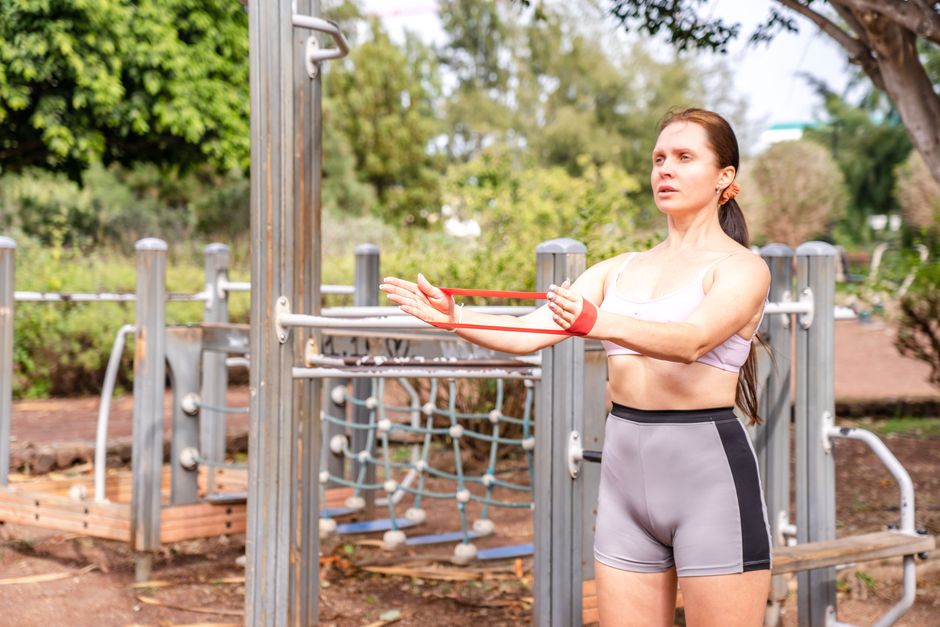
8. Lateral raise
Stand on the band and raise your arms out to the side until your hands reach shoulder height, with a slight bend in the elbows. Lead with your elbows, not your hands. This is the shoulder exercise with a resistance band that does most for width.
9. Front raise
The same as the lateral raise, but lift straight in front of you to shoulder height. If you already bench press or do push-ups, your front shoulders get plenty of work, so keep this one to 2 sets.
10. Overhead press
Stand on the band, start with the handles at shoulder height and press straight overhead. Squeeze your glutes so your lower back doesn't arch.
11. Band pull-apart
Hold a band at shoulder height with straight arms, hands shoulder-width apart. Pull it apart until it touches your chest. This works the rear shoulders and upper back, which most arm workouts skip, and it helps balance out a desk posture.
The 20-minute exercise band arm workout
Warm up with 2 sets of 20 light pull-aparts. Then do the moves below as three supersets. Do A, then B, rest 60 seconds, and repeat for 3 rounds.
| Superset | Exercise | Sets × reps |
|---|---|---|
| 1A | Standing band curl | 3 × 12–15 |
| 1B | Overhead tricep extension | 3 × 12–15 |
| 2A | Hammer curl | 3 × 10–12 |
| 2B | Tricep pushdown | 3 × 12–15 |
| 3A | Lateral raise | 3 × 12–15 |
| 3B | Band pull-apart | 3 × 15–20 |
On your second session of the week, swap in the concentration curl, kickback, front raise or overhead press.
A 4-week plan to keep it getting harder
With dumbbells you just pick up a heavier pair. With bands you have to plan it, or the workout stops working within a month. Change one thing a week:
- Week 1: the routine above, two sessions. Write down which band you used for each move.
- Week 2: same bands, add a 3-second lowering phase to every rep.
- Week 3: shorten the band, widen your stance or step further from the anchor. Add a third session if you're recovering well.
- Week 4: move up a band, or stack two, on any exercise where you got all your reps in week 3.
Then repeat the cycle with the new bands.
When bands aren't the right tool

Skip bands, or add something else, if any of these sounds like you:
- You already curl heavy dumbbells. If you're curling 20kg dumbbells for reps, you'll need to stack most of the set to match it. Our strength training equipment is the cheaper upgrade at that point.
- You want to track exact numbers. A band's tension changes with how far you stretch it, so you can't log "12.5kg" the way you can with a plate.
- Your bands are old, cracked or sticky. Latex perishes, especially in sun. Replace a band with a nick in it before it snaps towards your face. (It always picks your face.)
- You have a fresh elbow or shoulder injury. See a physio first. Bands are often part of rehab, but they should set the tension and the moves.
For loop bands, mini bands and the rest of the range, see our resistance bands collection.
Frequently Asked Questions
Can you build arm muscle with resistance bands?
Yes. A 2019 meta-analysis of 8 studies in SAGE Open Medicine found no difference in upper-body strength gains between elastic bands and dumbbells or machines. Train close to failure and keep making the band harder, and your arms grow.
How often should I do a resistance band arm workout?
Two or three times a week, with at least a day between sessions. The CDC recommends muscle-strengthening activity on at least 2 days a week, and arms recover well on that schedule.
What is the best tricep exercise with a resistance band?
The overhead tricep extension. With your arms overhead, the long head of the triceps works in a stretched position, which most pushing exercises miss. Add pushdowns from a door anchor for the other two heads.
Can a resistance band arm workout get rid of arm fat?
Not on its own. No exercise burns fat from one spot. Band work builds the muscle under the fat, and a calorie deficit removes the fat itself, so you need both for firmer-looking arms.
Related at Flexi Muscles
- Resistance Bands Set
- Resistance bands collection
- Strength training equipment
- More guides on the Flexi Muscles blog