

Home fitness machine guide: Which one to buy, and which to skip
By Flexi Muscles — 2 October 2026 · 20 min read
For most people, the best home fitness machine is a spin bike. It is low impact, quiet, easy to learn and works without a plug point. A water rowing machine is the better pick if you want a full-body session and your back is healthy. A stair climber or rebounder wins when floor space is tight. Strength machines come second, after a cardio habit is already in place.
Shop Cardio Machines at Flexi Muscles
Which home fitness machine to buy first

Buy one cardio machine first. Strength work at home is cheap to start with bands and dumbbells. Cardio is the part people struggle to do at home without a machine, especially in winter, after dark, or when the weather turns.
The table below sums up the main options. Prices are from the Flexi Muscles store at the time of writing. Treadmills and cable stacks are included for comparison, but we don't sell them, so there's no price listed.
| Machine | Best for | Skip it if | Flexi Muscles price |
|---|---|---|---|
| Spin bike | Beginners, bad knees, flats | You want upper-body work | R3,999 |
| Water rowing machine | Full-body cardio in one session | You have lower-back pain | R7,599 |
| Stair climber with handlebar | Glutes, short hard sessions, small rooms | Your knees complain on stairs | R2,399 |
| Rebounder trampoline | Low-impact cardio, folds away | You live above someone who notices | R2,199 |
| Mini elliptical / stepper | Desk workers, gentle daily movement | You want hard intervals | R2,599 |
| Treadmill | Runners training for races | Load shedding hits your area often | Not stocked |
| Cable stack / all-in-one trainer | Strength training with lots of variety | You haven't trained consistently yet | Not stocked |
Here's our one strong opinion on this topic. The best at home workout machine is the one you can ride, row or climb for 150 minutes a week without dreading it. That's the weekly target the World Health Organization sets for moderate activity. For most people starting out, that machine is a bike, not a rower. A rower is harder to learn, harder on a tired back, and easier to skip.
Home cardio machines compared

A home cardio machine does one job: get your heart rate up for long enough, often enough, to matter. The differences between them come down to impact, muscle involvement, noise and storage. Here's how each one stacks up in a normal South African home, not a showroom.
1. Spin bike
A spin bike is the safest first purchase. You sit, you pedal, you turn a resistance knob. There's almost nothing to learn, and you can hold a conversation at an easy pace or go flat out in intervals on the same machine.
It suits people with sore knees or hips because the seat carries your bodyweight. Harvard Health makes the same call for anyone with arthritis in the hips or knees, or with balance problems. The heavy flywheel gives a smoother ride than cheaper upright bikes, which makes longer sessions more pleasant.
Set it up properly before the first ride. Your knee should have a slight bend when the pedal is at its lowest point. A seat set too low loads the front of the knee, and that's the most common reason people say a bike "hurts".
- Good for: beginners, joint problems, intervals, watching a series while training
- Weak spot: almost no upper-body work
- Footprint: roughly the size of a dining chair, and it stays out permanently
Our Indoor Exercise Spin Bike with Device Mount is R3,999. The mount holds a phone or tablet, which matters more than it sounds. A bike you can watch something on gets used far more than one facing a blank wall.
2. Water rowing machine
A rowing machine works your legs, back, core and arms in every stroke. That makes it the closest thing to a full-body home fitness machine on the cardio side. The water resistance also feels natural: the harder you pull, the more the water pushes back.
The catch is technique. A good stroke goes legs, then hips, then arms on the way back, and the reverse on the way forward. Most beginners pull with their arms first and round their lower back, which is how people get hurt. Harvard Health doesn't recommend rowing for beginners, less-fit people, or anyone prone to back pain. We agree.
If your back is healthy and you're willing to spend two or three sessions learning the stroke, a rower gives you more per minute than anything else on this list.
- Good for: full-body conditioning, people who get bored easily on a bike
- Weak spot: technique has to be learned; poor form loads the lower back
- Footprint: long when in use, but most water rowers store upright against a wall
Our Water Rowing Machine for Exercise is R7,599, the most expensive cardio machine we stock. That's the reason to try the two-week test further down before buying one.
3. Stair climber
A stair climber gives you a hard session in very little time. It works the glutes and hamstrings more directly than a bike, and twenty minutes on one feels a lot longer than twenty minutes on anything else.
Compact home stair climbers use hydraulic pistons rather than a motor. They're quiet, need no power, and most are small enough to slide under a bed. The version with a handlebar adds stability, which helps beginners and older users keep their balance when their legs get tired.
- Good for: short, intense sessions, glute work, small rooms
- Weak spot: not ideal for knees that already hurt on real stairs
- Footprint: about the size of a bathroom scale for basic models
We stock the Exercise Stair Climber at R1,999 and the Stair Stepper with Handlebar, a foldable vertical climber, at R2,399. If you've never used one before, pick the handlebar model. Your first few sessions will be wobblier than you expect.
4. Rebounder trampoline
A rebounder is a mini trampoline built for training. The mat and bungee or spring system absorb most of the landing force, so it's far easier on ankles and knees than running. It also folds flat, which no bike or rower does.
It's the most fun option on this list, and that counts for a lot. People keep using equipment they enjoy. The trade-off is intensity: a rebounder is excellent for steady, low-impact cardio, but it won't push a fit person as hard as a rower or climber.
- Good for: low-impact cardio, older users, people who hate traditional cardio
- Weak spot: floor vibration in upstairs flats; lower top-end intensity
- Footprint: about one metre across in use, folds to a fraction of that
Our 40-inch foldable rebounder with safety bar and the 48-inch hexagon rebounder are both R2,199. The bar matters for balance, particularly for beginners and seniors.
5. Mini elliptical and under-desk stepper
A mini elliptical is a pedal unit without the tall frame of a gym elliptical. You can use it standing, seated on a chair, or under a desk while you work. It won't give you a hard workout, and it isn't meant to.
What it does well is add movement to long sitting days. If you work from home and barely leave your chair, an hour of slow pedalling under the desk adds up over a week. Treat it as a movement tool, not a training tool.
- Good for: desk workers, rehab, gentle daily movement
- Weak spot: too easy for real cardio training
- Footprint: fits under a desk
Our Exercise Stepper and Mini Elliptical Machine is R2,599 and the Under Desk Exercise Stepper is R2,799. For a tighter budget, the Exercise Stepper with Resistance Bands is R899, and the Exercise Stepper and Abs Cruncher combination is R1,499.
6. Treadmill
A treadmill makes sense for one group of people: runners who need to train on foot for races and can't run outside safely. If that's you, a treadmill is the right machine and nothing else on this list replaces it.
For everyone else, it's usually the wrong buy. Treadmills are heavy, loud on upstairs floors, need a plug point, and Harvard Health suggests looking at a 3-horsepower motor if you plan to run rather than walk. They're also the machine most likely to end up holding laundry. We don't stock treadmills, so if you need one, buy it from a specialist with local servicing.
7. Full-size elliptical
A full-size elliptical works arms and legs together and keeps your feet on the pedals the whole time. Harvard Health points to it as a good choice for people concerned about bone density, because it's weight-bearing without the pounding of running. The downside is size: a proper elliptical is as long as a treadmill and much taller than a bike. We don't stock full-size ellipticals either.
Strength machines for a home gym
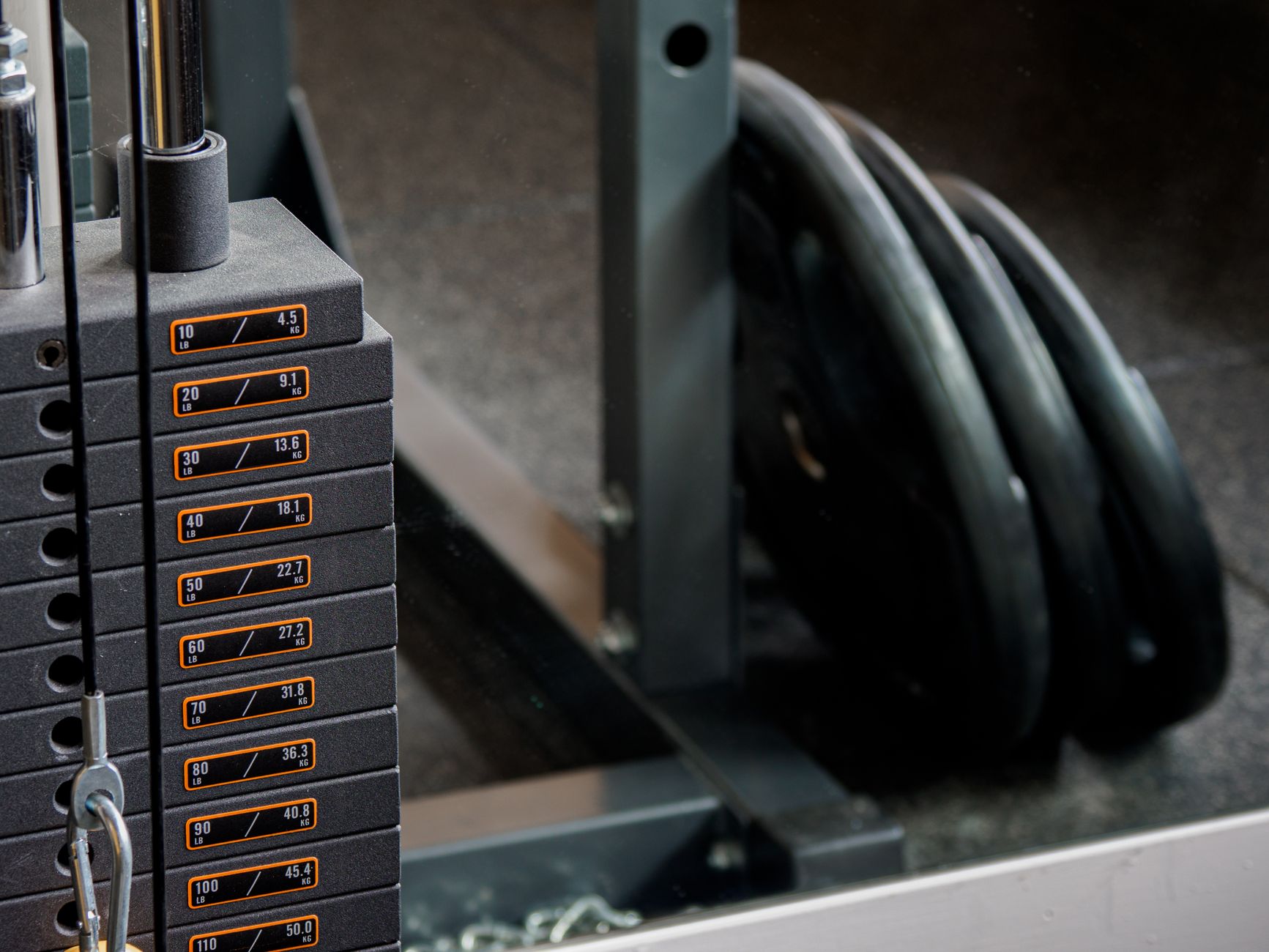
Most "best home gym" lists online are really lists of strength machines: cable towers, Smith machines and all-in-one trainers. They're good machines. They're also big, expensive, and easy to buy before you know which exercises you'll actually do. Here's what each type does and who it suits.
Functional trainers and cable stacks
A functional trainer is two adjustable cable columns with weight stacks. You can row, press, curl, do tricep pushdowns, face pulls and glute kickbacks, all from one frame. For variety, nothing beats it.
It needs a lot of space, a solid floor, and usually a two-person assembly job. It's a machine for people who have trained consistently for a year or more and know they want cable work specifically. We don't sell cable machines, but we do stock attachments for them: the Lat Bar at R949, the Double D Row Handle at R699, the Triceps Pushdown Bar at R499 and Ankle Straps at R299.
Smith machines
A Smith machine runs a barbell along fixed rails. The rails make it easier to rack the bar safely without a spotter, which is the main appeal for home lifters training alone. The trade-off is that the fixed path doesn't match how your body naturally moves through a squat or press. Many lifters prefer a squat rack with safety bars for that reason.
All-in-one trainers and stack home gyms
These combine a power rack, cable pulleys, a pull-up bar and sometimes a Smith bar in one footprint. They cover nearly everything a commercial gym does. They also cost as much as a decent used car at the top end, and they're the hardest piece of equipment to sell on if you stop using it.
Smart strength machines
Wall-mounted smart trainers use motors instead of weight plates and coach you through a screen. They're compact and clever. They also need constant power and Wi-Fi, which is a real problem in South Africa. A strength machine that switches off during load shedding is a strange thing to build a routine around.
The bench-and-rack route
For most home lifters, a weight bench, barbell and plates do the job of a machine for a fraction of the cost and space. Our Weight Lifting Bench with Barbell Rack is R1,999. The Adjustable Incline/Decline Gym Weight Bench is R3,999 and adds incline and decline pressing. Pair either with resistance bands and you cover pushing, pulling and leg work without a cable in sight.
Single-purpose machines
Ab crunchers and similar single-muscle machines have a place, but a small one. Our Abdominal Cruncher Machine is R1,799. It's useful if you find floor crunches hard on your neck, or if you want a guided movement while you learn to brace properly. If you're happy doing core work on the floor, you don't need it.
What a home fitness machine does better than a gym
A home machine removes the steps between deciding to train and training. No drive, no parking, no waiting for a bike, no packing a bag. That sounds minor until you count it up: a 20-minute session at home takes 20 minutes, while the same session at a gym often takes an hour door to door.
The other benefits follow from that:
- Training fits around real life. You can ride for 15 minutes while dinner cooks, or row before the school run. Short sessions add up to the weekly target just as well as long ones.
- Weather stops being an excuse. Highveld winter mornings, Cape Town rain and summer heat all stay outside.
- Safety after dark. Plenty of people stop running or cycling outdoors in winter because of early sunsets. A home machine keeps cardio going all year.
- The cost evens out. A machine is a once-off cost against a monthly membership. If it replaces sessions you'd otherwise miss, it pays for itself in usage, not just rands.
- No audience. Beginners who feel self-conscious in a gym often train more consistently at home, at least until they've built some confidence.
What a home machine doesn't give you is coaching, variety, or the push of training around other people. If those are what keep you going, a gym membership may be the better spend.
How to choose the best exercise machine for home use
Choosing the best exercise machine for home use comes down to five questions, asked in this order. Answer them honestly and the list narrows to one or two machines quickly.
1. What do your joints allow?
Start here, because joint pain is the fastest way to stop using any machine. Bad knees or hips point to a bike. A sore lower back rules out a rower until it's sorted. Weak ankles or balance problems point to a bike or a rebounder with a bar. If nothing hurts, everything is on the table.
2. What's the goal?
Weight loss and general fitness: any machine you'll use 150 minutes a week. Full-body conditioning: a rower. Leg and glute strength alongside cardio: a stair climber. Running performance: a treadmill. Muscle building: free weights and a bench first, a cable machine later.
3. How much space is there, really?
Measure the space before you shop. Then add clearance: about 60 cm behind a rower, enough ceiling height to stand tall on a stepper, and a clear metre around a rebounder. Machines always look smaller in product photos than they do in a spare bedroom.
4. Who's below you, and who's asleep?
Noise and vibration decide a lot in flats and townhouses. Bikes and hydraulic steppers are quiet. Water rowers make a gentle swoosh. Rebounders are quiet in the air but send some vibration through the floor. Treadmills are the loudest by a distance. If you train at 5 am, this question might matter more than any other.
5. What's the budget, including what comes after?
Budget for the machine plus a mat, and leave room for a replacement part or two over the years. A cheap frame that wobbles gets abandoned. An expensive machine you're not sure about is a bigger risk than a mid-priced one you know you'll use.
Exercise machines for small spaces

An exercise machine for small spaces either folds, stores upright, or is small enough to live under furniture. Here's how to match the machine to the room you actually have.
Studio flat or bedroom corner
Pick something that disappears completely between sessions. A foldable rebounder, a compact stair climber or an under-desk elliptical all fit the bill. Add resistance bands for strength and you have a complete home setup that fits in one cupboard.
Spare room
A spare room can hold one permanent cardio machine plus a bench. A spin bike in one corner and a weight bench in the other is a setup that covers cardio and strength without the room feeling like a storage unit. A water rower also works here, stored upright when not in use.
Garage
A garage is the only space in most homes that suits a squat rack, a full cable machine or a treadmill. Check the floor first: a cracked or uneven slab will make any heavy machine rock. Rubber flooring under the machine protects both the floor and the equipment.
Garages near the coast bring one extra issue: humidity. Steel frames, chains and bolts rust faster in coastal air. Wipe the machine down after sweaty sessions and keep it off bare concrete if you can.
Storage makes the space work
Small rooms fill up with loose kit faster than with machines. Bands, mats, weights and attachments scattered around the floor make a room feel smaller and make you less likely to train in it. Our Multi-Purpose Home Gym Equipment Storage Rack at R2,599 keeps all of that in one upright unit.
Machines that keep working during load shedding
Almost every international buying guide skips this, because it isn't a problem in the US or UK. In South Africa, it's a real factor. A home fitness machine that needs mains power is useless during an outage, and outages often fall in the early-morning and evening slots when most people train.
Here's how the main machine types compare:
- No power needed: water rowing machines, hydraulic stair climbers, mini steppers, rebounders, benches and racks.
- Battery display only: most magnetic and friction spin bikes. The resistance works without power; only the small screen uses batteries. Check the product listing to confirm.
- Needs mains power: treadmills, motorised smart trainers, and some high-end bikes with powered screens or electronic resistance.
If your area sees regular outages, lean towards the first two groups. A treadmill can still make sense, but plan your sessions around the schedule rather than discovering the problem in your running shoes.
There's a second load-shedding issue that people miss: surges. When power returns after an outage, voltage spikes can damage electronics. Any machine with a motor or a powered console should go through a surge protector plug.
The two-week test before you buy
The biggest risk with a home fitness machine isn't buying the wrong brand. It's buying the right machine and then not using it. A rowing machine stored upright against a wall looks rather like modern art, and gets admired about as often.
Before spending, run a simple two-week test:
- Pick three time slots a week that you can genuinely keep. Write them down.
- Do 20 minutes of the closest free equivalent in each slot. Brisk walking or stair repeats for a stair climber. A bodyweight circuit for a rower. Brisk walking or a gym-day bike session for a spin bike.
- Count the sessions you actually did. Six out of six means you're ready. Four or five means buy the cheaper, simpler machine first. Fewer than four means the problem is the schedule, not the equipment.
If you have access to a gym, even for a week, try the machine you're considering there. Ten minutes on a commercial rower or stepper tells you more than any review, including this one.
Accessories that keep a machine in use
Small things decide whether a machine gets used or avoided. None of these are expensive, and most fix a specific annoyance that would otherwise turn into an excuse.
- A rubber mat under any cardio machine cuts vibration, protects tiles and wooden floors, and stops the machine creeping across the room during hard intervals.
- A device mount or stand so you can watch something. This is the single most effective way to make a bike or stepper session feel shorter.
- A fan. Indoor cardio gets hot fast, and overheating ends more sessions early than tired legs do.
- Resistance bands to add strength work to a cardio machine session. Five minutes of banded rows and squats after a ride turns a cardio session into a full workout.
- Gloves for rowing, which can blister hands in the first few weeks until your grip toughens up.
- Replacement parts. Rebounder springs and bungees wear out over time. We stock Trampoline Replacement Springs at R359 for a pack of 10.
Setting up and looking after your machine
Most home machine problems start on day one, with a rushed assembly. Take your time with the build, and the machine will run quietly for years.
- Assemble on the floor where it will live. Moving a fully built rower or bike through a doorway is harder than it looks.
- Tighten every bolt twice. Once during assembly, and again after the first week of use. Bolts settle, and a small wobble becomes a loud creak quickly.
- Level it. Most bikes and rowers have adjustable feet. A machine that rocks on an uneven floor wears its frame and annoys you every session.
- Wipe it down after sweaty sessions. Sweat is salty, and salt corrodes steel. This matters more at the coast.
- Check moving parts monthly. Spin bike pedals and straps, rower seat rollers, stepper pistons, rebounder springs or bungees. Replace worn parts before they fail, not after.
- Treat the water in a water rower. Most come with purification tablets. Add one every few months to keep the tank clear.
Ten minutes of care a month costs far less than a replacement machine, and it keeps the machine pleasant to use, which is what keeps it in use.
When not to buy a home fitness machine
We'd rather you didn't buy a machine from us than buy one that ends up as furniture. Skip it, for now, in these situations:
- You're not training at all yet. Start with walking and a resistance band set. A machine won't create a habit; it rewards one that already exists.
- You have an injury or a heart condition. Speak to your doctor or a physio first. They may point you to a specific machine, or rule one out.
- You need a treadmill or a cable stack. We don't sell either. Buy from a specialist who can service the motor or pulleys locally.
- You're moving house in the next few months. Heavy machines are a pain to move. Wait until you know which room it will live in.
- You already have a gym membership you use. A home machine only adds value if it replaces trips you're missing, not ones you're already making.
If none of those apply, pick the machine that matches your joints and your space, set it up where you can see it, and book the first three sessions in your calendar before it arrives.
Frequently Asked Questions
What is the best home fitness machine for beginners?
A stationary or spin bike. It is seated, low impact, easy to learn in one session, and quiet enough for a flat. Most beginners can ride for 20 minutes on day one, which is not true of a rowing machine or a stair climber.
Which home exercise machine burns the most calories?
Rowing machines and stair climbers tend to burn the most per minute because they load large muscle groups at once. In practice, the machine that burns the most is the one you use for the most minutes each week, so pick for consistency before calorie numbers.
Is a rowing machine or an exercise bike better for home use?
A rower works more muscle and suits people with healthy backs who want a full-body session. A bike is easier to learn, easier on the lower back, and better for anyone with hip or knee arthritis. Beginners and people with back pain should start on the bike.
What exercise machine is best for small spaces?
A foldable rebounder, a compact stair stepper or an under-desk elliptical. All three store in a cupboard or under a bed. A water rower also stores upright against a wall, which takes far less floor space than its length suggests.
Can I get a full-body workout from one home machine?
A rowing machine comes closest on the cardio side, and a cable stack or all-in-one trainer comes closest on the strength side. No single machine covers both well, which is why most home gyms pair one cardio machine with resistance bands or dumbbells.
Do home exercise machines need electricity?
Treadmills and most smart trainers do. Water rowers, hydraulic stair steppers, rebounders and most magnetic or friction spin bikes do not, apart from a small battery-powered display. That matters during load shedding.
How much should I spend on a home fitness machine?
Enough to get a stable frame and a smooth resistance system, and no more until you have used the machine three times a week for a couple of months. At Flexi Muscles that ranges from R1,999 for a stair climber to R7,599 for a water rowing machine.
Related at Flexi Muscles
- Shop spin bikes, rowers and stair climbers
- Shop rebounder trampolines
- Shop benches, racks and strength equipment
- Shop resistance bands
- Shop gloves, cable attachments and accessories