

Gymnastic Rings Workout: The Complete Beginner Guide

article id="top">
By Flexi Muscles — 1 July 2026 · 11 min read
Gymnastic rings build upper-body strength better than most gym machines — not because they are harder, but because the instability forces every stabiliser muscle to switch on simultaneously. A gymnastic rings workout is compound by default: chest, shoulders, triceps and core all work together because the rings give them no choice. One pair of wooden rings costs less than a single month at a commercial gym, fits in a bag, and delivers a training stimulus that takes most people years to outgrow.
Shop Gymnastic Rings at Flexi Muscles
Why gymnastic rings build strength faster than you expect

The instability is the point. When you press or pull on a fixed bar, the bar does not move. Your body accommodates itself to a fixed position. On rings, the rings accommodate nothing — your muscles have to find and maintain position entirely on their own.
Studies on instability training show that ring push-ups activate roughly 15–20% more chest and shoulder muscle than a standard push-up. That is not a marginal difference. It is the reason athletes who switch from fixed-bar training to rings often report feeling muscle groups they did not know were under-recruited.
The second reason rings accelerate strength gain is range of motion. Ring dips allow a deeper range than parallel bars, which means more muscle recruited across the full movement. The third reason is the wrist-neutral grip. Rings rotate freely, which allows your wrists and elbows to settle into a comfortable angle throughout every rep. For anyone with shoulder or elbow sensitivity, rings frequently feel better than a locked barbell grip, not worse.
A pair of wooden rings costs around R450–R600. That is a once-off cost. The cable machine they replace costs fifteen times more and trains your muscles in a single plane only. Gymnastic rings are the most cost-effective upper-body strength tool available — and that is not an opinion that needs defending with adjectives.
What to look for when buying gymnastic rings
Material
Wooden rings are the standard for a reason. They provide grip, absorb sweat, and feel better under the hand than plastic. Plastic rings work, but your hands will begin to slide once a session runs past 20 minutes. If you train outdoors in high humidity, wood is the correct choice every time.
Ring diameter
Standard ring inner diameter is 28mm. Competition rings are 32mm. For beginners, 28mm is easier to grip and works for all standard movements. The 32mm option suits people with larger hands or those progressing toward muscle-up training at competition level.
Strap length and markings
You need at least 4.5 metres of strap per ring. More is better — you can shorten a long strap instantly; you cannot lengthen a short one. Look for numbered markings on the straps. Setting both rings to the same height without numbered markings wastes two to three minutes every session. Over a year of training, that adds up.
Weight capacity
Most quality rings are rated to at least 150kg. If you plan to add a weight belt for weighted ring dips or pull-ups, check that the buckle hardware is rated accordingly. A soft buckle rated to bodyweight only will not hold under additional load from a chain belt.
How to set up gymnastic rings at home
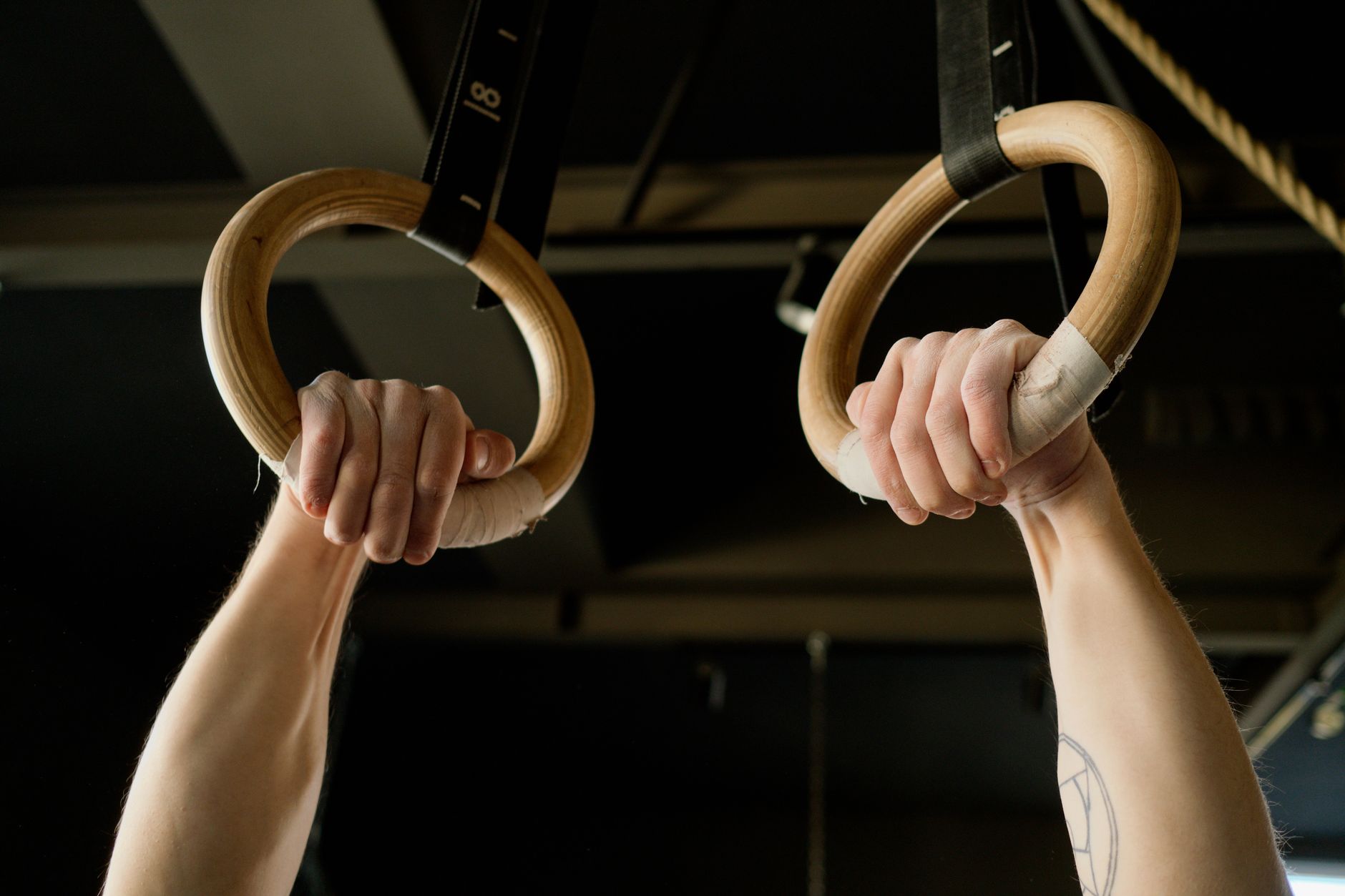
Hang rings from a pull-up bar, a ceiling beam, a strong door-frame bar, or a tree branch. The anchor point must handle at minimum 200kg — your body weight plus the impact load generated by dynamic movements. If you are uncertain, test the anchor by hanging your full body weight and performing several kipping swings before adding any exercise load.
Height guidelines:
- Rings at hip height — ring rows and horizontal pulling
- Rings at shoulder height — ring dips and ring push-ups
- Rings overhead at full arm extension — hanging, ring pull-ups, and skin the cat
Thread the strap through the buckle, pull it tight, and load-test before every session. A loose buckle is the only real hazard in ring training, and it takes three seconds to check. Keep both rings level — this is where numbered straps earn their cost immediately.
The grip technique you need before your first exercise
Before you attempt a single exercise, learn two hand positions. The wobble is not a bug. It is, unfortunately for your ego, the feature — and how you grip the rings determines whether you work with that instability or against it.
Overhand grip (pronated)
Palms facing away from you. This is the standard pull-up grip. Used for ring rows and ring pull-ups. Most beginners default to this correctly without instruction.
False grip
Your wrist sits in contact with the ring rather than just your fingers and palm. Your wrist is on top of the ring, not below it. It looks unusual and feels uncomfortable initially. False grip is mandatory for muscle-up progressions and useful for ring dips because it shortens the lever your wrist must control.
Practice false grip in a ring hang for 10–15 seconds at a time. Build to 30 consecutive seconds before attempting ring pull-ups with it. Most beginners can achieve a solid false grip hang within two weeks of regular practice.
8 gymnastic rings exercises for beginners

These eight exercises cover the full movement patterns available on rings. Work through them in order. Do not skip the support hold to get to dips — the support hold is what makes the dips safe and productive.
1. Ring hang
Grip the rings overhead, arms extended, and hang. Do not swing or go passive. Keep your lats engaged and your shoulders active — this is not passive hanging from a bar. Start: 3 sets of 20–30 seconds. This builds grip strength and teaches active shoulder position.
2. Ring support hold
Press down on the rings, lock your arms out, and hold your body vertical with legs together. This is the foundation position for every advanced ring skill. Shoulders pressed back and down, arms locked, core tight. Start: 3 sets of 10–20 second holds. When you can hold 30 seconds without shaking, you are ready for ring dips.
3. Ring rows
Set rings at hip height. Hang below them with feet on the floor and body in a plank position. Pull your chest to the rings, keeping elbows close to your sides. Walk your feet forward to increase the angle and the difficulty. Feet elevated on a box is the hardest variation. Start: 3 sets of 8–12 reps. This is the primary horizontal pulling exercise on rings and one of the best gymnastic rings exercises for beginners.
4. Ring push-up
Set rings 15–20cm off the ground. Perform a push-up. The rings will want to flare outward — resist this throughout the movement. Rotate them inward as you reach the top of each rep. Start: 3 sets of 5–10 reps. Ring push-ups activate significantly more chest and shoulder muscle than floor push-ups due to the instability and rotation.
5. Assisted ring dip
Loop a resistance band through the rings and place your knees in the band. This reduces the load while you learn the movement pattern. Lower to 90 degrees at the elbow, then press back up. Keep your torso upright — leaning forward shifts the emphasis to chest rather than triceps, and the rings will punish an inconsistent torso angle. Start: 3 sets of 6–10 reps.
6. Ring face pull
Stand facing the rings with arms extended. Pull both rings to face level while externally rotating your shoulders — elbows flare wide and back. This is one of the most underrated shoulder health exercises available on rings and deserves a place in every calisthenics ring workout. Start: 3 sets of 12–15 reps.
7. Tuck L-sit
In the support position, draw your knees to your chest and hold them there. This trains the core, hip flexors, and the ability to maintain ring support under additional challenge. Start: 3 sets of 5–10 second holds. Progress to a full L-sit when you can hold the tuck version for 20 seconds without the support hold breaking.
8. Skin the cat
Hang from the rings. Pull your legs up and through the rings behind you until you feel a deep stretch through the shoulders and chest. Reverse slowly and with control. This is an advanced beginner to intermediate movement — attempt it only once the ring hang is solid. Start: 3 sets of 3–5 controlled reps. The skin the cat is one of the most effective shoulder mobility exercises in gymnastics training.
A beginner routine and training frequency
Three days per week on non-consecutive days is the correct training frequency for beginners. Ring training stresses the stabiliser muscles heavily, and those muscles recover more slowly than primary movers. Monday, Wednesday, and Friday works well. Tuesday, Thursday, and Saturday also works. Daily ring training for beginners leads to shoulder fatigue within two weeks — not progress.
Beginner gymnastic rings home workout — 3 days per week
| Exercise | Sets | Reps / Hold |
|---|---|---|
| Ring hang | 3 | 30 seconds |
| Ring support hold | 3 | 15–20 seconds |
| Ring rows | 3 | 8–10 reps |
| Ring push-up | 3 | 5–8 reps |
| Assisted ring dip | 3 | 6–8 reps |
| Ring face pull | 3 | 12–15 reps |
| Tuck L-sit | 3 | 10 seconds |
Rest 60–90 seconds between sets. Total session time is 30–40 minutes. Do not add sets or exercises until every rep in the table is controlled and quiet — ring wobble during a set means you are at your current limit. Stay there until it disappears, then progress.
Most beginners see measurable strength improvement within four weeks at this frequency. The ring support hold is usually the first exercise to break through — when 30 seconds feels stable, the rest of the routine accelerates quickly.
Who should not start with gymnastic rings
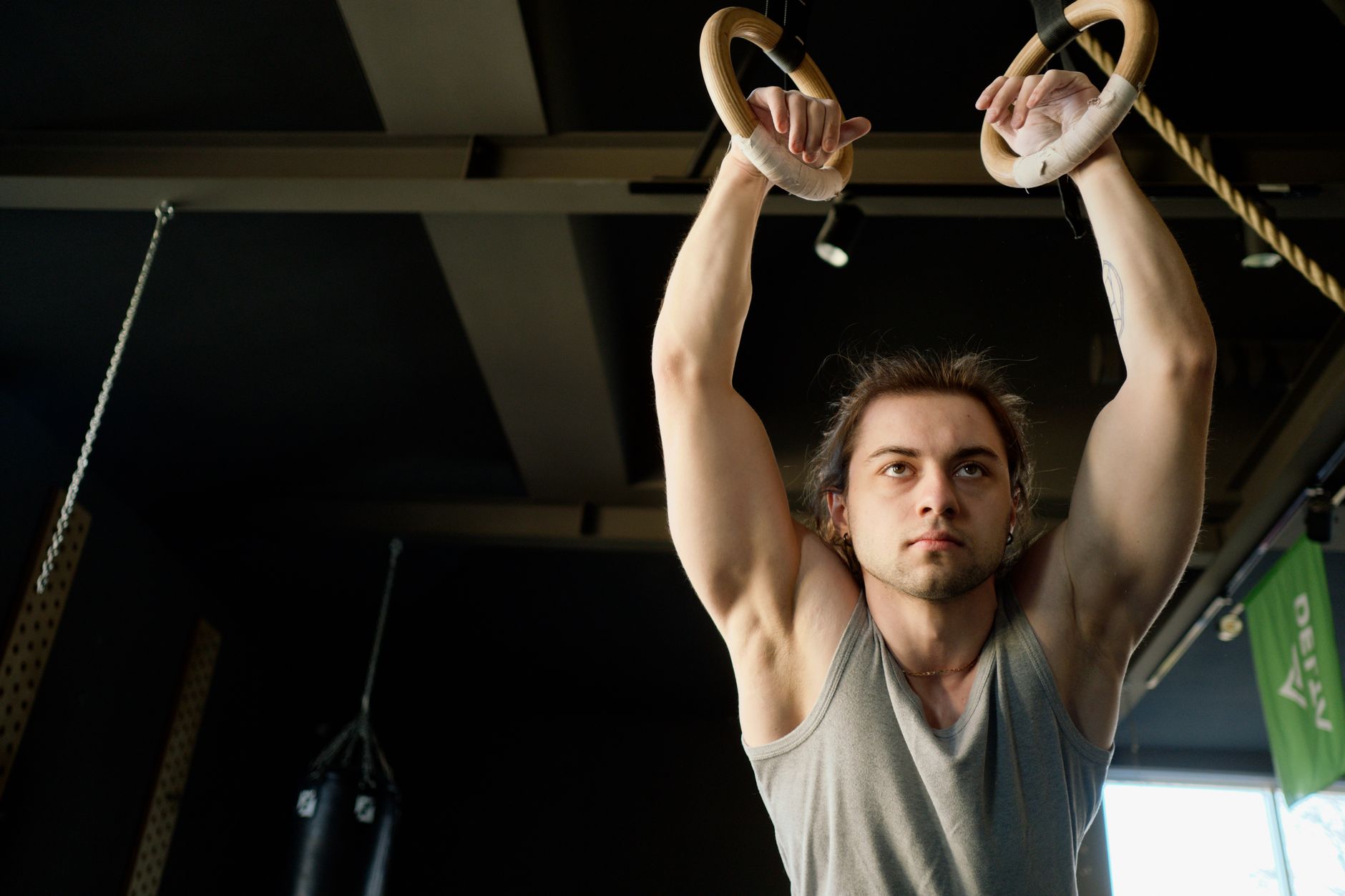
Rings are not the right starting point for everyone, and the honest answer is worth more than a sale.
If you cannot perform a single controlled push-up — chest to the floor, plank body position throughout — start on the floor. Return to rings in four to six weeks once you have 3 sets of 10 floor push-ups without form breakdown.
If you have an active shoulder injury or unstable shoulder joint — rings will aggravate it. The instability that builds strength in a healthy shoulder adds uncontrolled load to an injured one. Fixed bars, cables, and machines are safer while you recover. This is not a workaround you can manage around; it is a reason to wait.
If you are looking for a session under 20 minutes — rings are not a fast workout tool at beginner level. The support hold, the recovery between sets, and the attention each exercise demands means a beginner gymnastic rings workout takes 30–45 minutes to do correctly. A resistance band circuit or a dumbbell AMRAP will serve a short session better.
If you train outdoors without cover — wooden rings become slippery when wet. Chalk helps, but rain mid-session is a genuine problem. Keep a chalk block in your gym bag and check the forecast, or plan for shorter outdoor sessions on unpredictable days.
Frequently Asked Questions
Are gymnastic rings good for beginners?
Yes, if you start with the correct exercises. Ring rows, ring push-ups, and the support hold are accessible to most beginners and scale in difficulty as strength builds. The common mistake is attempting ring dips or pull-ups too early. Build the support hold first, then progress to the rest of the routine.
How often should I train with gymnastic rings?
Three times per week on non-consecutive days is the right frequency for beginners. Ring training places a heavy demand on stabiliser muscles, which recover more slowly than primary movers. Daily ring training for beginners typically produces shoulder fatigue within two weeks rather than strength gains.
Can gymnastic rings replace weight training?
For upper body, largely yes. Rings develop pressing strength through dips and push-ups, pulling strength through rows and pull-ups, and shoulder health through face pulls and skin the cat. They do not replace squats, deadlifts, or lower body barbell work. Use rings alongside lower body training, not instead of all gym work.
How high should gymnastic rings be hung?
An anchor point between 2.2m and 2.5m from the ground covers all standard exercises for adults of average height. Rings need to be adjustable between hip height for rows and full overhead reach for pull-ups and hangs. Numbered straps make height adjustment quick enough that you can change it between exercises without losing the session's momentum.
What muscles do gymnastic rings work?
Ring pushing exercises — push-ups and dips — primarily target the chest, shoulders, and triceps. Ring pulling exercises — rows and pull-ups — target the lats, rhomboids, biceps, and rear deltoids. The core and stabiliser muscles work in every ring exercise because the instability demands constant correction. This is what separates ring training from fixed-bar work.
Related at Flexi Muscles
- Strength Training Equipment — rings, pull-up bars, and home gym kit
- Resistance Bands — for assisted ring dips and warm-up work
- Lifting Accessories — chalk, straps, and grip support