

Fitness at Home Exercises: A Complete Beginner's Routine

By Flexi Muscles — 30 August 2026 · 11 min read
Fitness at home exercises means training with your bodyweight and floor space instead of a gym membership or equipment. Twelve moves — four cardio, four upper and lower body, and four core — cover every major muscle group and your heart rate in one session. What actually determines whether it works long-term is not the exercise list, though. It is whether you structure sessions consistently across the week, which most guides skip in favour of just listing more moves.
Shop Resistance Bands at Flexi Muscles
Why home fitness works
A home fitness routine removes the two biggest reasons people fall off a training plan: the commute to a gym and the cost of a membership. If a session takes twenty minutes in your own living room instead of an hour once travel and changing are factored in, you are considerably more likely to actually do it on a busy week.
It also holds up against the assumption that a home fitness routine is a lesser substitute for a gym programme. Bodyweight training builds real strength and improves body composition when the exercises are progressed properly — the same principles that make a barbell programme work apply here, just with your own mass as the load instead of a bar. What changes is the ceiling, not the starting effectiveness, and that ceiling is high enough for most beginner and intermediate goals.
How to structure a home workout session
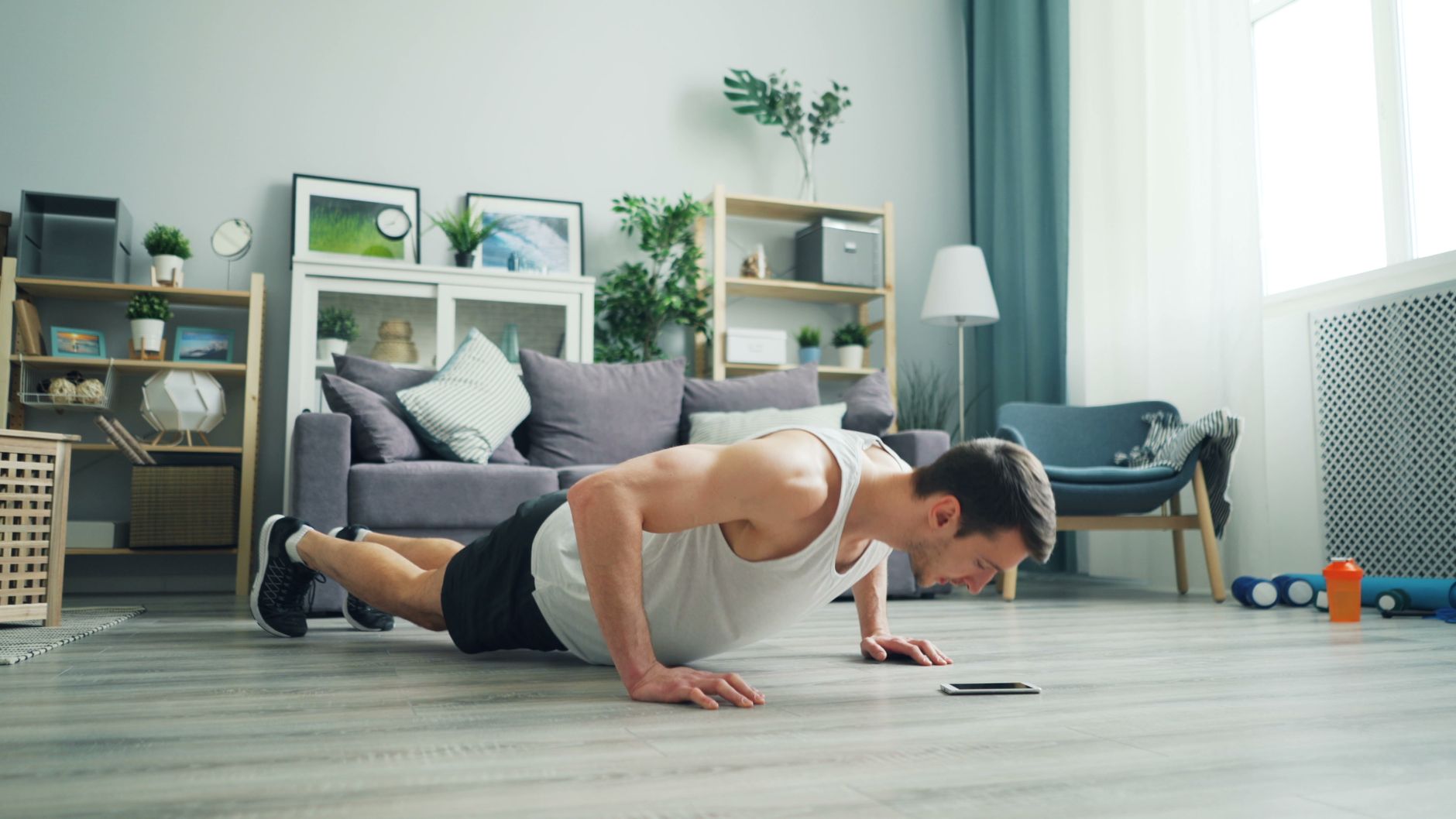
A workout for home without equipment still benefits from the same three-part structure a gym session uses, just compressed into less time.
Warm-up (3–5 minutes)
Light movement — marching on the spot, arm circles, hip openers — raises your heart rate gradually and gets joints moving before load goes through them. Skipping this step is the fastest way to turn a beginner session into a strained lower back.
Main workout (15–20 minutes)
This is where the twelve exercises below come in, arranged into a circuit or split by muscle group depending on the day. Fifteen to twenty minutes of focused work is enough volume for a beginner or intermediate session.
Cooldown (3–5 minutes)
A few minutes of static stretching for the muscles you just worked reduces next-day stiffness and gives your heart rate time to come back down before you stop moving entirely.
What you actually need
Nothing beyond a clear patch of floor roughly two metres by two metres and clothing you can move in. A yoga mat makes floor-based exercises more comfortable on hard flooring, and a sturdy chair or step is useful for tricep dips, but neither is essential to get started. Save any equipment spending for after you have a few weeks of consistent training behind you, once you know which movements you actually enjoy doing.
A weekly home fitness schedule
Most home workout without equipment guides stop at a single session and leave you to work out the rest of the week on your own. Here is a straightforward beginner home workout routine covering a full week:
| Day | Focus |
|---|---|
| Monday | Full body circuit (sample workout below) |
| Tuesday | Rest or light walking |
| Wednesday | Full body circuit |
| Thursday | Rest or light walking |
| Friday | Full body circuit |
| Saturday – Sunday | Rest, or a longer walk or light activity |
Repeating the same full-body circuit three times a week, rather than splitting muscle groups across separate days, works better for beginners because each movement pattern gets practised more often while you are still learning proper form. Once the six moves in the sample workout below feel manageable for two full rounds, swap one or two exercises per session for a different move from the same category to keep the routine progressing.
Twelve fitness at home exercises

Cardio
- Jumping jacks — raises heart rate quickly with no learning curve. Land softly through the balls of your feet to keep the impact off your knees.
- High knees — drive knees up toward chest height at a fast pace, pumping the arms in opposition. Keep the torso upright rather than leaning back.
- Mountain climbers — from a plank, drive knees toward the chest alternately at speed. Keep the hips low and level rather than piking upward as fatigue sets in.
- Stair climbing — if you have stairs at home, two to three minutes of continuous climbing works as well as any cardio machine. Use the full step, not just the toes, for a safer landing each time.
Upper body
- Push-ups — on knees for beginners, full plank once that feels controlled for the full set. Keep elbows at roughly 45 degrees from the torso rather than flared out to the sides.
- Tricep dips — hands on a chair or step, legs extended, lower until elbows reach about 90 degrees and press back up. Keep the hips close to the chair rather than drifting forward.
- Plank shoulder taps — from a plank, tap the opposite shoulder with each hand without rotating the hips. Widening your foot stance slightly makes it easier to resist the rotation while you build control.
Lower body
- Bodyweight squats — feet shoulder-width, sit back as if lowering into a chair, keeping weight through the heels. Go as low as you can while keeping your lower back flat.
- Reverse lunges — step back into a lunge rather than forward, which is gentler on the knees. Lower until the back knee is just above the floor, then drive through the front heel to stand.
- Glute bridges — lying on your back, knees bent, drive hips upward by squeezing the glutes rather than arching the lower back. Pause briefly at the top before lowering.
Core
- Plank — hold a straight line from shoulders to heels, forearms or hands on the floor. Squeeze the glutes and brace the abs as if bracing for a light punch to the stomach.
- Bicycle crunch — alternate elbow to opposite knee in a controlled cycling motion. Slow the tempo down if you feel the movement mostly in your neck rather than your abs.
Rotate two or three exercises per category across your three weekly sessions rather than doing all twelve every time — that keeps each session inside the fifteen to twenty minute window.
Sample 20-minute home workout
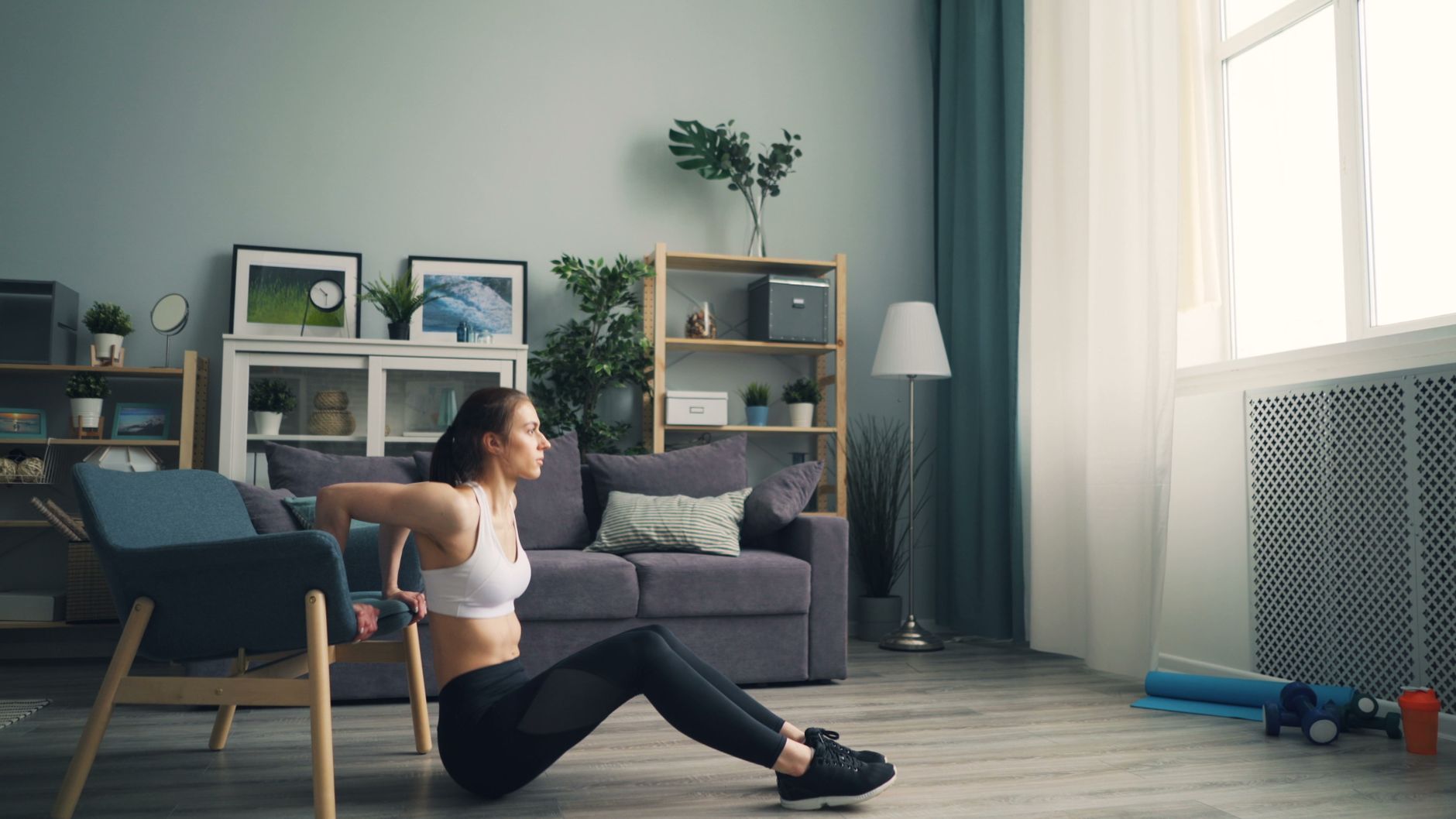
This is the circuit referenced in the weekly schedule above. Complete each exercise for 40 seconds, rest 20 seconds, then move to the next. Repeat the full circuit twice.
- Jumping jacks — 40 seconds
- Push-ups — 40 seconds
- Bodyweight squats — 40 seconds
- Plank — 40 seconds
- Reverse lunges — 40 seconds
- Mountain climbers — 40 seconds
Two rounds of this six-move circuit runs close to twenty minutes once you include the rest periods, warm-up, and cooldown. Beginners should feel worked by the end, not wrecked — if you cannot hold form through the last thirty seconds of a round, drop to a modified version of that exercise rather than pushing through with poor technique.
How to progress without adding weight
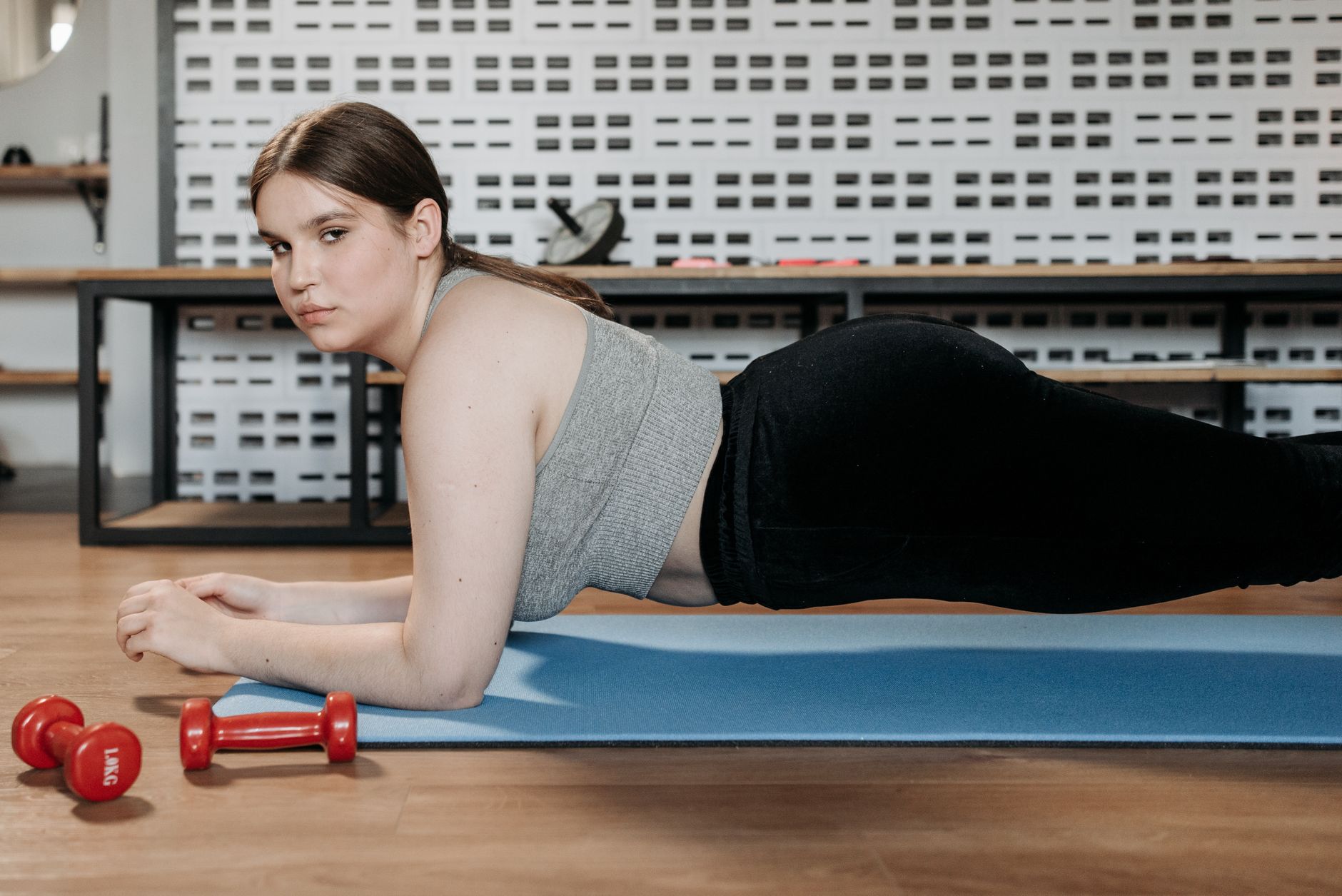
Without added resistance, four levers still drive progress:
- Slow the tempo — a three-second lowering phase on a push-up or squat increases time under tension without changing the exercise.
- Add reps or rounds — before making a move harder, see if you can complete more of the current version with good form.
- Move to single-limb variations — a single-leg glute bridge or one-arm-assisted push-up demands considerably more from each side than the two-limb version.
- Shorten rest periods — dropping from 20 seconds of rest to 10 between exercises increases the cardiovascular demand of the same circuit.
Work through these four levers roughly in order. Slowing the tempo and adding reps cost nothing and fit inside the same twenty-minute session, so exhaust those first before reaching for single-limb variations, which demand more balance and coordination on top of raw effort. Once you have exhausted all four for a given exercise, that is the point where added resistance starts producing results bodyweight alone cannot.
Common mistakes
Straight up: most beginner home workouts fail for the same handful of reasons.
- Skipping the warm-up — going straight into squats or push-ups cold increases injury risk for very little time saved.
- Jumping to advanced variations too soon — a full push-up with poor form trains bad movement patterns faster than a knee push-up with good form builds strength.
- Training every day with no rest — muscles adapt during recovery, not during the workout itself. Daily sessions with no rest day slow progress rather than speeding it up, and the fatigue tends to erode form on exactly the exercises where form matters most.
- Chasing more exercises instead of better ones — twelve exercises done with control beats thirty done sloppily.
- Comparing your first week to someone else's tenth — social media fitness content usually shows an advanced version of a movement. Progress from where your body actually is, not from where a video makes it look normal to start.
When you need more than bodyweight
A no equipment home workout is a genuinely complete starting point, not a compromise. That said, it is worth being upfront about where it runs out of runway.
Your goal is visible muscle growth
Building noticeable muscle mass generally requires progressively increasing load over months, and bodyweight variations have a ceiling — there are only so many ways to make a push-up harder. A resistance band or a pair of adjustable dumbbells extends that ceiling considerably.
You are training for a specific sport or event
Sport-specific strength and power work often needs external load or specific equipment — a rower for endurance athletes, a kettlebell for explosive hip power — that bodyweight training alone cannot replicate closely enough.
Your time is genuinely limited
Loaded exercises tend to fatigue muscle in fewer reps than bodyweight equivalents, which means a fifteen-minute session with a band or dumbbells can match the muscular demand of a longer bodyweight-only circuit. If time is your constraint rather than space or budget, a small amount of equipment closes that gap fast.
An exercise has become too easy in every variation
Some movements run out of harder bodyweight progressions faster than others. A single-leg glute bridge is close to the ceiling of what that exercise can offer without external load, whereas a push-up has more room to progress through decline and single-arm-assisted versions first. When you hit that ceiling on a specific exercise, adding light resistance to just that movement is a more targeted fix than overhauling the whole routine.
Browse resistance bands at Flexi Muscles for the simplest, most portable way to add load to any exercise in this guide.
Frequently Asked Questions
How long should a home workout be for a beginner?
Fifteen to twenty minutes is enough for a beginner session, including warm-up and cooldown. A shorter, consistent routine you actually complete three times a week beats a longer one you skip after the second week.
How many days a week should I work out at home?
Three sessions a week with a rest or light-mobility day between each is a sustainable starting point. It gives muscles time to recover while building the habit enough that missing a day does not derail the whole routine.
Can I get fit with just bodyweight exercises?
For general fitness, cardiovascular health, and building a base level of strength, yes. Bodyweight training has clear limits once your goal shifts to building visible muscle mass or continuing to get stronger past the first few months, at which point added resistance becomes the more efficient tool.
Do I need any equipment to start a home fitness routine?
No. Every exercise in this guide uses only bodyweight and a bit of floor space. A yoga mat improves comfort for floor-based moves but is not required to get started.
How do I keep progressing without adding weight?
Increase time under tension by slowing the lowering phase of each rep, add reps or rounds before adding difficulty, switch to single-limb variations, and shorten rest periods between sets. Each of these increases the demand on the muscle without any external load.
When should I add equipment to my home workouts?
Once bodyweight variations of an exercise stop feeling challenging even in their hardest form, or once your goal specifically requires building strength or muscle beyond what bodyweight training supports. A resistance band or a pair of adjustable dumbbells is usually the first addition, since both let you increase load gradually without buying a full setup.
Related at Flexi Muscles
- Resistance Bands — the simplest way to add load once bodyweight training plateaus
- Strength Training Equipment — dumbbells, benches, and barbells for the next stage
- Cardio Equipment — for cardio sessions beyond bodyweight intervals
- All Products — the full Flexi Muscles range