

Cycling Bike Exercise: A Beginner's Guide to Exercise Bike Workouts

By Flexi Muscles — 6 July 2026 · 10 min read
Cycling bike exercise is a low-impact cardio workout performed on a stationary or indoor bike, and it is one of the easiest ways to build aerobic fitness without stressing your knees, hips, or lower back. A 30-minute session burns roughly 210 to 441 calories depending on your weight and intensity, and most people see visible fitness gains within 4 to 8 weeks of riding 4 to 5 times a week. This guide covers the bike types worth buying, how to set one up correctly, a beginner workout plan, and when cycling bike exercise is not the right fit for you.
Shop Cardio Equipment at Flexi Muscles
What is cycling bike exercise?

Cycling bike exercise means pedalling against resistance on a stationary or indoor bike rather than riding outdoors, and it is built specifically to train your cardiovascular system and lower body without traffic, weather, or road surface getting in the way. The stationary bikes for exercise sold for home use fall into three broad categories — upright, recumbent, and spin-style — and all three deliver the same core adaptation: a stronger heart, better lung capacity, and legs that can sustain effort for longer.
Exercise bike exercise differs from outdoor cycling in one important way: you control every variable. Resistance, cadence, and duration are all dialled in rather than dictated by hills, wind, or traffic lights, which makes it far easier to build a repeatable, measurable routine on any exercise gym bike.
Benefits of cycling bike exercise
The biggest benefit of cycling bike exercise is that it trains your heart and lungs while going easy on your joints. Because the pedal stroke is a smooth, circular motion rather than the repeated impact of running, it suits people carrying old knee or ankle injuries just as well as people training for the first time.
Regular cardio workouts on a bike also build genuine aerobic capacity. Riding 30 to 60 minutes, three to five times a week, measurably improves resting heart rate and recovery time within a few weeks, and the lower body strength gains are real too — quads, hamstrings, and glutes all work through every rotation.
Cardiovascular health
Consistent cycling improves cholesterol markers and lowers the risk factors linked to stroke and heart attack. None of this requires high intensity — steady, moderate effort sustained over time does the job.
Low-impact joint health
Because a stationary bike supports your body weight through the seat, it removes the repeated ground-impact force that running and jumping place on knees and hips. This is why physiotherapists frequently prescribe stationary cycling during rehab from lower-body injuries.
Weight management
Cardio exercise for weight loss works best when it is sustainable, and cycling's low joint stress makes it easier to keep showing up day after day than higher-impact alternatives. Consistency, not intensity alone, is what drives fat loss over months rather than days.
Types of exercise bikes for a home gym
Not every exercise gym bike suits every rider. Before buying, match the bike type to your body and your goals.
Upright bikes
Upright bikes position you the same way a standard bicycle does — pedals below you, torso mostly vertical. They are the closest indoor equivalent to outdoor cycling and work well for general fitness and interval training.
Recumbent bikes
Recumbent bikes put you in a reclined seat with the pedals out in front, supporting your lower back fully. They are the better stationary bikes for exercise if you have existing back pain, are recovering from injury, or simply want a lower-stress ride.
Spin-style (indoor cycle) bikes
Spin bikes use a heavier flywheel and a more aggressive, forward-leaning position built for standing intervals and higher-intensity efforts. They suit riders training specifically for cycling performance or high-intensity cardio sessions.
Air bikes
Air bikes use fan resistance that scales with effort — pedal harder and the resistance increases automatically, with no dial to set. They are brutal for short, high-intensity intervals but less suited to longer, steady-state rides.
Straight up: for most home users, flywheel weight matters more than the screen or app that comes bundled with the bike. A flywheel under 6 kg feels jerky and inconsistent through the pedal stroke, while anything at or above 6 kg smooths the ride out enough that you will actually want to get back on it. Spend your budget there before you spend it on connected features.
Browse the full range of cardio equipment at Flexi Muscles to compare upright, recumbent, and spin-style options.
How to set up your exercise bike
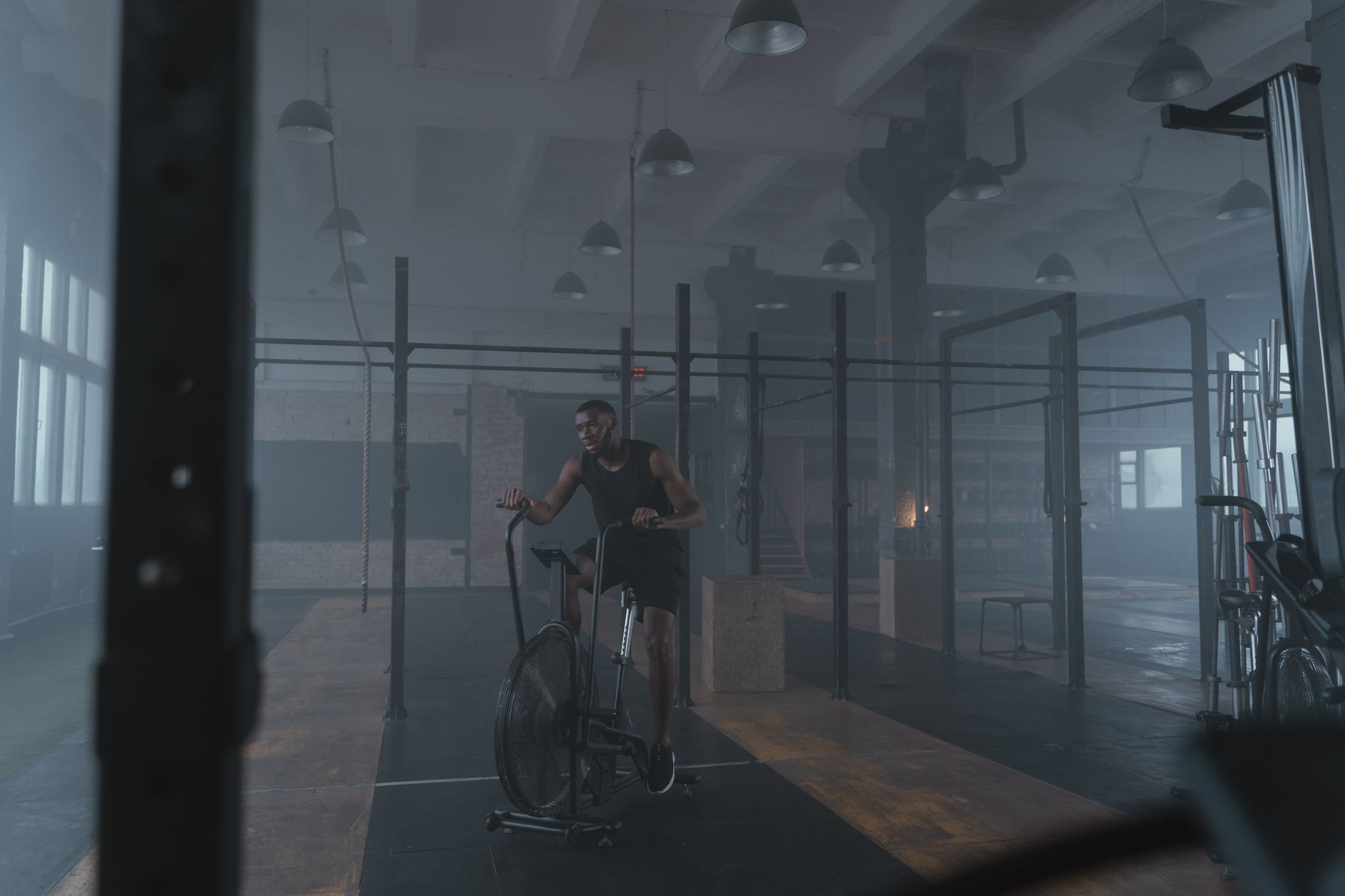
Getting your exercise bike exercise setup right prevents most of the knee and lower back discomfort beginners blame on the bike itself.
Seat height
Stand next to the bike — the seat should sit level with the top of your hip bone. Once seated, your knee should have a slight bend at the bottom of the pedal stroke, never a fully locked leg.
Seat and handlebar position
Your kneecap should track directly over your foot when the pedal is at the 3 o'clock position. Keep handlebars slightly higher than the seat when starting out — this reduces strain on your lower back and shoulders until your core strength catches up.
Riding form
Keep your back straight, core braced, and shoulders relaxed away from your ears. Light hands on the bars, not a death grip — gripping too hard wastes energy and tightens your neck and shoulders for no benefit.
Beginner cycling bike workout plan

Skip the temptation to go hard on day one. The most common reason beginners quit cycling bike exercise within two weeks is soreness from overdoing intensity before their body adapts.
| Week | Duration | Resistance | Sessions/week |
|---|---|---|---|
| 1 | 15–20 min | Low | 3 |
| 2 | 20–25 min | Low–moderate | 3–4 |
| 3 | 25–35 min | Moderate | 4 |
| 4 | 30–45 min | Moderate, plus 2 intervals | 4–5 |
Once week four feels manageable, start adding short intervals — 30 seconds at a hard pace followed by 90 seconds easy, repeated 4 to 6 times within a longer ride. High-intensity intervals add roughly 6 to 15 percent more total calories burned per session, thanks to the extra oxygen your body uses to recover afterward.
Heads up: if you feel sharp knee pain rather than general muscle fatigue, stop and check your seat height before your next session. Sharp pain almost always traces back to a seat set too low, not a fitness problem.
How many calories does cycling bike exercise burn?
| Body weight | Moderate (30 min) | Vigorous (30 min) |
|---|---|---|
| 57 kg | 210 kcal | 315 kcal |
| 70 kg | 252 kcal | 378 kcal |
| 84 kg | 292 kcal | 441 kcal |
Most riders burn between 400 and 600 calories per hour on an exercise bike, with heavier riders and more intense efforts landing at the top of that range. Upright and spin-style bikes tend to burn slightly more than recumbent bikes at the same perceived effort, because they recruit more stabilising muscle through your core and upper body.
Pair cycling bike exercise with two or three short resistance band sessions at Flexi Muscles each week to add strength work without adding much recovery time to your schedule.
Common mistakes to avoid
Skipping the warm-up
Jumping straight into a hard effort raises injury risk and makes the whole session feel worse than it needs to. Spend the first 5 to 10 minutes at an easy pace before increasing resistance.
Riding at the same resistance every session
Your body adapts to a fixed resistance within two to three weeks, and progress stalls. Increase resistance, duration, or add intervals every couple of weeks rather than repeating the same ride indefinitely.
Ignoring seat height
A seat set too low is the single most common cause of knee pain on an exercise bike, and it is also the easiest problem to fix — a two-minute adjustment before your next ride.
Chasing speed over resistance
Pedalling fast against low resistance feels productive but does less for strength and calorie burn than pedalling at a moderate cadence against real resistance. Judge effort by resistance and heart rate, not by how fast the pedals are spinning.
If you already own a rebounder or another low-impact cardio machine that gets used consistently, don't feel obligated to add an exercise bike on top of it. A second piece of cardio equipment only helps if it replaces sessions you'd otherwise skip, not if it just sits next to the one you already use. Browse rebounder trampolines at Flexi Muscles if low-impact variety, not another bike, is what your routine actually needs.
Frequently Asked Questions
How many calories does cycling bike exercise burn?
A 30-minute moderate-intensity session burns roughly 210 calories at 57 kg body weight, up to 292 calories at 84 kg. Riding at a vigorous pace over the same 30 minutes raises that to roughly 315 to 441 calories for the same weight range, and most riders burn between 400 and 600 calories over a full hour.
How often should I do cycling bike exercise to lose weight?
Four to five rides a week, combined with a moderate calorie deficit, produces visible results within 4 to 8 weeks for most people. If weight loss isn't the goal, 30 minutes on most days meets general cardiovascular health guidelines on its own.
Is cycling bike exercise better than running?
Neither is universally better. Cycling bike exercise is lower impact, which makes it the safer option if you have knee, hip, or back issues that running aggravates. Running tends to burn slightly more calories per minute at the same effort level, but only if your joints can tolerate the repeated impact well enough to train consistently.
Can beginners do cycling bike exercise every day?
Yes, cycling bike exercise is low-impact enough for daily sessions, unlike weight training or running. Keep early sessions to 15 to 20 minutes at low resistance, and increase duration before you increase intensity.
What muscles does cycling bike exercise work?
Cycling bike exercise primarily trains the quadriceps, hamstrings, glutes, and calves, with your core engaged throughout to stabilise your upper body. Standing intervals recruit the glutes and hip flexors more directly than seated pedalling.
Should I buy an upright, recumbent, or spin-style exercise bike?
Choose an upright or spin-style bike for a more intense, standing-friendly workout that mimics outdoor cycling. Choose a recumbent bike if you need back support or are recovering from an injury, since the reclined seat takes pressure off your lower spine.
Related at Flexi Muscles
- Cardio Equipment — exercise bikes and other low-impact cardio machines for home training
- Resistance Bands — add strength work to your cardio routine without extra recovery time
- Rebounder Trampolines — another low-impact cardio option for joint-friendly training
- All Products — the full Flexi Muscles range