

Cardio Exercise: Types, Benefits and How Much You Actually Need

By Flexi Muscles — 13 July 2026 · 12 min read
Cardio exercise is any activity that raises your heart rate and keeps it elevated for a sustained period — walking, running, cycling, rowing, jump rope, and bodyweight circuits all qualify. The World Health Organization's baseline guideline is 150 minutes of moderate-intensity cardio a week, or 75 minutes if the intensity is vigorous. That works out to roughly 30 minutes, five days a week, which is a target most people can hit without reorganising their life around it.
This guide covers what actually counts as cardio, how much you need for real health benefit, the bodyweight and equipment-based workouts worth your time, how to pick cardio equipment for a home gym, and when cardio is not the right tool for what you are actually trying to achieve.
Shop Cardio Equipment at Flexi Muscles
What Counts as Cardio Exercise
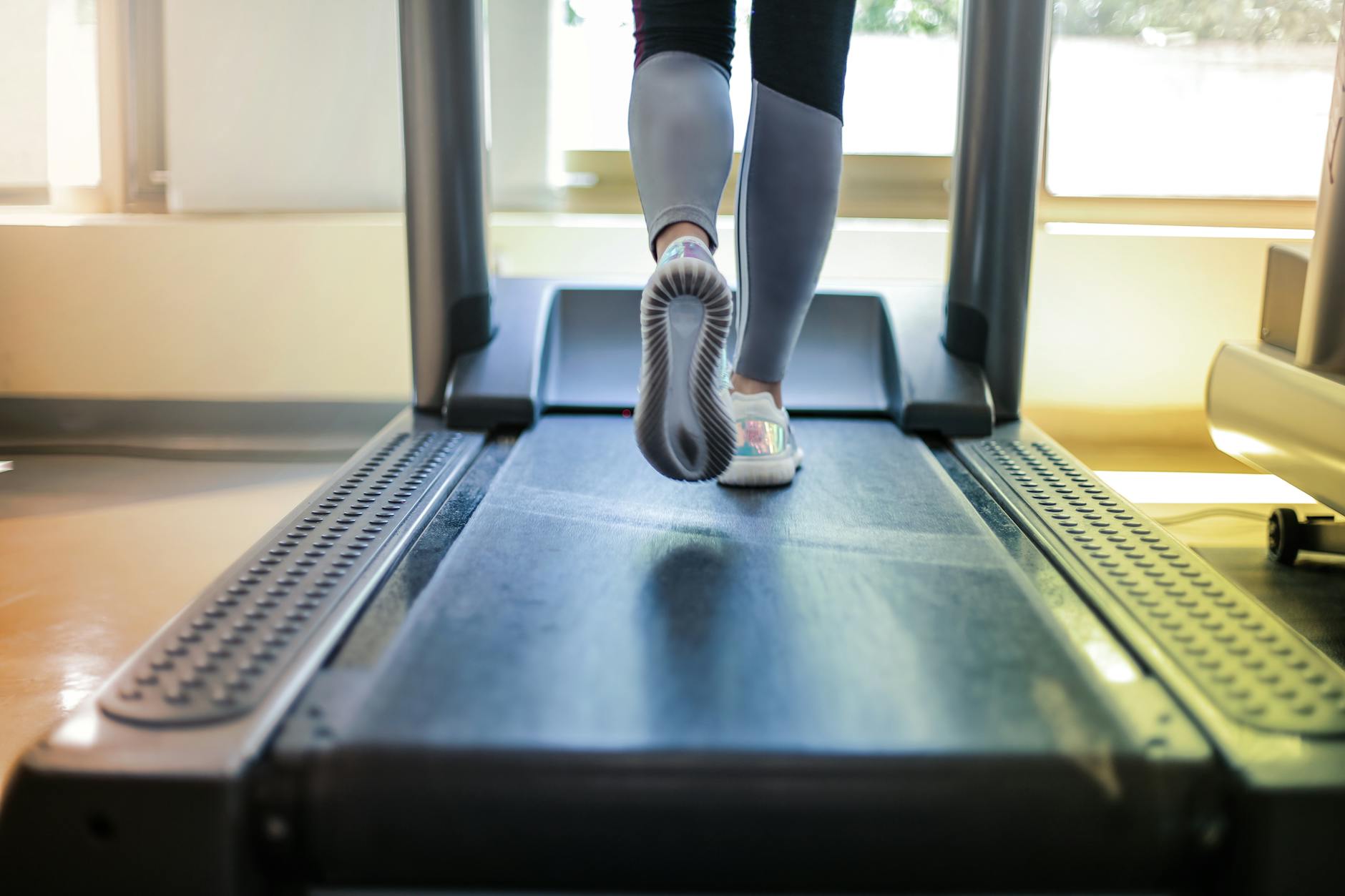
Cardio, short for cardiovascular exercise, is any sustained activity that raises your heart rate and breathing rate above resting level. It falls into three broad categories, and most training programmes end up using a mix of all three.
Steady-state cardio
A consistent effort held for an extended period — a 40-minute jog at a conversational pace, a 45-minute cycle, a long walk. Steady-state work is easy to recover from and builds the aerobic base that everything else depends on.
High-intensity interval training (HIIT)
Short bursts of near-maximal effort separated by rest or low-intensity recovery — 30 seconds hard on a rowing machine, 90 seconds easy, repeated. HIIT delivers a strong cardiovascular stimulus in less total time, but it costs more in recovery than steady-state work of the same duration.
Bodyweight and circuit-style cardio
Jumping jacks, mountain climbers, burpees, jump rope, and similar movements performed back to back with minimal rest. No equipment required, which makes this the category most people start with before deciding whether to invest in a bike, rower, or rebounder.
What does not count: strength training with long rest periods between sets, even though it raises your heart rate briefly during the set itself. The distinguishing feature of cardio training exercise is sustained elevation, not brief spikes.
The Real Benefits of Cardio Exercise
Cardio's primary job is training your heart and lungs to move oxygen more efficiently. Over weeks of consistent training, resting heart rate drops, stroke volume increases, and your body gets better at clearing lactate during hard effort — which is the physiological reason a fit person recovers faster between sets of anything, not just cardio.
The cardiovascular disease risk reduction is well established and is the reason the WHO and most national health bodies set a 150-minute weekly minimum. Regular aerobic exercise is also linked to better blood pressure control, improved insulin sensitivity, and measurable improvements in mood and sleep quality — the mood effect shows up within a single session for most people, not just after weeks of training.
None of this requires elite-level output. The health benefits curve is steepest at the bottom: going from zero exercise to 150 minutes a week produces a larger risk reduction than going from 150 minutes to 300. If you are currently doing no structured cardio, the first 30-minute walk you add this week matters more than any equipment decision you make after it.
How Much Cardio You Actually Need Per Week
The baseline guideline, used by the WHO and most major health authorities, is 150 minutes of moderate-intensity cardio a week, or 75 minutes of vigorous-intensity cardio, or an equivalent combination of both. Moderate intensity means you can hold a conversation but not sing. Vigorous means short sentences only.
In practice: five 30-minute moderate sessions, three 25-minute vigorous sessions, or some mix that fits your week. Splitting the total across four or five shorter sessions is generally easier to sustain than two long ones, and consistency across months matters more than any single week's total.
For general fitness maintenance, 150 minutes is the target. For weight management or endurance training beyond general health, 300 minutes a week of moderate-intensity work, or the vigorous equivalent, produces a stronger effect. Beyond that point, returns diminish relative to the added time and recovery cost, and the risk of overuse injury rises if intensity is also high.
Bodyweight Cardio Exercises You Can Do at Home
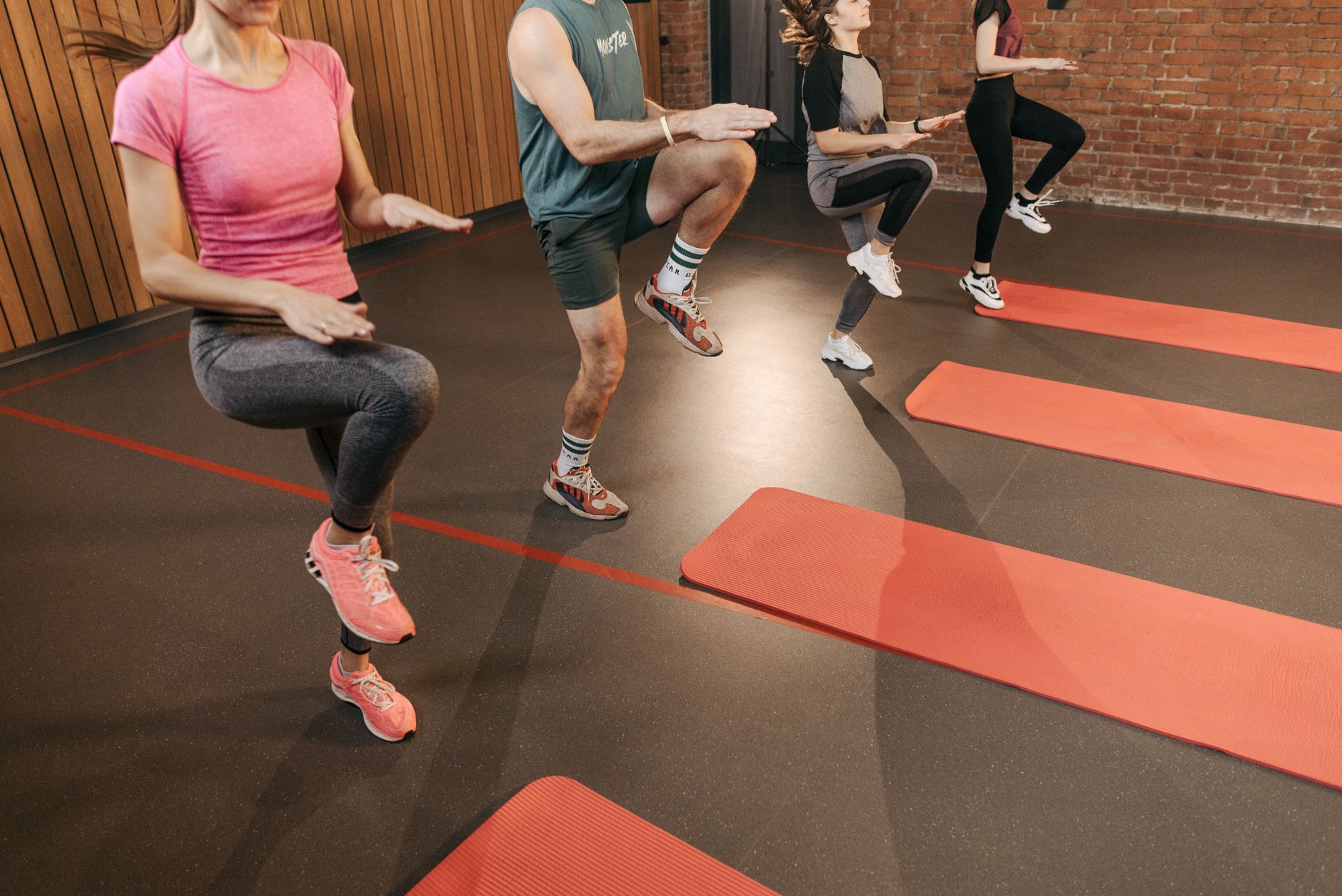
These six movements need no equipment and cover most of what a beginner cardio circuit requires. Rotate through them for 30-40 seconds of work with 15-20 seconds of rest, three to four rounds, for a complete session.
Jumping jacks — the standard warm-up move, but effective as a standalone cardio exercise at higher volume. Keeps the whole body moving with minimal coordination demand.
High knees — driving the knees up toward chest height at pace. Raises heart rate quickly and reinforces hip flexor drive, which carries over to running form.
Mountain climbers — from a plank position, driving alternate knees toward the chest. Combines cardio output with core and shoulder stability work, which most pure cardio movements do not.
Jump rope — the highest calorie burn per minute of any bodyweight cardio exercise, and a genuine skill that improves with practice. Start with 30-second sets; jump rope fatigue hits the calves fast for anyone new to it.
Squat jumps — a bodyweight squat with an explosive jump at the top. Builds power alongside cardio output, but is harder on the knees than the other movements here, so beginners should start with a lower volume.
Burpees — the one most people avoid, and the one that does the most in the least time. A squat, a plank, a push-up, and a jump combined into one movement. Four or five reps well short of exhaustion is a better start than ten reps done badly.
Equipment-Based Cardio for Building Real Endurance

Bodyweight cardio has a ceiling. Once your conditioning improves, equipment gives you a way to progressively increase resistance and volume without needing more space or more complex movements.
Rowing machine — the closest thing to a full-body cardio workout that exists. A rowing machine workout engages the legs, back, and arms in one continuous pulling motion, and it is genuinely low-impact on the joints because there is no ground-strike force involved. A 20-minute rowing session at moderate effort produces an endurance training stimulus comparable to a much longer run, with far less joint stress.
Exercise bike — the most joint-friendly option for anyone carrying an injury or extra bodyweight. Resistance is adjustable in small increments, which makes progressive overload straightforward, and the seated position removes impact entirely.
Rebounder (mini trampoline) — a low-impact option that still elevates heart rate meaningfully, because the trampoline surface absorbs a large portion of the landing force. Useful for anyone who wants cardio volume without the cumulative joint load of running on a hard floor.
Stair stepper — a compact, low-noise option well suited to apartments and smaller homes, delivering a steady moderate-to-vigorous cardio stimulus with a small equipment footprint.
Cardio for Weight Loss: What Actually Works
Cardio contributes to weight loss through energy expenditure, but the exercise itself is a smaller lever than most people assume. A hard 30-minute cardio session burns roughly 250-400 kcal for most adults, depending on bodyweight and intensity — meaningful, but easily offset by diet if nutrition is not also addressed.
Where cardio earns its place in a fat-loss plan is consistency and appetite regulation, not the single-session calorie count. Regular moderate cardio tends to improve appetite regulation over weeks, and it protects cardiovascular fitness during a calorie deficit when energy levels are otherwise reduced.
The practical answer to "which cardio burns the most fat" is the one performed most consistently. Rowing and running burn slightly more energy per minute than cycling or the stepper at matched perceived effort, but a moderate session done four times a week outperforms an intense session abandoned after two weeks. Pick the equipment and format you will actually return to.
How to Choose Cardio Equipment for a Home Gym

Most SERP guides tell you what cardio to do. Few tell you how to pick the equipment for it, which is the actual decision most home-gym buyers are stuck on.
Space first. A rowing machine needs roughly 2.4m of floor length when fully extended, though most fold or stand upright for storage. A rebounder needs a 1m diameter circle and nothing else. If floor space is the constraint, a rebounder or a foldable stepper solves it more directly than a bike or rower.
Noise and floor impact second. If you live in a flat or share walls, a stationary bike or rowing machine is close to silent. Rebounders and any jumping-based cardio transmit impact through the floor to whoever is below you, even though the movement itself is low-impact on your joints.
Match the equipment to the joint you're protecting. Bad knees or hips point toward a bike or rower, both of which remove ground-impact force entirely. A rebounder is the middle ground — more joint-friendly than running, more floor-impact than a bike.
Buy for the workout you'll actually do, not the one that sounds best. A rowing machine is the most complete cardio tool on this list, but if you know you won't use it because it feels like a chore, a rebounder or an exercise bike that you will actually get on five days a week beats a rower gathering dust in the corner.
Low-Impact Cardio for Bad Knees or Beginners
Low-impact does not mean low-effort. It means the exercise avoids the repeated ground-strike force that running and jumping put through the knees, hips, and lower back. You can raise your heart rate just as effectively with low-impact work — it simply requires slightly longer sessions or added resistance to match the output of high-impact training.
The best low-impact options are cycling, swimming, rowing, brisk walking, and rebounding. All five let you build meaningful endurance training volume without the cumulative joint loading of running on pavement or concrete. For anyone returning from injury, carrying extra bodyweight, or simply prioritising joint longevity over years of training, these five should form the core of a cardio programme rather than an occasional substitute.
When Cardio Alone Is the Wrong Approach
Cardio does not build or preserve muscle. If your primary goal is muscle gain, or you are in a calorie deficit and want to protect the muscle you already have, cardio equipment is not the priority purchase — a squat rack, a bench, and a set of adjustable dumbbells will do more for that goal than any bike or rower.
Cardio also will not fix a poor diet. If your main objective is losing a specific amount of bodyweight and your current eating pattern runs a consistent calorie surplus, no volume of rowing or running compensates for that on its own. Fix the intake side first; use cardio to support the deficit and protect fitness, not to outrun it.
Buy cardio equipment because you want to train your heart and lungs, improve endurance, or add low-impact movement to your week — not because it feels like the safe, obvious entry point into fitness. It often isn't the piece of equipment that gets you closest to your actual goal.
Common Cardio Mistakes That Waste Your Time
Doing the same session at the same intensity every time. Without progression — more time, more resistance, or higher intensity intervals — your cardiovascular system adapts and stops improving. Increase one variable every two to three weeks.
Going hard every single session. HIIT every day accumulates fatigue faster than it builds fitness. Most weeks should be mostly moderate-intensity work with one or two harder sessions, not the reverse.
Ignoring warm-up. Five minutes of easy movement before intervals or a hard row reduces injury risk and improves output in the working sets that follow.
Cardio-only trainers avoid the weights room. Strength-only trainers avoid the cardio machines. Both groups will tell you their approach is the complete answer, and both are leaving something meaningful on the table.
Frequently Asked Questions
How many days a week should I do cardio exercise?
Three to five days a week is enough for most people. The World Health Organization recommends at least 150 minutes of moderate-intensity cardio, or 75 minutes of vigorous-intensity cardio, spread across the week. Splitting that into four 30-40 minute sessions is more sustainable than trying to do it all in one or two long workouts.
Is 30 minutes of cardio a day enough?
Yes, for general health. Thirty minutes a day, five days a week, gives you 150 minutes weekly, which meets the minimum guideline for reducing cardiovascular disease risk. For faster fat loss or endurance gains, more volume or higher intensity helps, but 30 minutes daily is a solid baseline most people can maintain long term.
What is the best cardio exercise for weight loss?
The one you will actually do consistently. Rowing and running burn the most energy per minute for most people, but consistency matters more than the exercise you pick. Three moderate sessions a week for a year outperforms an intense programme abandoned after three weeks. Match the exercise to your joints, schedule, and what you don't dread doing.
Can I do cardio every day?
Low-to-moderate intensity cardio, such as walking or light cycling, can be done daily without issue. High-intensity sessions, including HIIT and hard rowing intervals, need at least one rest or active-recovery day between sessions to let your body recover. Doing hard cardio every day without recovery raises your risk of overuse injury and burnout.
Is walking considered cardio exercise?
Yes. Walking at a pace that raises your heart rate counts as moderate-intensity cardio, and it is the lowest-impact entry point for beginners, older adults, or anyone returning from injury. A brisk 30-minute walk contributes directly toward the 150-minute weekly guideline in the same way a gym-based cardio session does.
Related at Flexi Muscles
- Cardio Equipment — exercise bikes, rowing machines, steppers and more for home cardio training
- Rebounder Trampolines — low-impact cardio for bad knees, beginners, and small spaces
- Strength Training Equipment — build and protect muscle alongside your cardio work
- All Products — browse the full Flexi Muscles range
Sources
- World Health Organization — global physical activity guidelines and weekly minimum recommendations
- American Heart Association — recommendations for aerobic physical activity in adults
- Mayo Clinic — aerobic exercise benefits and intensity guidance