

Best Kettlebells for Home Gym: Weight, Type and What to Avoid

By Flexi Muscles — 16 June 2026 · 13 min read
The best kettlebells for a home gym are cast iron, flat-based, and in the right starting weight — which is heavier than most beginners expect. A single 12kg bell for women or a 16kg bell for men covers the foundational movements that make kettlebell training worth doing. You do not need a full set. You need one bell, the right exercises, and the patience to get the basics right before adding load.
This guide covers what to look for in the bell itself, how to pick the correct starting weight, which material to buy and which to avoid, the five exercises that underpin a solid kettlebell programme, and — just as importantly — when a kettlebell is the wrong tool for what you are trying to do.
Shop Strength Training Equipment at Flexi Muscles
What to Look for in a Kettlebell for Home Use
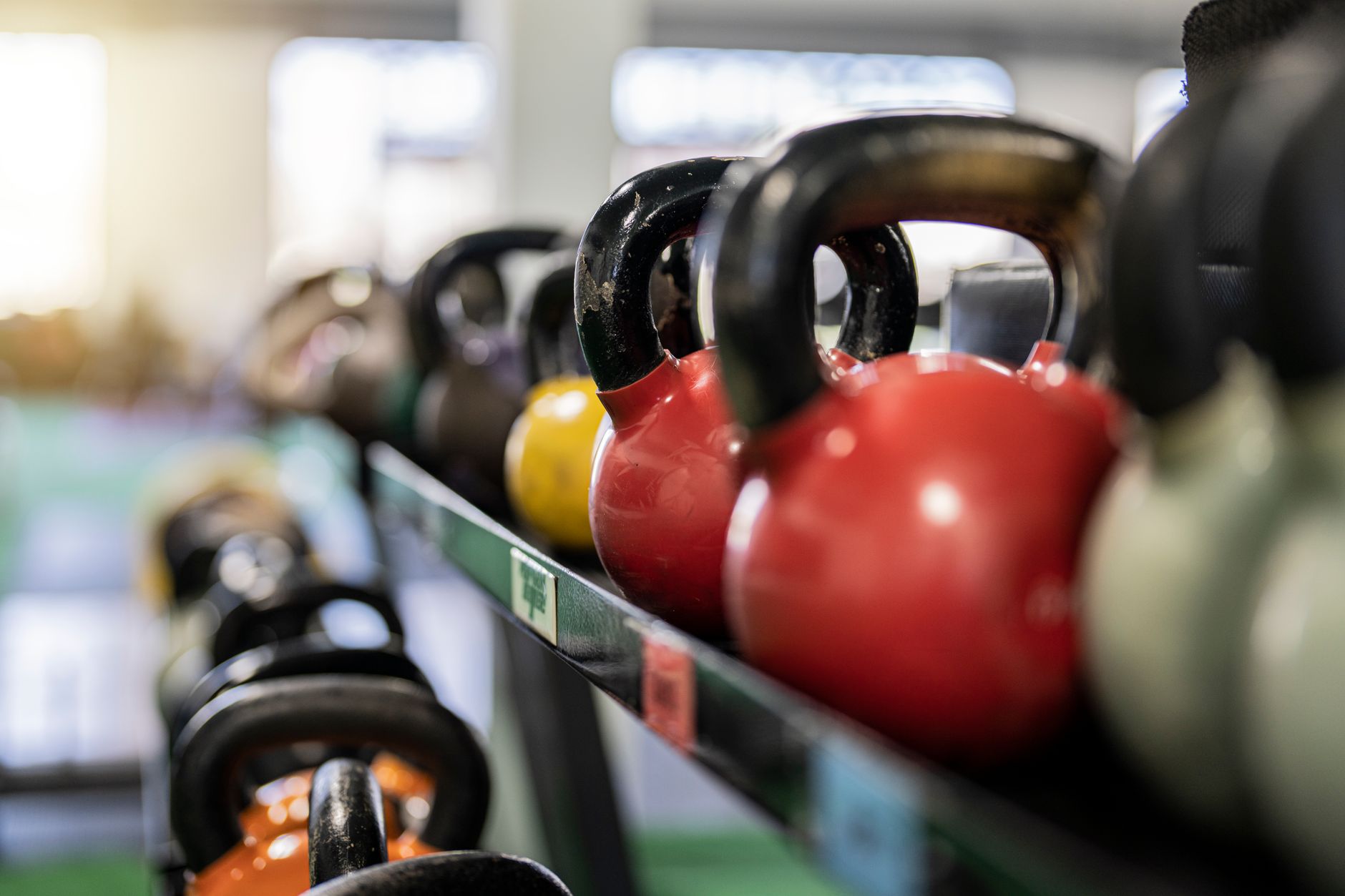
The handle is the part of a kettlebell that matters most. A good handle sits between 33mm and 35mm in diameter — narrow enough to swing without tearing the skin on your palm, wide enough to grip securely under load. Competition kettlebells standardise this at exactly 33mm. Traditional cast iron bells vary slightly depending on the manufacturer.
Surface finish matters as much as diameter. The best handle finish for training is matte, lightly textured, or e-coated — enough texture to grip without chalk, not so rough that it shreds calluses. Chrome handles look clean and are popular on cheaper bells, but they become slippery the moment your palms sweat. Very rough powder coat feels grippy at first and tears skin during high-rep sets. If you can hold the bell in a shop before buying, run your palm along the handle. If it feels like medium-grit sandpaper, it will feel significantly worse during 20 swings.
A flat base is a detail that sounds trivial until the bell rolls across your floor and connects with the skirting board. Quality kettlebells sit stable on any flat surface. Cheaper models have a slightly curved bottom from inconsistent casting. Place the bell on a table and see if it rocks. A bell that rocks is one that will move during floor exercises like the Turkish get-up.
Weight accuracy is something most first-time buyers overlook. A bell marked 16kg should weigh 16kg, not 14.5kg. Off-brand imports — particularly vinyl and sand-filled models — regularly run 5–10% under their stated weight. This matters when you are trying to track progress: if your "24kg" bell is actually 21kg, your programming numbers mean nothing. Reputable manufacturers cast to within 1–2% of stated weight and mark the bell in kilograms on one face and pounds on the other.
Single-piece casting versus a welded handle is the structural difference that separates quality from cheap. A properly cast kettlebell is made in one pour — bell body, neck, and handle are one piece of iron with no weak points. A welded handle, common on vinyl-coated models, can develop microfractures at the joint under sustained use. You will not see this failure coming.
The window — the opening between the handle arch and the body of the bell — should be wide enough for your hand to sit comfortably with room to shift grip during swings. A tight window restricts grip adjustment and makes the rack position uncomfortable. Aim for at least 55mm of clearance from the top of the handle to the bell body. If the bell pinches the back of your hand in the rack, the window is too small.
Choosing the Right Kettlebell Weight for Beginners
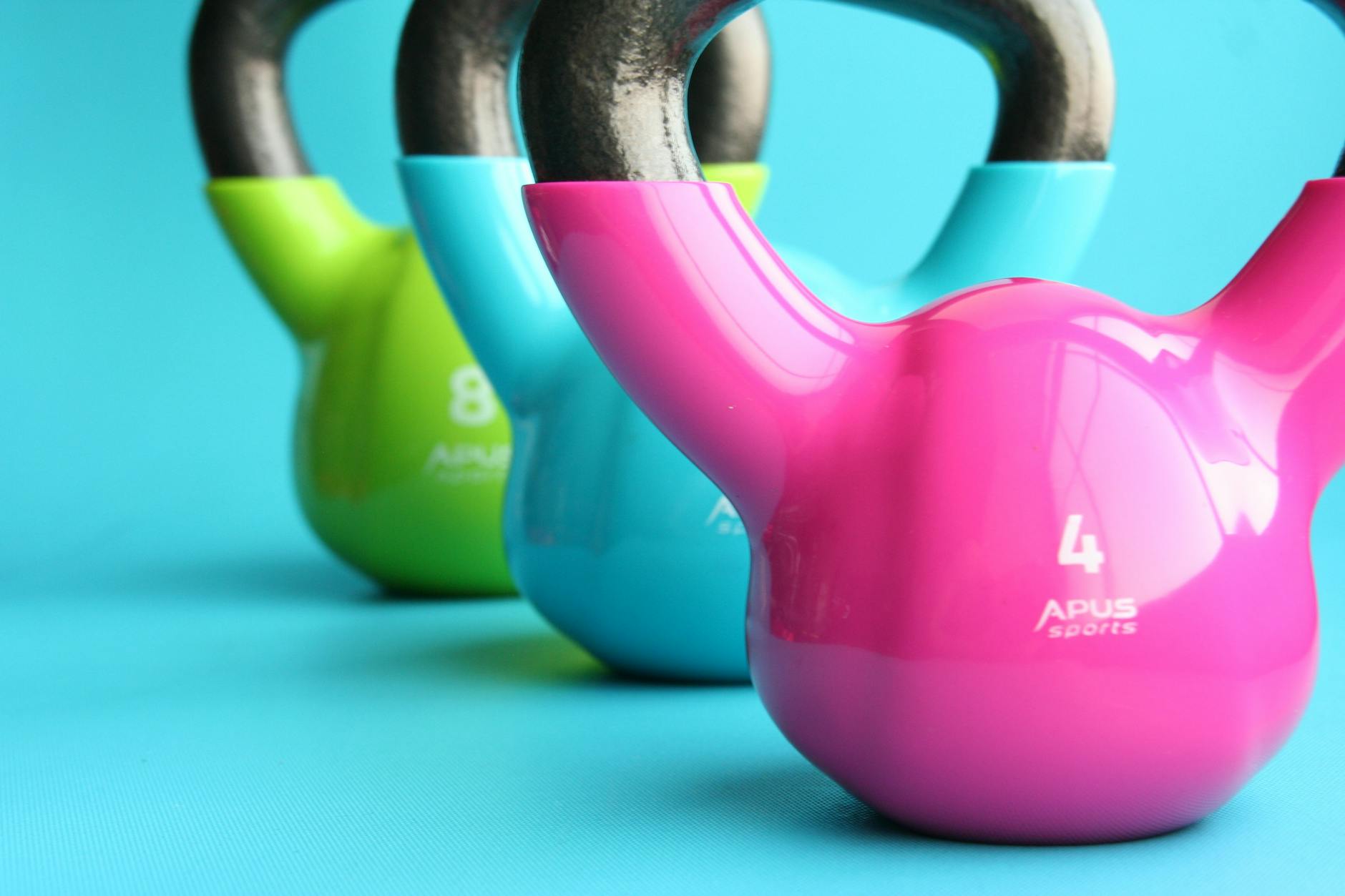
The most consistent mistake beginners make with kettlebells is starting too light. A 4kg or 6kg bell forces you into compensating movement patterns — you end up treating a strength tool like a warm-up prop. The movements that make kettlebell training effective — swings, squats, cleans — require enough load to teach the body to brace, hinge, and generate power. A bell that feels effortless teaches none of these things.
Recommended starting weights
Women new to weight training: 8kg for overhead pressing and Turkish get-ups; 12kg for swings and goblet squats. If you have a background in other training — running, yoga, pilates, or any bodyweight work — start at 12kg for all movements from the beginning.
Men new to weight training: 12kg for pressing movements; 16kg for swings and squats. If you have any existing strength base from sport, gym work, or manual labour, 16kg across all movements is the better starting point. Most men who begin at 12kg outgrow it within three to four weeks for the lower body exercises.
Women with a strength base: 12–16kg depending on the movement. Swings at 16kg, presses and get-ups at 12kg until technique is consistent across all sets.
Men with a strength base: 20–24kg for swings and squats; 16kg for pressing and the Turkish get-up to start.
The practical weight test
Pick up the bell and do 10 goblet squats. If your form breaks down on reps eight, nine, and ten — chest dropping, heels lifting, knees caving — the weight is correct. You are working close to your limit without exceeding it. If all 10 reps are controlled and easy with no technique breakdown, go one weight up. If you cannot complete five reps with reasonable form, go one weight down.
How kettlebell weights are structured
Kettlebell weights follow a standardised progression rooted in the Russian pood system: 8, 12, 16, 20, 24, 28, 32kg. Each step is 4kg. You do not need to buy every weight on the ladder. Start at the right level for your current strength, train consistently, and move up when your primary exercises feel genuinely easy across all working sets. For most people, that progression from one weight to the next takes 6–12 weeks of regular training per major movement.
The common trap: buying one light bell and one heavy bell on the assumption you will rotate between them. In practice, the lighter bell collects dust within a month. Buy the correct weight for where you are now. Progress from there.
Cast Iron, Rubber, or Vinyl: Which Type Should You Buy?

Cast iron
Cast iron is the original material and still the best long-term value for most home trainees. A quality cast iron bell is dense, accurate, and will outlast years of regular training without any meaningful degradation. The surface is typically bare iron, painted, or powder coated. Cast iron gets cold in winter — this is unpleasant for some people and irrelevant to others. If a cast iron bell is dropped on tiled, wooden, or sealed concrete floors, expect surface damage. The bell itself will be fine. Your floor may not be.
Rubber coated kettlebells
Rubber coated kettlebells are cast iron bells with a moulded rubber shell over the body. The handle remains bare metal. The coating protects floor surfaces when the bell is set down hard and provides minor impact protection if the bell tips over. For home training on wooden flooring, ceramic tiles, or any finished surface, rubber coated bells are the practical choice. New rubber bells can carry a noticeable smell for the first few weeks — it fades. They cost slightly more than bare iron equivalents but the difference is small relative to the floor protection they provide.
Vinyl coated kettlebells — avoid
Vinyl coated bells are the category to skip. Most are filled with sand or poured concrete rather than solid iron, which keeps manufacturing costs low but produces a bell with inconsistent weight, a poor centre of gravity, and a handle that is typically welded rather than cast in one piece. The vinyl coating cracks and peels under regular use. If a kettlebell is priced well below comparable bells on the market with no explanation, vinyl is almost certainly the reason.
Competition kettlebells
Competition kettlebells are precision-made steel bells built to exact international sport standards. Every competition bell from 8kg to 48kg is the same physical size — same height, same width, same handle diameter at 33mm. Only the density of the steel differs. This matters for technique: your grip, hand position, and forearm angle do not change as you move up in weight. For trainees who plan to progress seriously through the weight ladder, or who use lighter bells for technique work and heavier bells for competition, this consistency is worth the higher cost. For general home training, quality cast iron or rubber coated bells serve perfectly well.
Five Exercises to Do With a Kettlebell First

Most kettlebell exercises exist on a spectrum from foundational to specialist. Five movements are worth learning before anything else. These five build the strength, mobility, and movement patterns that make every other exercise in kettlebell training accessible — and safe.
1. Kettlebell swing
The swing is the foundational kettlebell movement, and the one most commonly performed incorrectly. The swing is a hip hinge — the power comes entirely from snapping the hips forward, not from lifting with the arms or squatting under the bell. The bell floats to chest or shoulder height from the momentum of the hip drive. The arms are cables. The hips are the engine.
Set up with the bell on the floor about 30cm in front of your feet. Hinge forward, grip the handle, tilt the bell slightly toward you, and hike it back between your legs. Drive your hips forward explosively as the bell swings forward. Stand tall at the top — glutes squeezed, trunk braced, bell at chest height. Let it swing back as you hinge again to repeat.
Common mistake: squatting down as the bell descends rather than hinging at the hip. If your shins are vertical and your knees are tracking forward over your toes, you are squatting. In a correct swing, the shins remain more vertical, the hips push sharply back, and the movement happens at the hip joint.
Start with the two-handed swing. Progress to single-arm once the hip-hinge pattern is consistent across multiple sets.
2. Goblet squat
Hold the bell vertically by the horns — the sides of the handle — at chest height with elbows tucked. Feet shoulder-width or slightly wider, toes turned out 15–30 degrees. Squat down with the chest tall and the elbows tracking between the knees at the bottom. Go as deep as your mobility allows with the heels flat on the floor. Drive through the heels to return to standing.
The goblet squat teaches correct squat mechanics more effectively than almost any other method. The front-loaded weight placement counterbalances the tendency to fall forward, producing an upright torso naturally. The elbows between the knees cue external hip rotation. Many people who have been squatting for years and never quite got it right find the goblet squat the first squat pattern that feels correct.
Common mistake: letting the torso collapse forward and the elbows cave inward as the load increases. If you cannot maintain an upright chest throughout the full range of motion, the weight is too heavy. Reduce it and rebuild from the bottom position.
3. Turkish get-up
Lie flat on the floor with the bell pressed in one hand, arm extended directly above the shoulder. Your same-side knee is bent, foot flat on the floor. The opposite arm and leg are on the floor at roughly 45 degrees to the body. From there: stand up, keeping the bell pressed overhead throughout the entire movement. Then reverse the sequence and return to the floor.
The Turkish get-up develops shoulder stability, hip mobility, rotational strength, and total-body coordination simultaneously. It is the most complete single-movement diagnostic tool in kettlebell training. Most trainees encounter the get-up, note that it looks complicated, and decide they will learn it properly next time. This tends to continue indefinitely. Learn it now. Start with a light weight — even a shoe balanced on your fist — to master the seven movement transitions before adding any load.
Common mistake: rushing through the position changes. The Turkish get-up is a slow, deliberate exercise. Each position should be stable and controlled before moving to the next. Speed in the get-up is not a goal — it is a sign that something is being skipped.
4. Single-arm kettlebell row
Place the bell on the floor beside a bench, box, or stable surface. Rest one hand and the same-side knee on the surface so the body is roughly parallel to the floor. Grip the bell with the opposite hand, keeping the back flat and the spine neutral. Pull the bell to your hip by driving the elbow back and up. Lower it back to the floor under control.
The row is the primary pulling movement in a standard kettlebell programme. It builds back thickness — specifically the lats, rhomboids, and rear deltoids — and develops grip strength in the same session. Most people's pulling capacity lags behind their pressing capacity; the row addresses this imbalance directly.
Common mistake: rotating the torso to assist the lift, particularly as fatigue sets in. The movement should come from the arm and shoulder, not from twisting the body. If you need torso rotation to complete the rep, the weight is too heavy.
5. Kettlebell overhead press
Clean the bell to the rack position: bell resting against the forearm and upper chest, forearm vertical, elbow pointed straight down. From the rack, press the bell overhead in a smooth arc until the arm is fully extended with the bicep beside the ear. Lower it back to the rack under control.
The single-arm overhead press builds shoulder strength and forces the trunk to brace against a lateral load. The stability demand through the trunk is significant — the press is harder than it looks. Most beginners find they need to reduce weight considerably from what they use for swings and squats.
Common mistake: pressing the bell forward and away from the body rather than directly overhead, or allowing the elbow to flare outward during the ascent. The bell should travel in a near-vertical arc above the shoulder. If it drifts forward, your shoulder is not moving through the correct path.
For programming: three sets of five reps works well for pressing movements and the Turkish get-up. Swings and goblet squats respond to higher rep ranges — ten to fifteen reps per set across three to four sets. The row sits comfortably at eight to twelve reps per side.
When a Kettlebell Is Not the Right Buy
Kettlebells do several things very well. They do not do everything well. Here is when to buy something else.
If your primary goal is maximal strength in the bench press, squat, or deadlift: you need a barbell. The heaviest kettlebell most home gyms will stock runs to 32–40kg. That is a moderate challenge for a trained person's swing — it is a fraction of what a serious strength athlete moves on a barbell. Kettlebells are not a substitute for a barbell in a powerlifting or strength-focused context. If your goal is a big squat or deadlift, buy a barbell first.
If you want muscle isolation: machines and adjustable dumbbells serve this goal better. Kettlebell training is built around compound movement patterns and full-system effort. If your programme centres on leg extensions, cable curls, or lateral raises with fine weight increments, a kettlebell does not address those directly.
If you are recovering from a shoulder injury and have not been cleared for overhead work: hold off. The swing creates significant shoulder demand at the top of the arc, and the press, clean, and snatch are all overhead-intensive movements. Work with a physiotherapist, get clearance for overhead loading, and bring in the kettlebell when your shoulder can handle it.
If both space and budget are limited: a pair of adjustable dumbbells covers more exercise variety than a single kettlebell at the same price point. Kettlebells are a sound investment when the training style suits your goals and you know you will use them consistently. They are not the automatic answer for every home gym setup.
How Many Kettlebells Do You Actually Need?
One. For the first six months, one kettlebell at the correct starting weight is enough. The five exercises covered above — swing, goblet squat, Turkish get-up, row, and overhead press — give you a complete training programme with a single bell. The limiting factor in the early months is technique consistency and work capacity, not equipment variety.
Two makes sense once you are ready for double-bell work: double swings, double cleans, double front squats, and racked carries. These are effective and demanding exercises, but they are intermediate techniques. You learn them after months of consistent single-bell training, not before.
A third bell becomes practical when the first two are genuinely too light for certain movements. A common three-bell home setup for an intermediate trainee: 16kg for swings, 12kg for pressing and get-ups, 20kg for heavy goblet squats and rows. This covers most training scenarios without excess.
A full set from 4kg to 32kg belongs in a gym or a personal trainer's studio. For a home setup serving one or two people, it is more equipment than you will use and a poor allocation of money at any training stage. Buy one bell at the right weight. Train it for 8–12 weeks. When you have genuinely outgrown it for the primary movements, buy the next weight up. Repeat this process and you will build a lean, functional collection rather than an expensive range of rarely-touched equipment.
Frequently Asked Questions
What kettlebell weight should a beginner start with?
Women new to training should start between 8 and 12kg. Men should start between 12 and 16kg. If you have any strength background, start at the heavier end of those ranges. The practical test: do 10 goblet squats with the bell. If your form holds for all 10 reps with no breakdown, go heavier. If it breaks down in the last two or three reps, the weight is correct. If you cannot complete five reps with decent form, go one weight down.
Is one kettlebell enough for a home gym?
For the first six months, yes. The swing, goblet squat, Turkish get-up, single-arm row, and overhead press give you a complete training programme with a single bell. Add a second when you have outgrown the first weight for the primary exercises — typically 2–4 months of consistent training per weight.
Are rubber coated kettlebells better than cast iron?
It depends entirely on your floor. For tiled or wooden floors, rubber-coated bells reduce the risk of surface damage and are worth the small extra cost. For concrete floors or rubber matting, bare cast iron is adequate and usually cheaper. Neither material changes how effective the exercise is — this is a practical question about your training surface, not a performance question.
Can you build muscle with kettlebells alone?
Yes, particularly in the first one to two years of training. The loading ceiling of a single bell eventually limits how much progressive overload you can apply, which is why more advanced trainees use kettlebells alongside barbells rather than instead of them. For general fitness, functional strength, and body composition, kettlebells are effective on their own — especially with consistent programming and sufficient weekly volume.
What is the best first kettlebell exercise to learn?
The goblet squat. It is the safest entry point, it teaches the hip hinge and bracing patterns that transfer to every other kettlebell movement, and it builds leg and trunk strength at the same time. Learn the goblet squat before moving on to swings, presses, or any single-arm work. If your goblet squat is solid, the rest follows more easily.
Related at Flexi Muscles
- Strength Training Equipment — home gym gear for building strength
- Lifting Accessories — chalk, straps, belts, and grip aids to support your training
- All Products — browse the full Flexi Muscles range
Sources
- ACE Fitness Exercise Library — technique reference for compound and functional movements
- NSCA — National Strength and Conditioning Association — evidence-based programming guidelines for resistance training
- British Journal of Sports Medicine — peer-reviewed research on resistance training outcomes and injury prevention