

Best Dumbbell Workouts: The Complete Guide to Every Muscle Group

By Flexi Muscles — 5 August 2026 · 17 min read
The best dumbbell workouts train every major muscle group with three to four exercises each, working compound movements first and isolation exercises second. A full-body session — one squat pattern, one push, one pull, plus targeted arm and shoulder work — done three times a week covers chest, back, shoulders, arms, legs and core without needing a barbell or a rack. Below is the full breakdown by muscle group, a weekly plan you can follow, and a straight answer on what dumbbells you actually need to run it.
Shop Dumbbells at Flexi Muscles
Why Dumbbells Work for Most Home Training
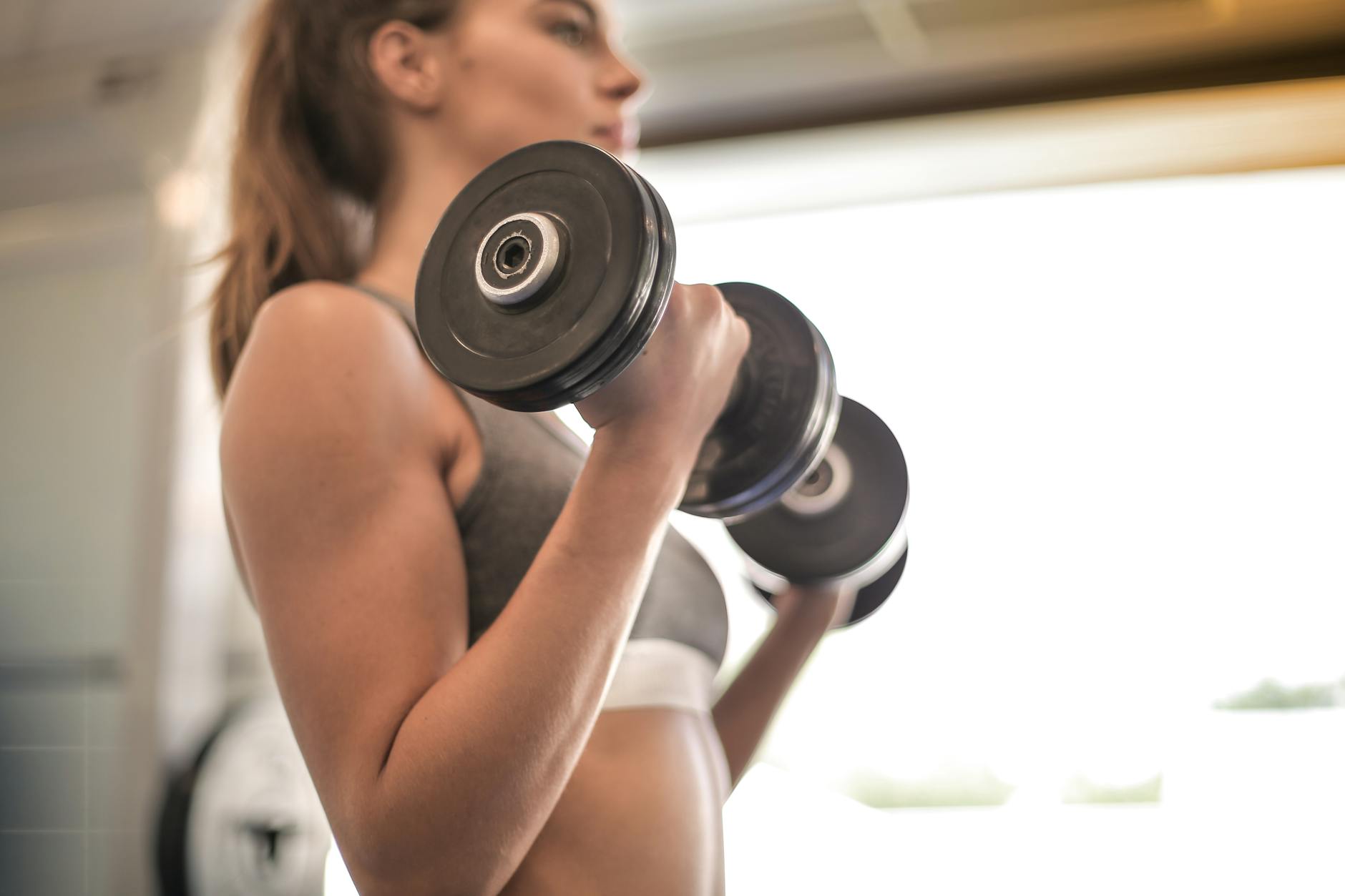
A barbell moves as one rigid unit, which means your stronger side can quietly compensate for your weaker side on every rep. Dumbbells remove that option. Each arm works independently, which is why dumbbell exercises are so effective at exposing and correcting strength imbalances that a barbell hides for years.
They also cover a wider range of movement than a fixed barbell path allows. A dumbbell press lets your wrists rotate and your elbows track naturally through the lift, which is easier on the shoulder joint than a barbell bench press for a lot of lifters. Rows, presses, lunges and curls all benefit from that added freedom of movement.
The practical case is simpler still: one pair of adjustable dumbbells and a bit of floor space covers chest, back, shoulders, arms, legs and core. No rack, no bench required for most of the exercises below, and no spotter needed at home-gym weights.
Straight up: dumbbells will not out-lift a barbell for pure maximum-strength work on squats or deadlifts once you are moving serious weight. For building muscle and general strength in a home gym, they do the job as well as anything else on the market.
Chest Exercises
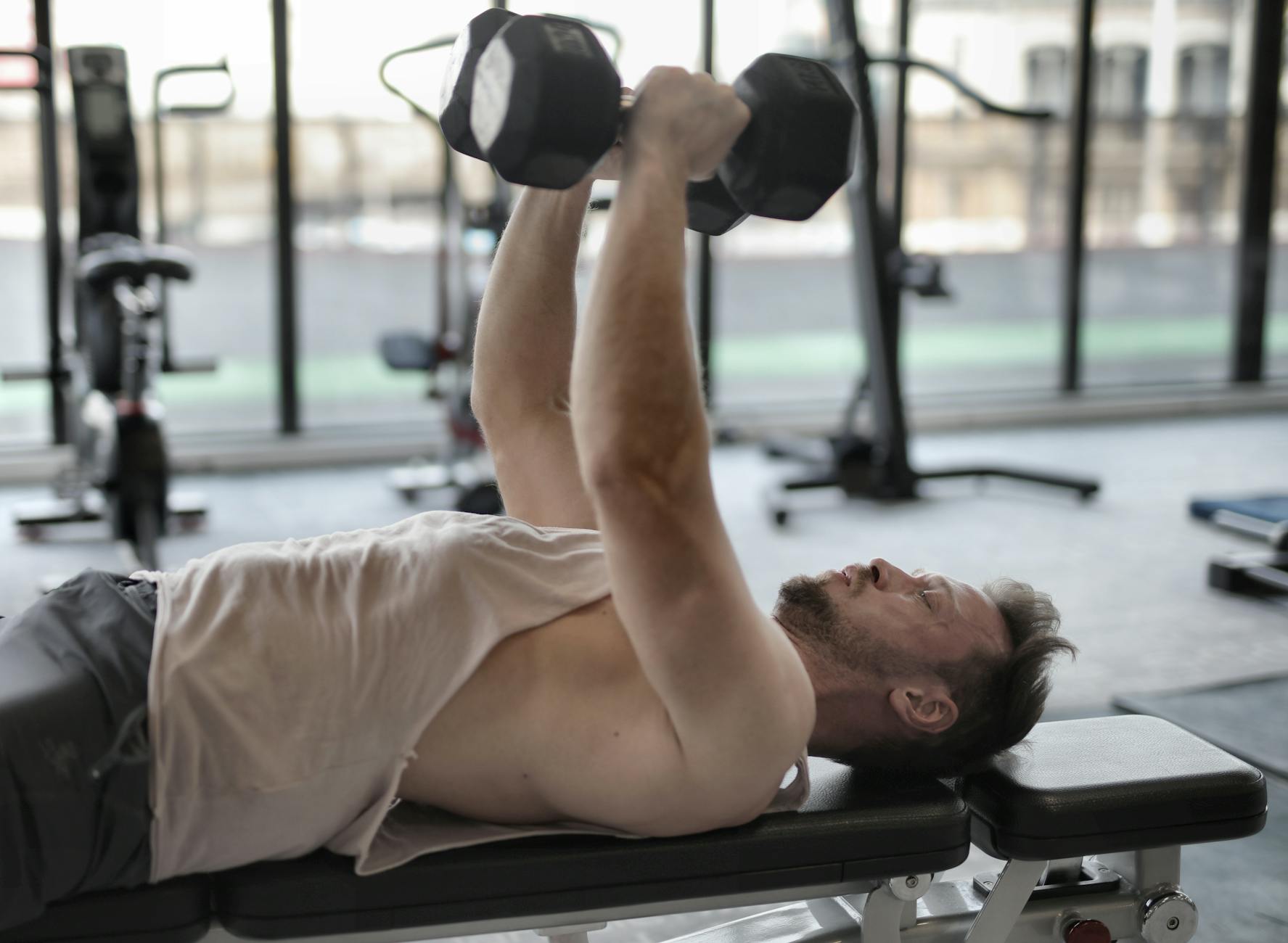
Dumbbell bench press
Lie flat on a bench, press both dumbbells from chest level to full extension, and lower them under control until your upper arms are roughly parallel to the floor. Keep your elbows at around 45 to 60 degrees from your torso rather than flared out to 90 degrees, which protects the shoulder joint on heavier sets.
Incline dumbbell press
Set the bench to 30 to 45 degrees and press from shoulder height. The steeper angle shifts more of the work onto the upper chest, which a flat press trains less directly. This is the exercise most home routines are missing, and it is worth doing before flat pressing if upper chest development is a priority for you.
Dumbbell flyes
With a slight bend in the elbows, lower the dumbbells out to the sides in a wide arc until you feel a stretch across the chest, then bring them back together over your chest. Use roughly 40 to 50% of your bench press weight — flyes load the shoulder joint at the bottom of the movement, and going heavy here is the most common way people strain a pec.
Dumbbell pullover
Lying flat on a bench with just your shoulders supported, hold one dumbbell with both hands above your chest and lower it back over your head until you feel a stretch through the chest and lats, then pull it back over your chest. It is a slower, more controlled movement than the other three, and it works the chest and upper back together in a way the presses above do not.
Back Exercises
Bent-over row
Hinge at the hips to roughly 45 degrees, keep a flat back, and pull both dumbbells to your ribcage while squeezing your shoulder blades together at the top. The most common mistake is rounding the lower back to move heavier weight — if your form breaks down, drop the load rather than the technique.
Single-arm row
With one knee and hand supported on a bench, row with the free arm through a full range of motion. Because only one side is working, you can focus on pulling with the back muscles rather than the arm, and the supported position removes lower-back strain entirely.
Renegade row
From a plank position with hands gripping the dumbbells, row one side at a time while resisting the urge to rotate your hips. This trains the back and the core in the same movement, and it is one of the better exercises to do with dumbbells if your sessions are time-limited.
Shoulder Exercises
Seated dumbbell shoulder press
Press both dumbbells overhead from shoulder height while seated with back support. The seated position takes the lower back out of the movement almost entirely, which lets you focus the effort on the shoulders instead of stabilising your torso.
Lateral raise
Raise both arms out to the sides until they reach shoulder height, then lower with control. Use a lighter weight than you think you need — the side delts respond well to higher rep ranges of 12 to 15, and swinging heavier dumbbells through momentum trains your traps more than your shoulders.
Arnold press
Start with the dumbbells in a curled position, palms facing you, then rotate and press overhead until your palms face forward at the top. The rotation works the front and side delts through a longer range than a standard press, at the cost of being slightly harder to load heavy.
Front raise
Raise one or both dumbbells straight out in front of you to shoulder height, then lower with control. This targets the front delts specifically, which already get significant work from every pressing exercise in this guide — one or two sets is enough rather than a full three, since you are topping up a muscle that is already being trained indirectly.
Arm Exercises: Biceps and Triceps
Here is the one strong opinion in this guide: isolation work for biceps and triceps is the most overrated part of a home dumbbell routine. Your arms already do substantial secondary work in every press and every row above. Three compound exercises done well will build more arm size in 20 minutes than six isolation sets, because the arms are working through nearly every set in this guide, not just the two below.
That said, direct arm work has a place for anyone chasing visible arm size specifically, so here are the two exercises worth including.
Bicep curl
Keep your elbow fixed at your side and curl the dumbbell up without swinging your torso to generate momentum. Slow the lowering phase down — the eccentric portion of a curl is where most of the muscle-building stimulus happens.
Overhead tricep extension
Hold one dumbbell with both hands behind your head and extend upward until your arms are straight. This targets the long head of the triceps more directly than pressing movements do, which makes it a useful addition rather than a duplicate of your chest and shoulder work.
Hammer curl
Curl the dumbbells with your palms facing each other rather than facing up. The neutral grip shifts more of the work onto the brachialis and forearm, which a standard curl trains less directly, and it is easier on the wrists for anyone who finds a full supinated curl uncomfortable.
Leg Exercises
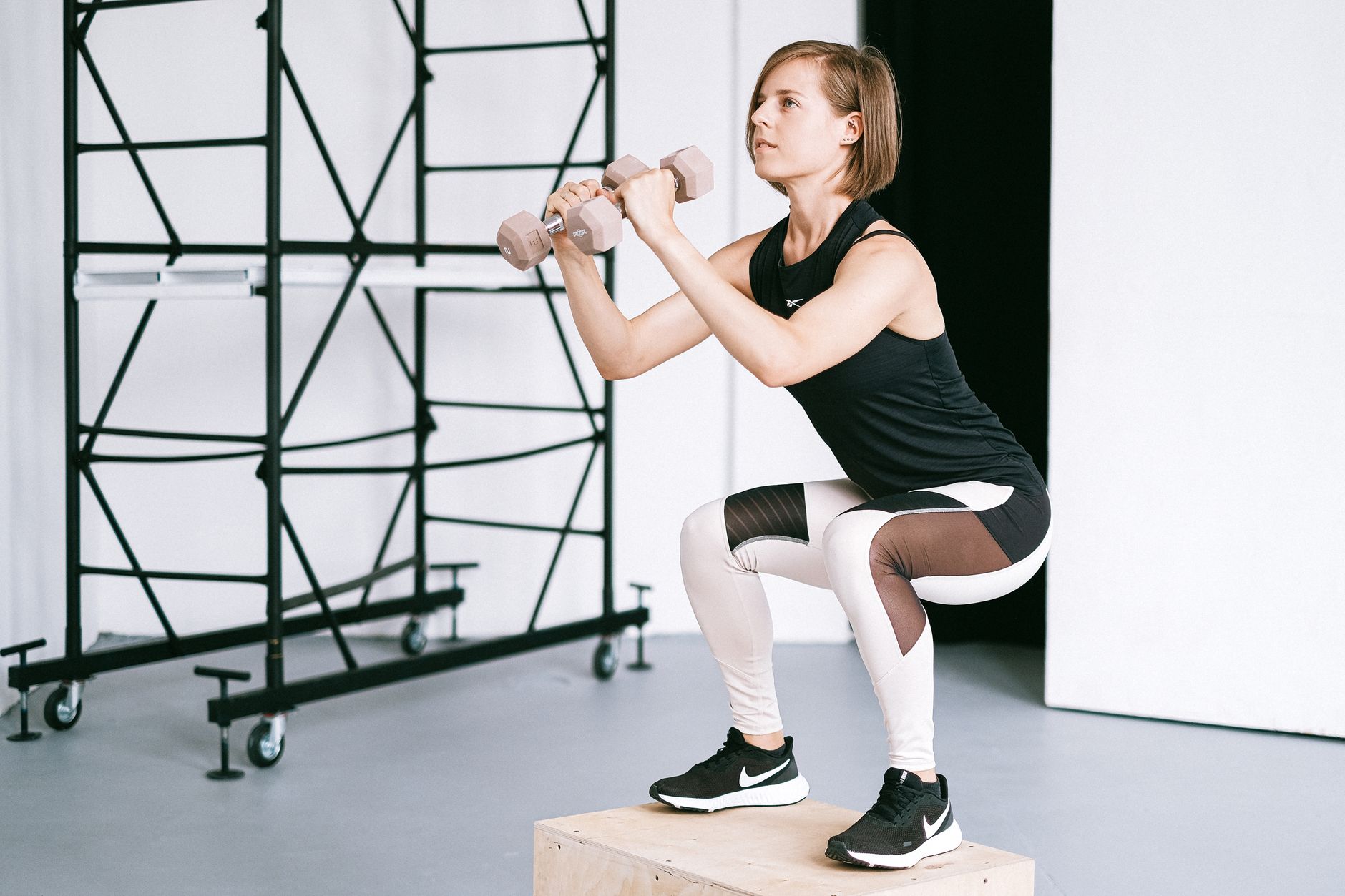
Goblet squat
Hold one dumbbell vertically against your chest and squat to depth while keeping your torso upright. This is the most beginner-friendly loaded squat pattern there is — holding the weight in front naturally counterbalances the movement and makes it easier to keep good form than a back squat.
Dumbbell Romanian deadlift
Hinge at the hips with a slight knee bend, keeping the dumbbells close to your legs as you lower them toward your shins, then drive your hips forward to stand. This targets the hamstrings and glutes specifically, and it is the exercise most full-body dumbbell routines skip in favour of squats alone.
Walking lunge
Holding a dumbbell in each hand, step forward into a lunge and alternate legs as you move across the room. Working one leg at a time exposes strength imbalances between sides and adds a balance component that a squat does not.
Bulgarian split squat
With one foot elevated behind you on a bench or step, lower into a lunge on the front leg until your back knee nearly touches the floor. This is the single most demanding leg exercise on this list — most people need noticeably lighter dumbbells here than on a goblet squat, and that is expected given how much stabilising work the front leg is doing on its own.
Core Exercises
Russian twist
Seated with your torso leaned back slightly, rotate a single dumbbell from side to side while keeping your core engaged. Lifting your feet off the floor increases the difficulty considerably, so start with feet planted if you are new to the movement.
Dumbbell woodchopper
Holding one dumbbell with both hands, rotate diagonally from high on one side to low on the other, driving the movement from your hips and core rather than your arms. This trains rotational strength, which the other exercises in this guide largely miss.
Weighted sit-up
Hold a dumbbell against your chest during a standard sit-up to add resistance once bodyweight sit-ups stop being challenging. Keep the weight light at first — 2 to 4 kg is plenty of added load for most people starting out.
Full-Body Circuits
When time is tight, combining several of the exercises above into a circuit gets a full-body stimulus into a short session without cutting corners on any single muscle group.
Man-makers
From a plank position with hands on the dumbbells, do a renegade row on each side, a push-up, then jump or step your feet forward, stand up, and finish with a squat into an overhead press. One repetition covers back, chest, legs and shoulders in a single continuous movement.
Thrusters
Hold the dumbbells at shoulder height, squat down, then drive up out of the squat and press the dumbbells overhead in one motion. This is one of the best full body exercises with dumbbells for conditioning specifically — it raises your heart rate fast because it recruits the legs and shoulders together.
A Weekly Dumbbell Workout Plan
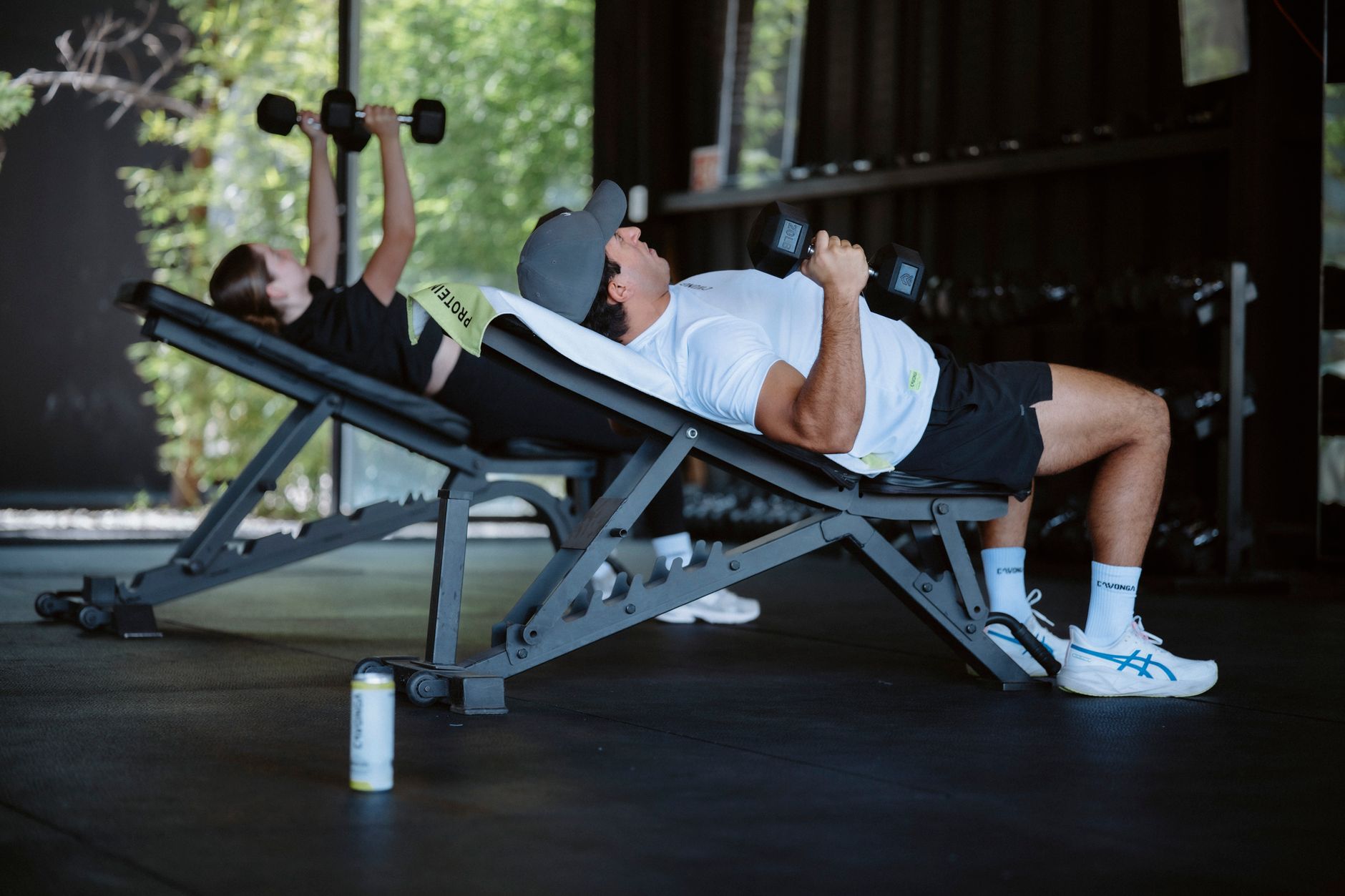
Three full-body sessions a week, spaced with at least one rest day between them, is the most reliable structure for anyone training with dumbbells at home. Each session hits every major muscle group, and the rest days between sessions give you roughly 48 hours of recovery before a muscle group is loaded again.
| Day | Focus | Exercises |
|---|---|---|
| Monday | Full body A | Goblet squat, bench press, bent-over row, shoulder press, plank |
| Wednesday | Full body B | Romanian deadlift, incline press, single-arm row, lateral raise, Russian twist |
| Friday | Full body C | Walking lunge, Arnold press, renegade row, curl/extension superset, woodchopper |
Three sets of 8 to 12 reps on the compound lifts (squats, presses, rows) and 2 to 3 sets of 12 to 15 reps on isolation work (raises, curls, extensions) is a reliable rep scheme while you are building the habit. Rest 60 to 90 seconds between sets on most exercises, and closer to 2 minutes on your heaviest compound lifts.
Once three sessions a week feels manageable and recovery is not an issue, adding a fourth session with an upper/lower split lets you train each muscle group with slightly more total volume per week.
How to Progress These Workouts Over Time
A workout plan only works for as long as it keeps demanding more from you than the last session. Progressive overload is the mechanism behind every result in this guide, and it is simpler than most people make it.
Add reps before you add weight
If your target is 3 sets of 10 on the goblet squat, start adding reps once you can complete all three sets cleanly: 3 sets of 11, then 12, then 13. Once you reach 3 sets of 15 with good form, increase the weight and drop back down to 3 sets of 10. This keeps every session slightly harder than the last without forcing a jump in load before your joints and connective tissue are ready for it.
Track your numbers
Write down the weight and reps for each exercise, even if it is just a note on your phone. Without a record, it is easy to repeat the same session for months without realising you have stopped progressing. A simple log also tells you exactly when a dumbbell has become too light for a given exercise — once you can do more than 15 reps on a compound lift with your heaviest pair, that pair is holding you back.
Expect different rates of progress by exercise
Compound lower-body movements like the goblet squat and Romanian deadlift tend to outgrow a dumbbell's weight range faster than upper-body pressing work, because the legs are simply stronger than the arms and shoulders. Do not be surprised if you are still adding weight to your shoulder press months after your squat has hit the top of your dumbbell set — that is normal, not a sign you are doing something wrong.
Deload every six to eight weeks
After six to eight weeks of consistent progression, take one week at roughly 60% of your usual weight and reps. This is not a rest week — you are still training — but the reduced load lets your joints and connective tissue catch up to the strength you have built, which keeps nagging aches from turning into actual injuries.
What Dumbbells You Actually Need
For everything in this guide, a single adjustable pair covering 2.5 kg to 24 kg per hand handles a beginner's full range of exercises without needing a second set. Compound lifts like squats and rows use the top end of that range first; isolation work like curls and raises stays lighter for longer.
Intermediate lifters typically need up to 32 to 40 kg per hand on presses and rows before a barbell becomes the more efficient tool for continued progress. If you are already pressing near 40 kg per hand on a flat bench, you are close to the point where dumbbells stop being the limiting factor and floor space or budget becomes the real constraint.
A flat-to-incline adjustable bench opens up the bench press, incline press and single-arm row variations above — browse strength training equipment at Flexi Muscles for benches and racks that suit a home setup. For pressing and pulling work specifically, wrist wraps and lifting straps help maintain grip and wrist position once the loads on rows and overhead presses start to add up.
See the full dumbbell range at Flexi Muscles to find a set that covers the weight range this guide recommends.
When a Dumbbell-Only Routine Isn't Enough
Straight up: dumbbells are not the right tool for everyone, and it is worth knowing when to look elsewhere before you spend money on a set.
- You are chasing a specific one-rep max on squat or deadlift. Most home dumbbell sets top out between 24 kg and 40 kg per hand. A trained lifter working toward a serious squat or deadlift number outgrows that range within a year or two and needs a barbell and rack instead.
- You are training in a fast circuit or HIIT format with constant weight changes. Switching dumbbells between exercises takes longer than switching a resistance band or moving along a cable stack, which slows down a format built around minimal rest.
- You are rehabbing an injury under guidance. Fixed-path machines control the range of motion in a way free weights cannot, which is often exactly what a rehab programme needs in its early stages. Follow what a physiotherapist recommends over a general workout guide in that situation.
For general strength, muscle building and a home routine that covers every major muscle group, dumbbells do the job as well as any equipment on the market. The three situations above are the exceptions, not the rule.
Frequently Asked Questions
How many days a week should you do dumbbell workouts?
Three full-body sessions a week, on non-consecutive days, works for most people training with dumbbells at home. That gives each muscle group roughly 48 hours to recover before it is loaded again, which is enough for a beginner or intermediate lifter to keep progressing. Four sessions a week starts to make sense once you move to an upper/lower split.
Can you build muscle with dumbbells alone?
Yes. Muscle growth responds to mechanical tension, not to the specific tool that creates it. A dumbbell row and a barbell row load the back muscles in a comparable way. The practical limit is how heavy your dumbbells go — once you can comfortably do 12 or more reps with your heaviest pair on a given exercise, you need either more weight or more reps and sets to keep progressing.
What is a good beginner dumbbell workout routine?
A full-body routine done three times a week: one squat pattern (goblet squat), one push (dumbbell bench or shoulder press), one pull (bent-over row), and two isolation moves for arms or shoulders. Three sets of 10 to 12 reps per exercise, resting 60 to 90 seconds between sets, is a reliable starting point for the first two to three months.
How heavy should my dumbbells be for these workouts?
Most beginners are comfortable with a range from 2.5 kg to 24 kg per hand, which covers compound lifts and isolation work. Intermediate lifters typically need up to 32 to 40 kg per hand on presses and rows before a barbell becomes the more efficient tool. Start lighter than you think you need — form breaks down fast on unfamiliar movements.
Is a full-body dumbbell workout as effective as split training?
For anyone training three times a week or less, full-body sessions are more effective because every muscle group gets trained often enough to drive progress. Split routines, where you dedicate a day to specific muscle groups, only pay off once you are training four to six days a week and can afford to hit each muscle group less frequently per session.
How long should a dumbbell workout take?
Between 35 and 50 minutes, including a short warm-up, for a full-body session of five to six exercises. Compound lifts first, isolation work second keeps the session efficient — you want to do your heaviest, most technical lifts while you are still fresh.
Do I need a bench for dumbbell workouts?
No, but it expands your options. A bench adds flat and incline pressing, single-arm rows, and step-ups to your routine. Almost every exercise has a standing or floor-based alternative — floor press instead of bench press, for example — so a bench is a useful addition rather than a requirement.