

Balance ball chair benefits: The settings where It actually earns its place
By Flexi Muscles — 23 September 2026 · 7 min read
Balance ball chair benefits depend far more on where you use one than most articles admit. The same chair that measurably improves in-seat behaviour in a classroom, or gives a physiotherapist a genuine training tool, does very little for someone bolted to a desk for eight hours or gaming for two. This guide goes setting by setting — home office, classroom, physical therapy, post-workout recovery, and gaming — so you know exactly where the benefit shows up and where it doesn't.
Shop Gym Equipment at Flexi Muscles
Why the setting decides the benefit, not the chair
Most articles on a chair with yoga ball construction list the same four benefits — core activation, posture awareness, more movement, a small calorie bump — as if they apply equally everywhere. They don't. Sitting unsupervised at a desk for a full workday is a completely different demand on your body than sitting on the same ball for 20 minutes in a classroom, or using one under a therapist's direction to rebuild core control after an injury.
The instability that makes the chair work is the same in every setting. What changes is the duration, the supervision, and what you're actually asking your body to do. That's the difference this guide tracks, setting by setting, instead of repeating a generic benefits list.
Home office and desk work

This is the setting most people picture first, and it's also the weakest one. A balance ball desk chair genuinely activates your core and discourages slouching — for roughly the first 20 minutes. After that, postural muscles fatigue and you end up compensating with worse posture than a normal chair would have allowed. It works best here as a rotation: 20 minutes on the ball, then back to a proper chair, repeated through the day rather than treated as your only seat.
If your home office setup means six or more unbroken hours at the same desk, a stability ball chair for office use is the wrong tool for that specific problem — the fix for constant static sitting is more frequent breaks or a sit-stand desk, not a different seat under the same unbroken sitting pattern.
Classroom and focus-support seating
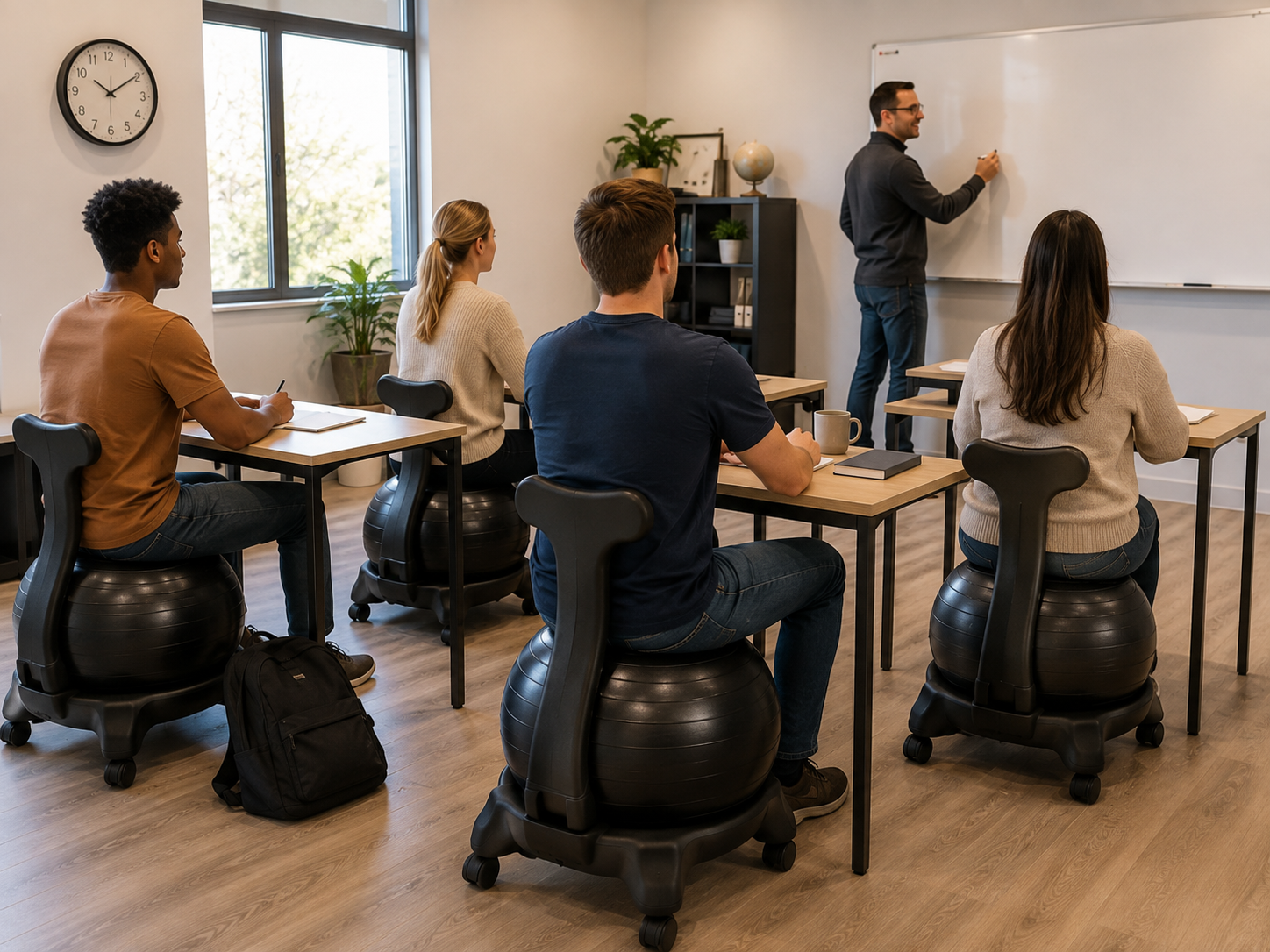
This is the setting with the strongest published evidence behind it. A study in the American Journal of Occupational Therapy found that students with ADHD showed improved in-seat behaviour and more legible handwriting when seated on therapy balls instead of standard chairs. A separate classroom study found the same attention and behaviour improvements specifically in students diagnosed with ADHD — students without ADHD showed no significant change.
That last detail matters: this isn't a blanket classroom upgrade, it's a targeted intervention for children who need to move to focus. The subtle bounce and shift the ball allows gives sensory-seeking or hyperactive students an outlet that a fixed chair doesn't, without them leaving their seat. Some later studies found smaller or no effect on grades and discipline referrals specifically, so treat it as a seating accommodation worth trying for a specific child, not a guaranteed fix for a whole class.
Physical therapy and rehab settings
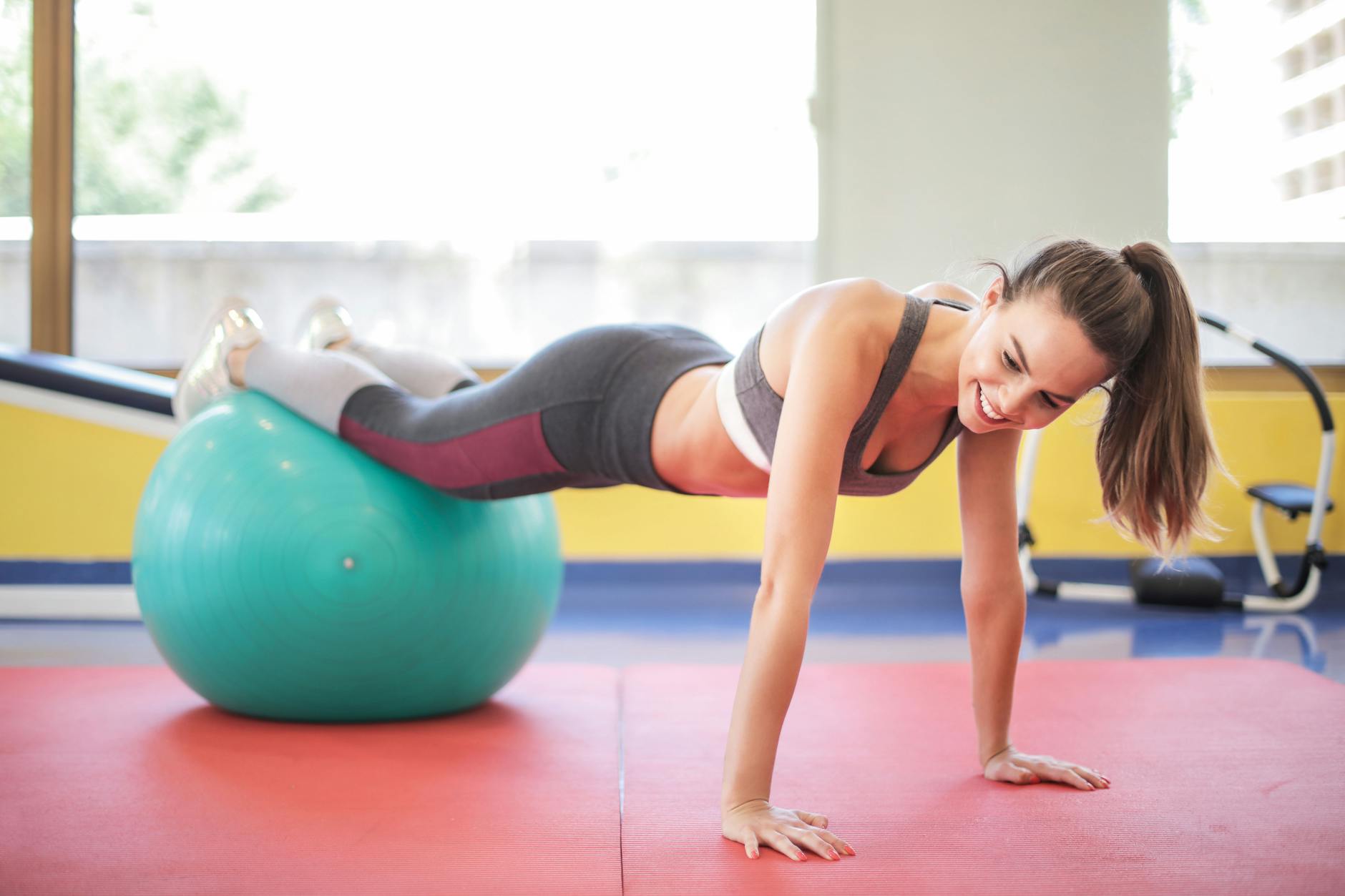
Occupational and physical therapists use stability balls deliberately, as a graded exercise tool for building core control, postural stability, and motor coordination — not as passive seating. A therapist sets the duration, the exercise, and the progression, which is the key difference between this setting and sitting on the same ball unsupervised at a desk.
If you're recovering from a back or core injury and considering a yoga ball chair benefits claim you've read online, the honest answer is: ask your physiotherapist first. The instability that helps in a controlled rehab exercise is the same instability that adds compressive spinal load if you sit on it, unsupervised, for hours with a compromised core.
Post-workout recovery (and why gaming is different)

A short, light stretch and movement routine after training reduces muscle stiffness and helps manage delayed onset muscle soreness, which typically peaks 24 to 48 hours after a hard session. Used as mobile, light seating between cool-down stretches — sit, stretch a muscle group, shift position, stretch the next — a balance ball chair fits that routine reasonably well because it keeps you moving instead of collapsing into a fixed seat.
Gaming is a different story, and it's worth being direct about it: a balance ball chair is the wrong seat for a long gaming session. Gaming sessions routinely run 90 minutes or longer without a break, while every occupational therapy and ergonomics source on this topic converges on roughly 20 minutes as the point where the benefit reverses. Sit on an unstable ball for four times that long and you've converted a mild core-activation tool into a fatigue and fall risk, with none of the supervised structure that makes it work in a classroom or a therapy session.
Where it doesn't belong
Skip a balance ball chair entirely if you have an existing disc injury, sciatica, or lumbar instability — get a physiotherapist's input before adding an unstable surface to a compromised back. The same goes for anyone whose day genuinely means six or more unbroken desk hours: buy a properly fitted ergonomic chair for that job, and keep the ball for shorter, supervised, or rotation-based use instead.
And if you've read this far hoping it would justify replacing your gaming chair, it won't — that's the one setting on this list where the chair works against you rather than for you.
Buying guide for your setting
Whichever setting you're buying for, a few things don't change:
- Correct diameter. Match the ball to height — 55cm under 5'3", 65cm for 5'3" to 5'10", 75cm above that — sizing up if the desk, table, or workstation sits higher than standard.
- Anti-burst rating. Look for a load rating comfortably above body weight, especially for classroom or shared-use settings where different people will sit on it.
- Textured, non-slip surface. Matters more on hard classroom or office flooring than on a gym mat.
- A stabilising base for desk or classroom use. A ring-style base with locking feet stops the ball rolling away — useful in a classroom, less necessary for a supervised therapy session where the ball itself is the working tool.
- Firmness you can adjust. An under-inflated ball changes hip angle and reduces the stability challenge that makes it useful in the first place — keep a hand or foot pump on hand.
Frequently Asked Questions
What is a balance ball chair actually used for?
Beyond the office, a balance ball chair is used in classrooms as alternative seating for children with attention or hyperactivity concerns, in physical therapy and occupational therapy for core and postural control work, and as active recovery seating after a workout. The setting changes which benefit actually shows up.
Are balance ball chairs good for classrooms and kids with ADHD?
Research published in the American Journal of Occupational Therapy found that students with ADHD showed improved in-seat behaviour and handwriting legibility when seated on therapy balls instead of chairs. A separate classroom study found the same benefit specifically in students diagnosed with ADHD, with no significant change for students without it — so it's a targeted intervention, not a blanket classroom upgrade.
Can a balance ball chair be used for physical therapy?
Yes — occupational and physical therapists use stability balls to build core control, postural stability, and motor coordination under direct supervision. That's a different use case to sitting on one unsupervised at a desk, because a therapist controls the exercise, the duration, and the progression.
Should you use a balance ball chair for gaming?
No. Gaming sessions often run 90 minutes or longer without a break, while every ergonomic and occupational therapy source recommends rotating off a balance ball roughly every 20 minutes. Long, static gaming sessions turn the chair's instability into a fall and fatigue risk with none of the movement benefit that makes it useful elsewhere.
Is a balance ball chair good for post-workout recovery?
It can work well as light, mobile seating between cool-down stretches, since gentle movement and light stretching after training reduces muscle stiffness and helps manage delayed onset muscle soreness. Use it for short seated stretch breaks, not as your main recovery-day seat.
What size balance ball chair should you buy?
Size to your height: 55cm if you're under 5'3", 65cm between 5'3" and 5'10", and 75cm if you're taller, sizing up one increment if your desk or table is above standard height. Whatever the setting, your hips should sit level with or slightly above your knees.
Related at Flexi Muscles
Sources
- PubMed — Classroom Seating for Children With Attention Deficit Hyperactivity Disorder: Therapy Balls Versus Chairs
- American Journal of Occupational Therapy — Stability Balls and Students With Attention and Hyperactivity Concerns
- ACE Fitness — Five Reasons You Shouldn't Skip Your Cool-Down After Exercise