

Ankle Resistance Bands with Cuffs: Exercises and How to Choose a Set

By Flexi Muscles — 30 August 2026 · 9 min read
Ankle resistance bands with cuffs clip a resistance tube or loop to a padded strap worn just above the ankle bone, anchored to the floor or the opposite leg. The setup lets you do kickbacks, hip abductions, and lateral raises against constant tension instead of just bodyweight, which a plain loop band around the ankle or a fixed ankle weight cannot replicate. They work the glutes, outer hips, and inner thighs, and a light set doubles as an ankle stability tool.
Shop Resistance Bands at Flexi Muscles
What are ankle resistance bands with cuffs

A padded cuff wraps around each ankle, just above the bone, and clips to a resistance tube or loop band by carabiner. One end anchors to the floor, a door, or the opposite ankle, depending on the exercise. A typical set includes two cuffs, a small carry bag, and two or three bands of increasing resistance, usually colour-coded by tension level.
The point of the cuff is not the padding — it is what the padding lets you do. Plain resistance loop bands worn directly around the ankle dig in and slip during standing exercises. A cuff spreads the load across a wider strap, stays in place through a full set, and gives the band a fixed clip point so tension stays consistent from the first rep to the last.
Ankle cuffs vs ankle weights vs loop bands
These three get confused for one another, but they train the leg differently. Here is how they compare:
| Ankle cuffs + band | Ankle weights | Loop band (no cuff) | |
|---|---|---|---|
| Resistance type | Increases through the movement | Fixed, constant mass | Increases through the movement |
| Best for | Kickbacks, hip abduction, lateral raises | Walking, marching, straight-leg raises | Light lateral work, quick sessions |
| Slips during sets | Rarely, padded strap holds position | Rarely, buckled snugly | Often, especially standing exercises |
| Needs an anchor point | Yes — floor, door, or other ankle | No | Sometimes |
Ankle weights suit exercises where you simply want the leg itself to be heavier — walking, marching, straight-leg raises. Ankle cuffs suit exercises where the direction of resistance matters — kickbacks, abductions, and lateral raises all rely on the band pulling against the movement, not just added mass. If your training is mostly hip and glute isolation work, cuffs are the more useful buy of the two.
Best ankle resistance band exercises

Ten exercises with resistance bands, legs included from hip to calf, cover glutes, hips, calves, and ankle stability with nothing but a set of cuffs.
Glutes and hips
- Standing hip abduction — anchor the band to the opposite ankle or a low anchor point, stand tall, and lift one leg out to the side.
- Glute kickback — anchor at floor level, hinge forward slightly, and kick one leg straight back.
- Fire hydrant — on all fours, lift one knee out to the side while keeping it bent at 90 degrees.
- Donkey kick — on all fours, drive one heel up and back with the knee bent, squeezing the glute at the top.
- Clamshell — lying on your side, knees bent, lift the top knee while keeping your feet together.
Outer thigh and lateral stability
- Lateral leg raise — standing, lift one leg straight out to the side and lower with control.
- Monster walk — band around both ankles, take small sideways steps while staying in a partial squat.
Ankle mobility and stability
- Ankle dorsiflexion and plantarflexion — seated, band anchored to a fixed point, flex the foot up and then point it down against resistance.
- Single-leg stance hold — band around the standing ankle anchored to the side, hold balance on one leg for 20–30 seconds.
Calves
- Standing calf raise with band tension — band looped under one foot and held or anchored, rise onto the toes against the added resistance.
Rotate through two or three exercises from different categories each session rather than doing all ten every time. The glute and hip exercises above target the same muscles from slightly different angles, so three or four per session is enough training volume without unnecessary repetition.
Sample ankle band workout routine

A ten to fifteen minute session of leg training with resistance bands, done two to three times a week on non-consecutive days:
- Standing hip abduction — 2 sets of 15 reps per side
- Glute kickback — 2 sets of 15 reps per side
- Fire hydrant — 2 sets of 12 reps per side
- Clamshell — 2 sets of 15 reps per side
- Monster walk — 2 sets of 10 steps each direction
Rest 20 to 30 seconds between sets and roughly a minute between exercises. Once every set finishes feeling easy at the current resistance, move up to the next band in the set rather than adding more reps indefinitely.
One opinion worth stating: a set with three resistance levels is a better buy than a single fixed-resistance band. Of the ten exercises in this guide, at least six get noticeably easier within a few weeks on one resistance, and without a heavier band to progress to, most people plateau and the set ends up unused in a drawer within a month.
How to choose a set
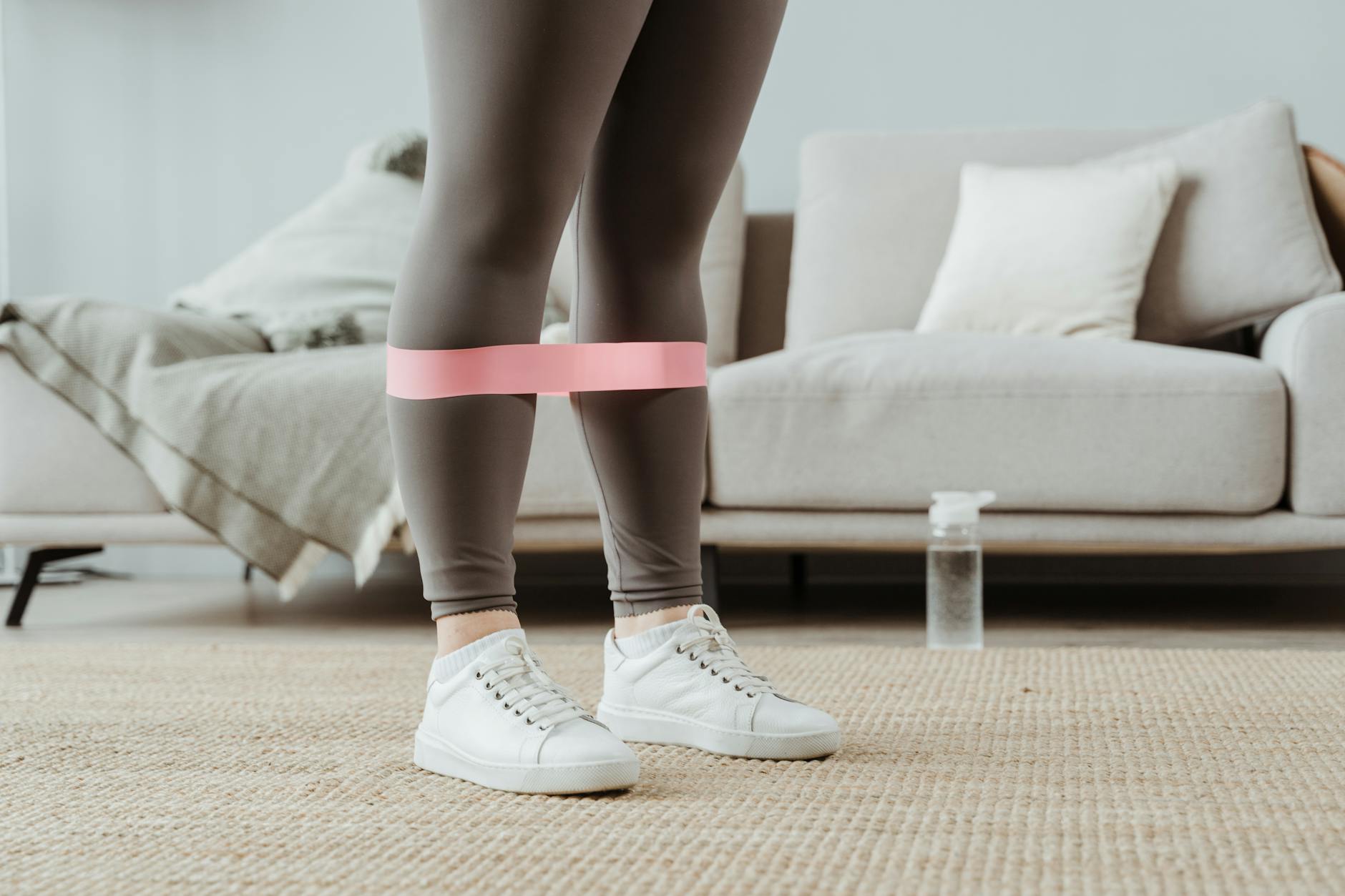
Cuff padding and width
A wider, padded cuff spreads pressure across more of the ankle and stays comfortable for longer sets. Thin, unpadded straps dig into the ankle bone within a few reps, particularly during kickbacks where the strap pulls against the same spot repeatedly.
Number of resistance levels
Look for a set with at least two, ideally three, bands of increasing tension rather than a single fixed-resistance band. Progression is what keeps the equipment useful past the first few weeks.
Carabiner and clip quality
Check that the clip connecting the band to the cuff is metal, not moulded plastic. Plastic clips are the most common failure point on cheap sets, and a clip failing mid-kickback is both startling and occasionally painful.
Strap sizing
Confirm the adjustable range fits your ankle circumference comfortably at both ends of the strap — too short and it will not close properly, too long and the excess strap flaps during movement.
Beyond the cuffs themselves, plain exercise bands for legs — loops without any attachment — are worth keeping in the same bag for stretching and warm-up work before a session of workout resistance bands for legs.
Common mistakes and safety tips
Straight up: most of the problems people run into with ankle bands come down to a handful of avoidable habits.
- Using momentum instead of control — swinging the leg through the kickback or abduction reduces muscle engagement and puts more strain on the lower back.
- Skipping the anchor check — a door anchor or floor clip that is not secure will release under tension, and the band snaps back toward you.
- Leaning on furniture for balance — if you need something to hold onto for every rep, the resistance is too high or your core is not engaged enough to stabilise the movement.
- Ignoring cuff wear — check the strap stitching and carabiner periodically, particularly on a set used several times a week.
When NOT to buy ankle resistance bands
You already have a cable machine or functional trainer
A cable stack with an ankle attachment does the same exercises with smoother, more consistent resistance and a wider load range. Ankle bands exist to fill the gap when that equipment is not available at home.
You want to build serious lower-body strength
The resistance range of a band and cuff set tops out well below a barbell or loaded machine. Ankle bands are an accessory for isolation and activation work, not a replacement for squats, lunges, and hip thrusts if strength is the main goal.
You have an untreated ankle or knee injury
Get clearance from a physiotherapist or doctor before adding resistance around an injured joint. Light band work is often part of rehabilitation, but the exercise selection and resistance level need to be appropriate for the specific injury, not guessed from a blog post.
Frequently Asked Questions
What muscles do ankle resistance bands with cuffs work?
Ankle resistance bands with cuffs primarily target the glutes, outer hips, and inner thighs through kickbacks, hip abductions, and lateral leg raises. Adding calf raises and ankle flexion movements brings the lower leg into the same session. Because the resistance stays constant through the full range of motion, these muscles get more time under tension than they do with a bodyweight version of the same exercise.
How tight should the ankle cuff be?
The cuff should sit snugly just above the ankle bone, tight enough that it does not slide down mid-set but loose enough to fit a finger underneath comfortably. A cuff that is too tight restricts circulation during longer sets. One that is too loose rides down and interrupts the exercise.
What is the difference between ankle cuffs and ankle weights?
Ankle weights add fixed extra mass to your leg, which increases the effort of moving the limb itself. Ankle cuffs paired with a resistance band add tension that increases through the range of motion, targeting the muscle differently and allowing exercises like kickbacks and hip abductions that a plain weight cannot replicate. The two are not interchangeable — cuffs suit hip and glute isolation, weights suit general leg conditioning.
How many sets and reps should beginners do?
Beginners get a solid result from two sets of twelve to fifteen reps per exercise, per side, with the lightest resistance band in the set. Add the next band up once fifteen controlled reps stop feeling challenging, rather than jumping straight to the heaviest band in the box.
Can ankle resistance bands help with ankle stability or rehab?
Yes, within limits. Light-resistance ankle band work is commonly used to rebuild strength and control around the ankle and hip after injury, but it is not a substitute for a rehabilitation programme prescribed by a physiotherapist. Anyone recovering from a recent ankle or knee injury should get clearance before starting.
When should I not use ankle resistance bands with cuffs?
Skip them if you already train on a cable machine or functional trainer with a proper ankle attachment, since that setup handles the same exercises with more consistent load. They are also the wrong tool for building serious lower-body strength on their own, since the resistance range tops out well below a barbell or loaded machine. Treat them as an accessory to squats, lunges, and hip thrusts, not a replacement for them.
Related at Flexi Muscles
- Resistance Bands — loop bands, tube bands, and full sets for home training
- Lifting Accessories — straps, belts, and support gear for your training
- Strength Training Equipment — barbells, dumbbells, and benches to pair with band work
- All Products — the full Flexi Muscles range