

Abs Wheel Guide: Muscles, Form, Mistakes & Exercises

By Flexi Muscles — 29 June 2026 · 7 min read
An abs wheel is a rubber wheel with handles on either side that you roll forward from a kneeling or standing position. When the American Council on Exercise measured muscle activation across common abdominal exercises, rollouts outperformed crunches, planks, and standing cable rotations for rectus abdominis and oblique engagement. The movement demands full-body tension on every rep — that is why it outperforms the crunch. The trade-off is form: a collapsed lower back under load will tell you about it the next morning in exactly the wrong place.
Shop Core & Strength Equipment at Flexi Muscles
What Muscles Does an Abs Wheel Work?
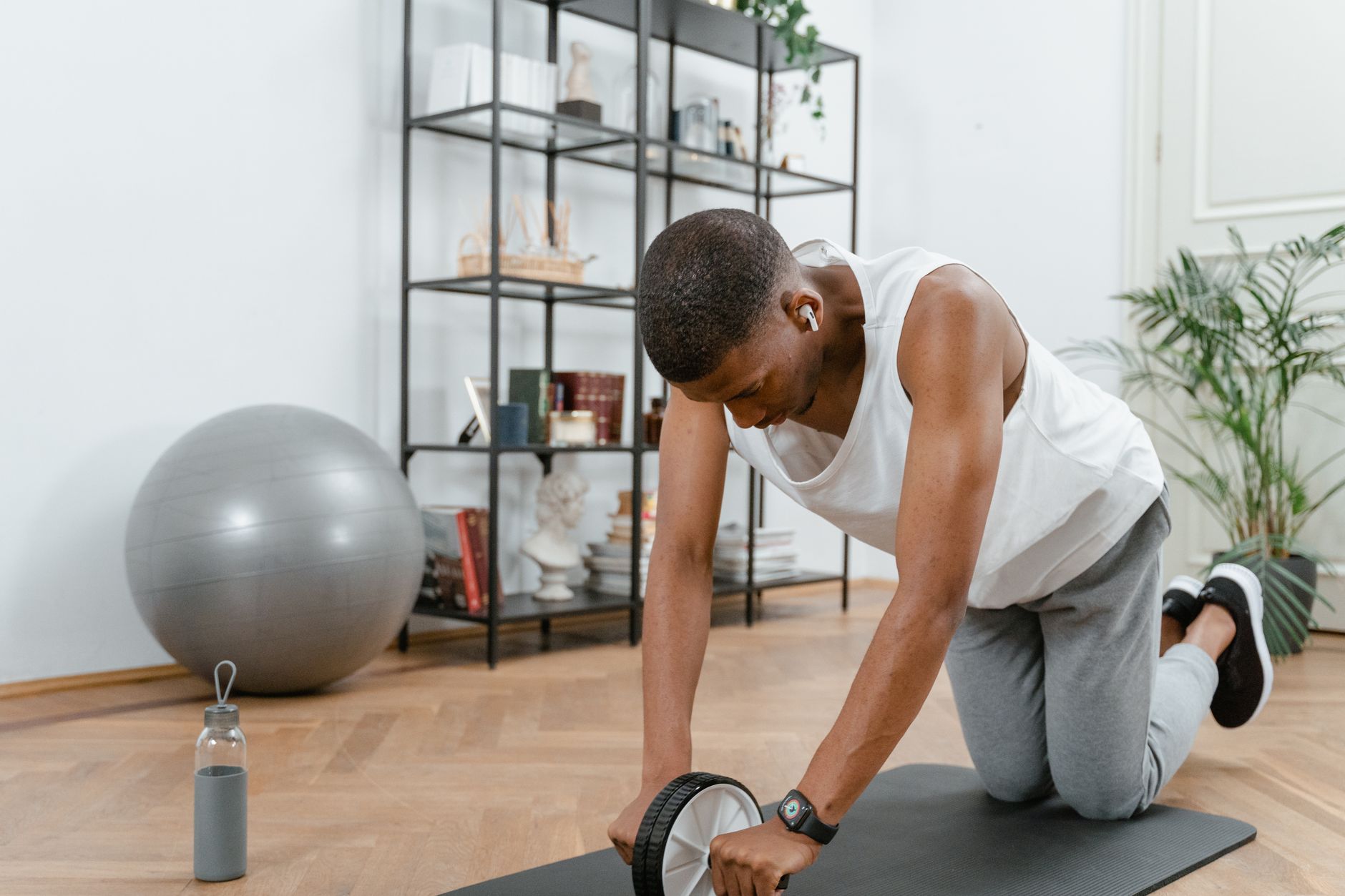
The abs wheel is one of the few core tools that works the entire anterior chain in a single movement. The primary target is the rectus abdominis — the muscle that runs vertically down the front of your abdomen. But the rollout also demands simultaneous engagement from the transverse abdominis (the deep stabilising layer beneath the rectus) and both the internal and external obliques.
Secondary muscles that work on every rep:
- Spinal erectors — work isometrically to prevent the lower back from collapsing during the roll-out
- Latissimus dorsi — initiate the return phase, pulling the wheel back toward your knees
- Serratus anterior — stabilises the scapula throughout the movement
- Deltoids and triceps — hold the body in position at full extension
- Hip flexors — assist with pelvic position during the roll
This co-contraction across the full chain is what separates rollouts from crunches. A standard crunch produces high rectus abdominis activation in isolation. A rollout produces similar activation while the lats, shoulders, and spinal erectors work simultaneously to hold the load. Training those muscles together, rather than in sequence, is more relevant to real movement than isolating each one.
One caveat: the abs wheel does not train the hip flexors the way a hanging leg raise does, and it does not isolate the obliques the way a cable woodchop does. It is an efficient multi-muscle core tool — not a complete core programme on its own.
How to Use an Abs Wheel Correctly
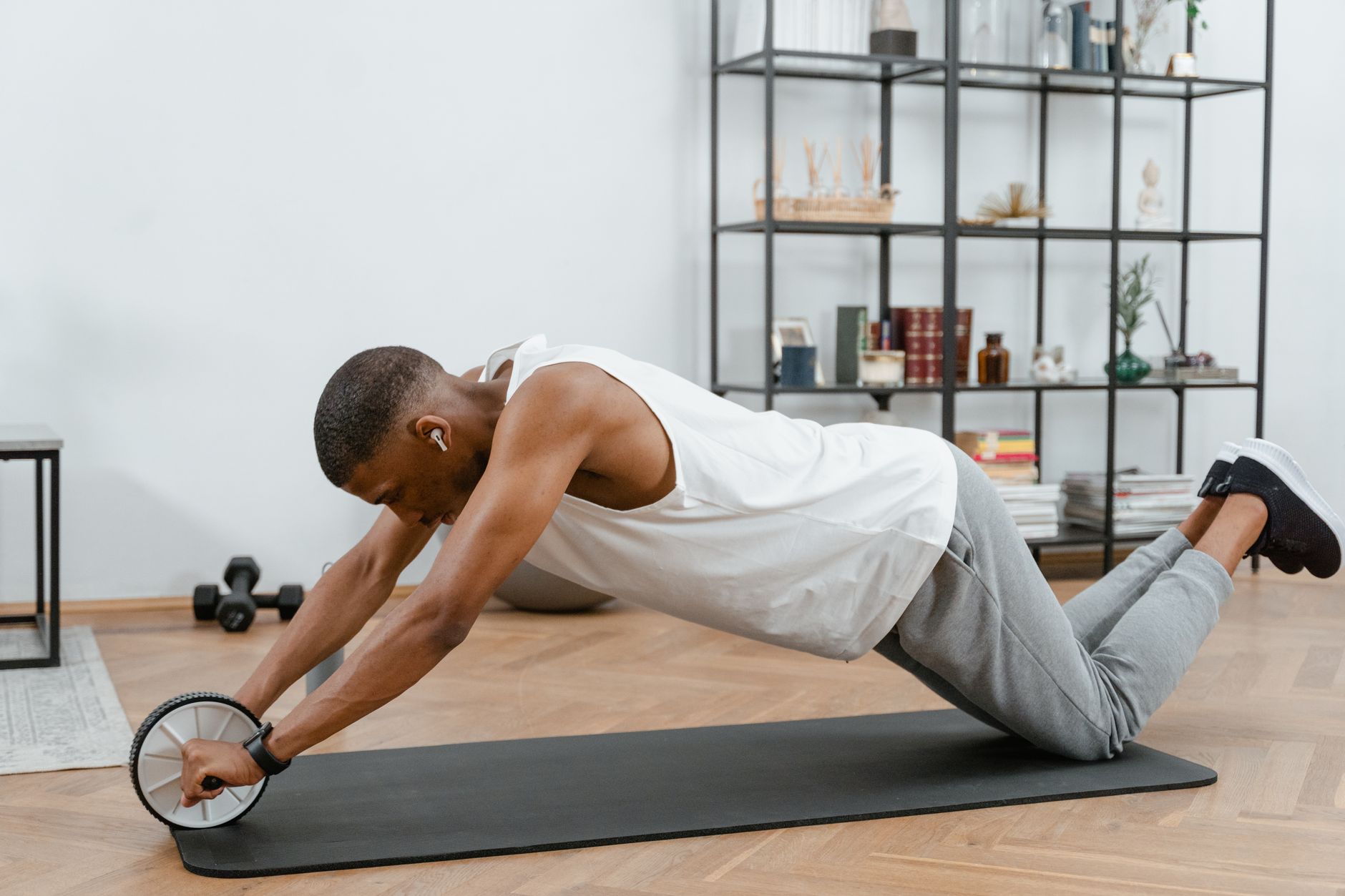
Starting position matters more than rolling distance. Most lower back pain from abs wheel exercise comes from starting in the wrong pelvic position — not from rolling too far.
Set-up
- Kneel on a mat with the wheel directly below your shoulders
- Grip both handles firmly — hands shoulder-width, wrists neutral
- Tuck your pelvis slightly so your lower back is flat, not arched
- Brace your core as though you are about to take a punch to the stomach
The roll-out
- Breathe out as you roll forward
- Keep hips, spine, and head in a straight line — do not let your hips drop
- Roll to the furthest point you can hold that alignment
- Pause for one second at the end range
The return
- Drive your elbows toward your knees — think lats and abs, not biceps
- Breathe in as you come back
- Return to the start position under control, without using momentum
A useful cue: imagine a glass of water balanced on your lower back. If it would spill as you roll out, your spine is losing position. A shorter roll with a flat back is worth more than a long roll with a dipping lumbar. Distance is not the goal — controlled tension is.
Five Mistakes That Cause Lower Back Pain

Most people who hurt themselves on an abs wheel do not have weak abs. They have a form breakdown that shifts load to the lumbar spine. These are the five that come up most.
1. Starting with an anterior pelvic tilt
If your pelvis tips forward before you begin rolling — lower back arched, tailbone pointing back — you have already pre-loaded your lumbar extensors. Rolling from that position compresses the structures the exercise should be training, not loading. Tuck your pelvis to neutral before your hands reach the wheel. Every rep.
2. Rolling further than your core strength allows
The moment your hips start to drop or your lower back dips, you have hit your current limit. Stop there. Rolling further does not add core work — it adds lumbar compression. Distance is not a measure of how good your form is.
3. Pulling back with the arms
The return phase is where the abs and lats do their heaviest work. If you pull with your biceps and shoulders, you skip the most valuable part of each rep. The lats are the prime mover on the way back — spread your shoulder blades and drive your elbows toward your knees.
4. Going straight to the standing rollout
The kneeling version is not a beginner modification. It is the correct starting point for most people, including those who are otherwise fit. The standing rollout dramatically increases lumbar load. Moving to it before your core can handle kneeling rollouts at full extension is the most reliable way to injure yourself on this piece of equipment.
5. Holding your breath
Breath drives intra-abdominal pressure, which stabilises the spine during loaded movement. Exhaling on the roll-out and inhaling on the return is not optional advice — it is the mechanism that protects your lower back. If you hold your breath to muscle through a rep, your form has already broken down.
Abs Wheel Exercises: Beginner to Advanced

Work through these stages in order. Each stage should feel controlled and pain-free across two or three sessions before moving on.
| Stage | Exercise | Sets & Reps | Key focus |
|---|---|---|---|
| Beginner | Kneeling rollout (short) | 2 × 8 | Roll 30–40cm; focus entirely on pelvic position |
| Beginner–Intermediate | Kneeling rollout (full extension) | 3 × 10 | Arms fully extended; lower back stays flat |
| Intermediate | Kneeling rollout with pause | 3 × 8 | 2-second hold at end range; noticeably harder |
| Intermediate–Advanced | Oblique rollout | 3 × 6 per side | Roll at 45° angle; targets lateral core heavily |
| Advanced | Standing rollout (pike return) | 3 × 5 | From standing; roll to near-parallel, pike back up |
The kneeling rollout with a two-second pause is harder than most people expect. Done with a flat lower back and genuine lat engagement on the return, there is real training value left in it before anyone needs to progress to standing. Progress through these stages over weeks, not days.
My honest take: the abs wheel is one of the most dismissed pieces of core equipment, usually by people who tried it once with poor form, felt it in their back rather than their abs, and decided it was not worth the trouble. A controlled kneeling rollout done correctly is more demanding than a plank, a crunch, or a cable pull-down — most people have simply never done it correctly long enough to find out.
Looking for equipment to pair with abs wheel training? Resistance bands work well for warm-up activation before core sessions. For a complete home set-up, browse lifting accessories at Flexi Muscles.
Who Should Not Use an Abs Wheel
The abs wheel is not the right tool for everyone. Skip it, or get medical clearance first, if any of these apply:
- Active lower back injury or diagnosis — disc issues, facet joint problems, and lumbar strains are all conditions where the rollout’s demands on the lumbar extensors can cause real harm. A physiotherapist can advise whether and when it is appropriate.
- No prior core training foundation — if you cannot hold a plank for 30 seconds with a flat lower back, build that baseline first. The rollout assumes core stability is already present. Without it, the load shifts to the lumbar spine on most reps.
- Shoulder or wrist injuries — full shoulder flexion under load throughout the rollout stresses the rotator cuff and wrist extensors. Existing injuries in either area are likely to be aggravated by the movement.
- Pregnancy — any exercise that increases intra-abdominal pressure or strains the linea alba is not appropriate during pregnancy. An obstetric physiotherapist can advise on core training throughout and after pregnancy.
- You are looking for a calorie-burning tool — the abs wheel builds core strength and stability. It is not a cardio machine. If fat loss is the primary goal, pair it with cardio equipment rather than using it as your main exercise.
If none of those apply, an abs wheel is one of the more cost-effective additions to a home gym. A decent single model costs well under R400, takes up roughly the space of a water bottle when stored, and will outlast most of the other equipment around it.
Frequently Asked Questions
What is an abs wheel good for?
An abs wheel builds core strength and stability by forcing the rectus abdominis, obliques, transverse abdominis, and lower back to work simultaneously under load. The American Council on Exercise found rollouts generate higher muscle activation than crunches, planks, and cable rotations. It is not a cardio tool and will not burn significant calories on its own.
How many reps should you do with an abs wheel?
Start with 2–3 sets of 8 reps on the knees, focusing on form rather than distance. Once form is consistent, work up to 3 sets of 10–12 reps at full kneeling extension. Advanced users performing standing rollouts typically work in the 3–5 rep range per set due to the significantly higher load on the core and lumbar spine.
Is an abs wheel better than crunches?
For total core muscle engagement, yes. The American Council on Exercise found rollouts produce higher rectus abdominis and oblique activation than crunches, planks, and standing cable rotations. They also recruit the lats, serratus anterior, and shoulder stabilisers on every rep, making each repetition more efficient than an isolated crunch.
Can you get a six-pack from using an abs wheel?
The abs wheel builds the rectus abdominis effectively. Visible definition is a function of body fat percentage — a diet and cardio question, not a training question. Rollouts will develop and thicken the muscle, but will not reveal it if body fat is above the point where abdominal definition becomes visible.
How do you know if your abs wheel form is correct?
Correct form feels like effort in your abs and lats, not your lower back. If the lower back is the first thing that fatigues or hurts during or after rollouts, you are rolling with an anterior pelvic tilt. Tuck the pelvis to neutral before each rep and reduce the rolling distance until the core holds that position throughout.
What is the difference between a single-wheel and a dual-wheel abs roller?
A single-wheel roller requires more balance and lateral core engagement because it can tip side to side. A dual-wheel model is more stable and better suited to beginners. If you are new to rollouts, a dual-wheel design lets you focus on the core movement rather than stabilising the device — and most people train more productively that way when starting out.