

Abs Training With Weights: Equipment, Exercises and When to Skip the Load

By Flexi Muscles — 20 July 2026 · 10 min read
Abs training with weights works when you add load to a small set of well-chosen exercises — not when you strap a plate to every crunch variation you know. A pair of dumbbells, a kettlebell, or a couple of weight plates is enough equipment. Weight makes the core resist rotation, extension, and lateral flexion under real tension, which builds strength that bodyweight sit-ups stop providing after a few weeks. Get the movement pattern right first. Add weight second, not the other way round.
This guide covers the equipment worth owning, how to choose a starting weight per exercise, five movements that cover every pattern your core actually needs to handle, how weighted ab work fits into a normal training week, and the specific cases where adding weight does more harm than good.
Shop Dumbbells at Flexi Muscles
Why Add Weight to Ab Training

Bodyweight core work plateaus faster than most people expect. Once you can hold a plank for two minutes or do 30 controlled sit-ups, adding more reps stops producing meaningful strength gains — you are just building endurance in a pattern your body has already mastered. The core is a muscle group like any other. Without progressive overload, it stops adapting.
Weight also changes what the core is doing. A bodyweight crunch trains flexion in isolation. A loaded carry, a weighted twist, or a dead bug with a dumbbell reach trains the core to resist forces — rotation, extension, lateral bending — which is closer to what the trunk actually does under a heavy squat, a deadlift, or an awkward lift off the floor. Anti-rotation and anti-extension strength transfers directly to every other lift in your programme. Isolated crunching does not.
There is also a time argument. Five sets of weighted dead bugs done with control build more usable strength in eight minutes than 200 unweighted crunches done on autopilot. If your ab training has stalled — same reps, same exercises, same result for months — weight is usually the missing variable, not more volume.
Equipment You Actually Need
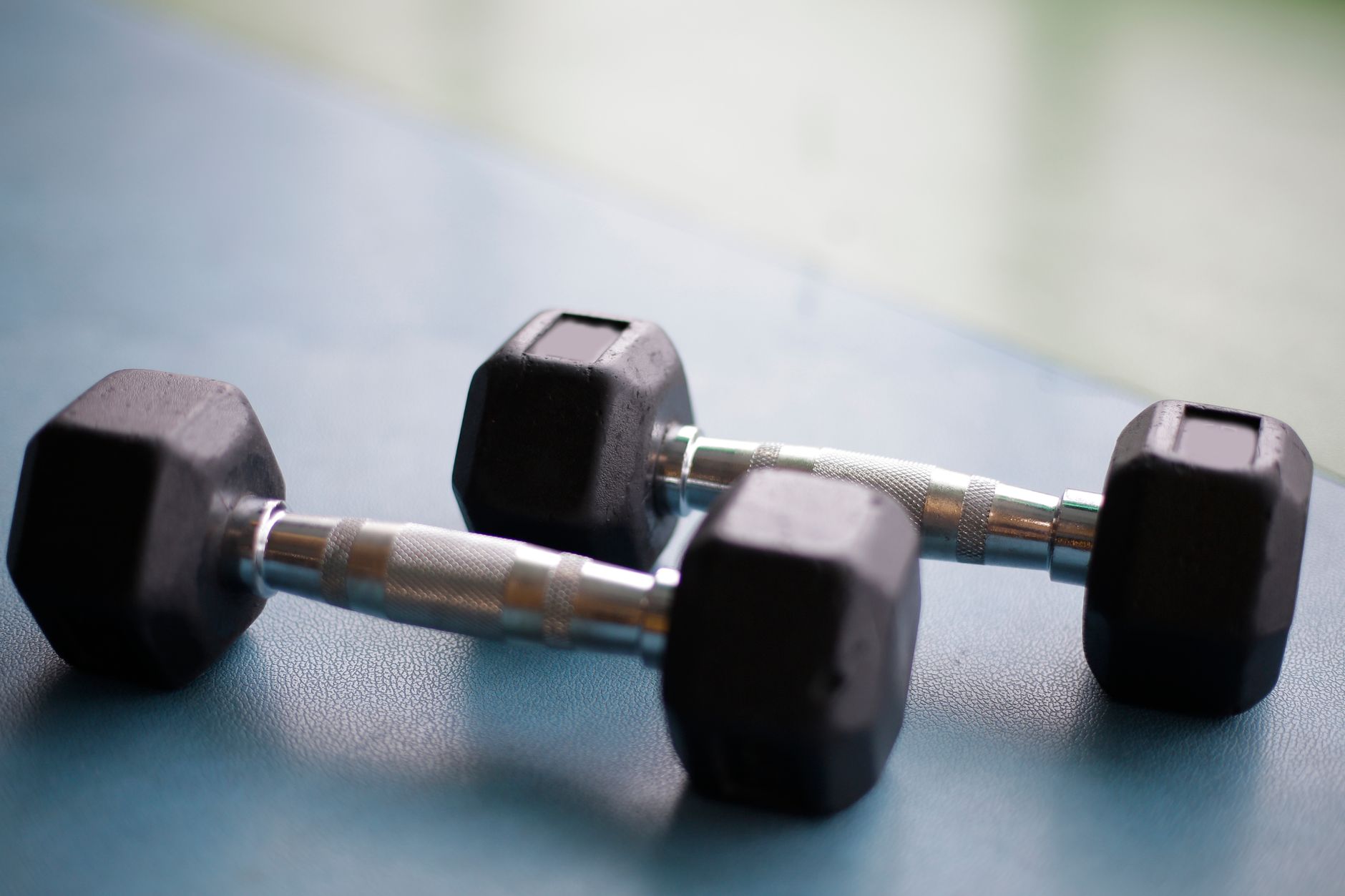
A pair of dumbbells covers most of what you need. They work for carries, rows, dead bug reaches, and loaded planks, and you can adjust the load in small increments as you get stronger — something a fixed medicine ball cannot do.
One weight plate is the second purchase worth making. A plate is the easiest object to hold at arm's length for twisting movements like the Russian twist, and it is easier to grip securely than a dumbbell for that specific motion.
A kettlebell is useful but not essential. It excels at carries and halos because the offset weight distribution challenges the core differently to a dumbbell, but everything in this guide can be done without one.
What you do not need: a cable crossover machine, a dedicated ab machine, or a full plate rack. None of that equipment does something a pair of dumbbells and one plate cannot. Spend the money on load you can actually progress with, not machines that lock you into one movement pattern.
How to Choose Your Starting Weight
The right starting weight depends entirely on the exercise — there is no single number that applies across the board.
Stability exercises (dead bug, weighted plank hold): start light. 2–4kg dumbbells are usually enough. The challenge in these movements is control, not resistance — if you cannot keep your lower back pressed into the floor during a dead bug, the weight is already too heavy, regardless of how light it feels to lift.
Rotation exercises (Russian twist, weighted chop): most beginners manage a 4–8kg plate or dumbbell held at the chest. Go heavier only once you can complete the full set without the torso losing its upright position.
Loaded carries (farmer's carry, suitcase carry): go heavier here — 12–20kg per hand for most beginners, working toward whatever you can hold for 30–40 metres with a firm grip and tall posture. Carries are one of the few core exercises where heavier genuinely means better, within the limits of your grip.
Across every category, the same test applies: if your lower back arches, your ribs flare, or your spine loses its neutral position before you finish the set, drop the weight. Progress by adding one rep before you add one kilogram.
Five Weighted Ab Exercises That Build Real Core Strength
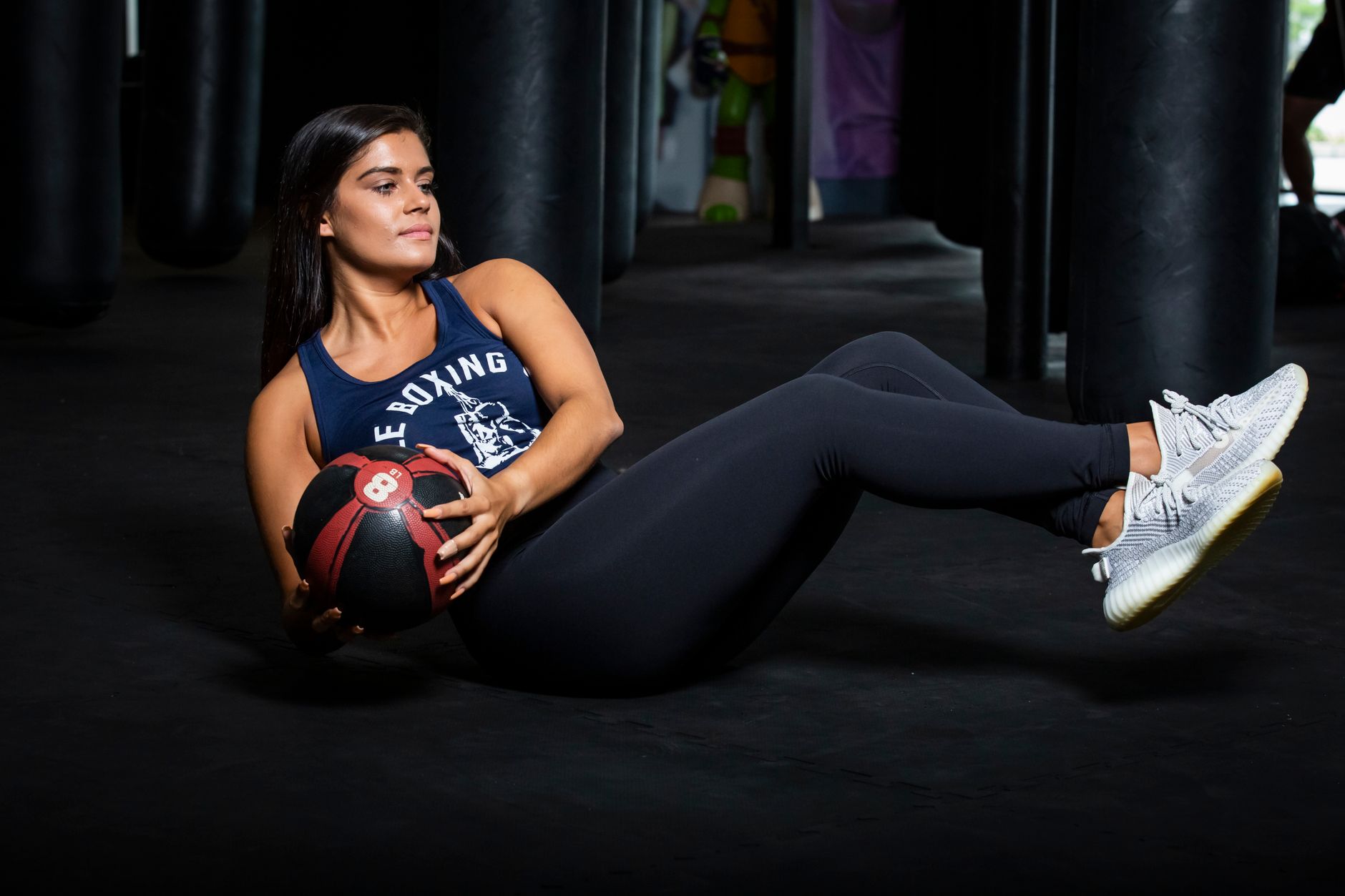
1. Weighted dead bug
Lie on your back, arms extended toward the ceiling holding a light dumbbell in each hand, knees bent at 90 degrees. Lower one arm behind your head and the opposite leg toward the floor at the same time, keeping your lower back pressed flat throughout. Return to the start and switch sides. This is the safest entry point into weighted core work because it teaches trunk bracing without any spinal flexion or rotation. Three sets of 8 reps per side is enough to start.
2. Weighted Russian twist
Sit with knees bent, heels on the floor, torso leaned back to roughly 45 degrees, holding a plate or dumbbell at your chest. Rotate the weight to touch the floor beside your hip, then rotate to the other side. Keep the movement in your torso, not your arms — the weight should travel because your ribcage is turning, not because your shoulders are swinging it. Three sets of 12–16 total reps.
3. Farmer's carry
Pick up a heavy dumbbell or kettlebell in each hand and walk for 30–40 metres, keeping your shoulders back, ribs down, and core braced as if you were about to be tapped in the stomach. Grip fatigue usually ends the set before your abs do — that is the exercise working. Two to three sets, resting fully between them.
4. Renegade row
Start in a plank position with one dumbbell under each hand. Row one dumbbell to your hip while keeping your hips square to the floor — the temptation is to let the hips rotate toward the rowing side, which turns the exercise into a twist instead of an anti-rotation hold. Alternate sides. Three sets of 6–8 rows per side, using a weight light enough that your hips stay still throughout.
5. Weighted sit-up
Lie flat, knees bent, holding a light plate or dumbbell against your chest. Curl up through the spine one vertebra at a time rather than snapping upright, then lower back down under control. This is a flexion exercise, so keep the weight modest — a 2–5kg plate is plenty for most people — and stop immediately if you feel any strain in your lower back rather than your abs.
How to Program Weighted Ab Training Into Your Week
Two to three sessions a week is enough, with at least one rest day between them. The core recovers faster than a large muscle group like the quads or back, but it still adapts through recovery, not through daily fatigue.
Train it after your main lifts, not before. A pre-fatigued core cannot brace properly under a heavy squat or deadlift, which increases injury risk in the exercises that matter most. Ten to fifteen minutes of weighted ab work at the end of a session is enough to make progress without compromising anything earlier in the workout.
Progress reps before you progress load. For most of the exercises above, work toward the top of the stated rep range with clean form before adding weight. Once you can complete every set with the spine staying neutral throughout, add the next increment — usually 1–2kg for stability and rotation work, 2–5kg for carries.
When Not to Train Abs With Weight

If you have unresolved lower back pain: hold off on loaded flexion and rotation work — weighted sit-ups and weighted Russian twists in particular. These movements put real compressive and rotational force through the spine, and adding load to a back that has not been assessed is the wrong place to experiment. See a physiotherapist first.
If you are pregnant or in the early postpartum period: loaded flexion and heavy anti-rotation work are not appropriate until you have been assessed for diastasis recti. Gentle bracing work is usually fine — get specific guidance rather than following a general guide like this one.
If your form breaks down before you hit your target reps: stop the set. Grinding out extra reps with a rounded spine to hit a number on paper trades short-term ego for long-term back trouble. Drop the weight and rebuild.
If visible abs are the entire goal: weighted training builds the muscle. It does not remove the layer of fat sitting on top of it. Your obliques do not care how hard you trained them if your plate says otherwise — visible definition comes from diet far more than from any exercise in this guide. If nutrition is not addressed, no amount of loaded twisting will get you there.
Frequently Asked Questions
Is it safe to train abs with weights?
Yes, for most people, provided the spine stays neutral and the weight is light enough to control through the full range of motion. The risk is not the weight itself — it is loading a rounded or twisted spine under fatigue. If you have unresolved lower back pain, get cleared by a physiotherapist before adding load to flexion or rotation exercises.
How much weight should you use for ab exercises?
It depends on the exercise, not a fixed number. For stability work like the dead bug, 2 to 4kg dumbbells are usually enough — the challenge is control, not load. For rotation work like the Russian twist, most beginners manage a 4 to 8kg plate. For loaded carries, use whatever you can hold with a firm grip and an upright posture for 30 to 40 metres, which is often 12 to 20kg per hand.
How often should you do weighted ab training?
Two to three sessions a week, with at least one rest day between them. The core recovers faster than large muscle groups, but it still needs recovery time to adapt to the added load. Training it every day tends to produce fatigue rather than extra progress.
Will weighted ab training make your waist bigger?
Not in any way that matters for most people. The obliques and rectus abdominis can add some size with heavy, high-volume training, but this takes years of dedicated loading, not a few sessions a week with moderate dumbbells. Visible ab definition is determined far more by body fat than by muscle size — training builds the muscle, diet reveals it.
Do you need special equipment, or will dumbbells work?
A pair of dumbbells covers almost everything. Add one weight plate for twisting and loaded sit-up variations, and you have every exercise in this guide covered. Cable machines and dedicated ab machines are not necessary — they add convenience, not results you cannot get from free weights.
Related at Flexi Muscles
- Dumbbells — the core piece of equipment for every exercise in this guide
- Strength Training Equipment — weight plates, kettlebells, and general home gym gear
- Lifting Accessories — grip aids and support gear for carries and rows
- All Products — browse the full Flexi Muscles range
Sources
- ACE Fitness Exercise Library — technique reference for core and functional movements
- NSCA — National Strength and Conditioning Association — evidence-based programming guidelines for resistance training
- British Journal of Sports Medicine — peer-reviewed research on spinal loading and injury prevention in resistance training